
- Translated with AI
From Cleanroom to Space
APO AMG
Cleanroom clothing

Starship Enterprise

Astronaut
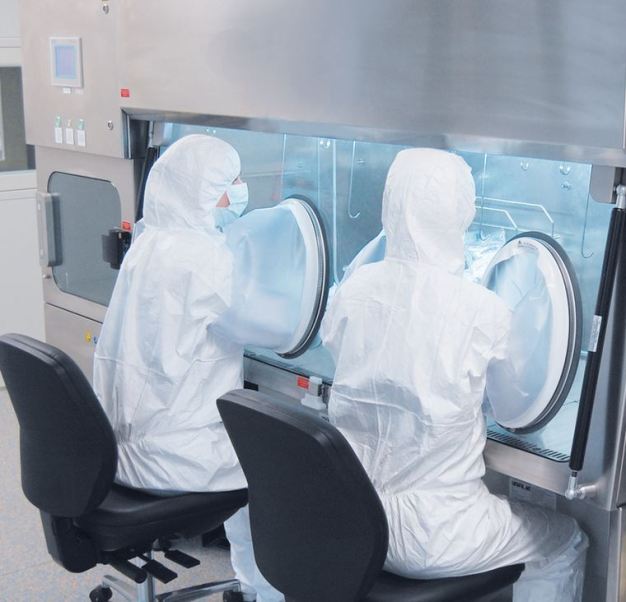
Isolator
These quantum leaps are only possible when protective clothing for the product is exchanged with clothing to protect the human being. If everything were that simple, we could fulfill our wish to become space travelers. Unfortunately, it's not that easy.
Cleanroom technology primarily aims to prevent particles; however, with increasing complexity of the products to be maintained, additional aspects such as contaminant removal, sterility, production technology, and numerous other disciplines have been added.
Relevant studies report that 80% of all particulate contamination encountered in cleanrooms is introduced by personnel. Contamination originating from staff is generally critical when emissions occur near the product or when particles are transported to the product through propulsion effects ("cross contamination").
Cleanroom: A technically or mechanically delineated area in which the particulate purity of the air corresponds to a specific cleanliness class. Furthermore, cleanrooms are characterized by maintaining a positive pressure relative to their surroundings. Exceptions are cleanrooms in biotech and genetic engineering processes.
To work in a cleanroom, cleanroom clothing is required.
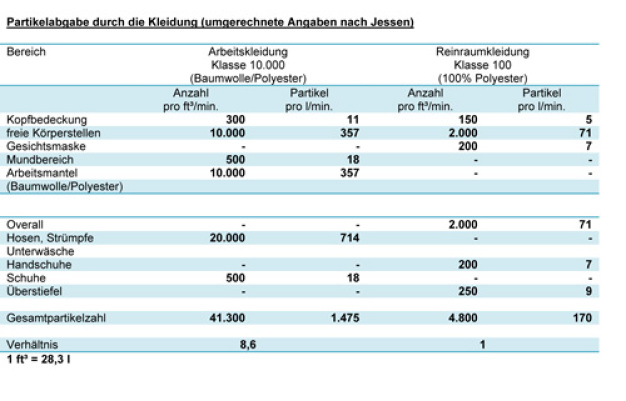
Cleanroom clothing: is protective clothing for the product. If it is necessary for personnel to work under sterile conditions, cleanroom clothing must be worn (shoes or boots, coats or coveralls, gloves, head coverings, masks, etc.). The selection of cleanroom clothing depends on the type of cleanroom and the manufacturing requirements, especially the cleanroom class and airflow method. The need for a barrier (protective clothing for the product) arises because there is an air space between the surface of the human body and the outer surface of the cleanroom garment, which originates from two sources:
1. From human skin, which releases millions of particles (including microorganisms) during wear: some of these particles fill the airspace between the cleanroom clothing and the body surface as airborne particles.
2. The under- or intermediate clothing re-releases some skin particles depending on time and movement; additionally, they emit fibers, fiber fragments, and particles originating from other contamination sources.
The cleanroom clothing worn by personnel should retain all such contaminants to ensure product protection.
Under Good Manufacturing Practice (English, abbreviated GMP, German "Gute Herstellungspraxis") are guidelines for quality assurance of production processes and environments in the manufacture of medicines and active substances, but also in cosmetics, food, and feedstuffs, as well as the protective function of work clothing. One of the main sources of contamination during microbial transfer is the personnel’s clothing. Naturally, it must be decided on a case-by-case basis which type of work clothing should be worn, whether it can replace or be worn over street clothing. However, contact between street clothing and work clothing inevitably leads to microbial transfer. The extent of protective clothing largely depends on the tasks to be performed, being most extensive in the aseptic area and leading to gradations in other less contamination-prone areas.
Aseptic areas are required for the production of sterile medicines as well as in hospitals, e.g., for operating rooms (OR), transplantation units (TU), and intensive care units (ICU). Although asepsis is clearly defined, there are inevitably differences in implementation possibilities. Undoubtedly, the most consistent shielding against possible microbial contamination occurs in the aseptic production of liquid, non-sterilizable medicines, because it involves not only eliminating infectious microbes but also saprophytes that would otherwise multiply in the product and spoil it. It is not always possible to prevent this risk by adding a suitable preservative.
The strictest requirements apply in aseptic areas, where only sterilized clothing is permitted. Suitable clothing for this purpose must therefore:
- be sterilizable (autoclave sterilization at 121°C or 134°C),
- be durable, showing good tear and abrasion resistance,
- emit few particles (lint) into the environment,
- have good skin compatibility and comfortable wearing properties.
The choice of textile fabric largely depends on the application area. In "clean rooms," it is crucial that particle emission from the textile is as low as possible. These particles act as "carriers" for microorganisms, increasing contamination risk. Textiles made from 100% synthetic fibers, such as Trevira textured (polyester), undoubtedly exhibit the best properties here and are recommended for sterile clothing in cleanrooms of class 5 according to DIN EN ISO 14644-1 or VDI guideline 2083 3.
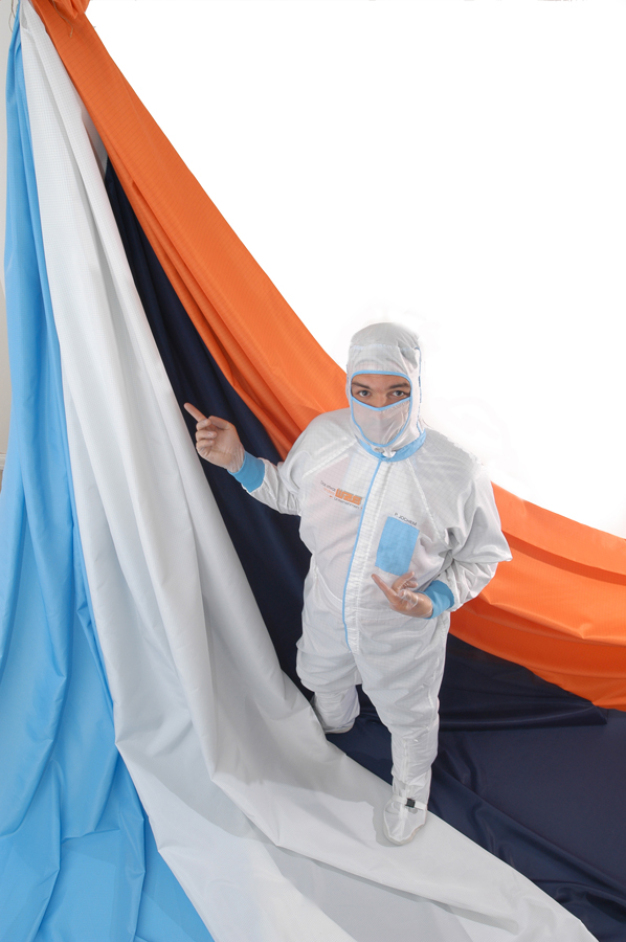
There are a variety of materials from which cleanroom clothing is made.
When selecting the fabric, the cleanroom clothing must be matched to the required classification of the monitored area. Factors such as workplace conditions (physical work, temperature, humidity, etc.), special protective functions (e.g., chemical protection), and spatial arrangements (e.g., personnel or changing rooms) must be considered.
A high retention capacity against airborne and mechanically transported contaminants through the fabric is the essential requirement for the cleanroom clothing system.
Reusable cleanroom clothing is preferred over disposable clothing here. However, it must be reprocessed (particle-free) before reuse.
Reusable cleanroom clothing for defined initial conditions must be washed and decontaminated before the first wear cycle because manufacturing-related contaminants are present. Additionally, during use in the cleanroom, it becomes contaminated. Particulate and liquid contaminants from the body, undergarments, and environment contribute to this contamination. The overarching goal of a decontamination process is to achieve a low residual contamination level of the fabric; that is, the fabric barrier should be emptied, and surface-adhering contaminants should be removed. Regarding quality assurance measures, the residual contamination level plays a central role. A particle standard according to ASTM F51-68 is the target for this measure.
"Space, infinite vastness. We write the year 2200. These are the adventures of the starship Enterprise, which with its 400 crew members is on a 5-year mission to explore distant galaxies, seeking new life and new civilizations. Many light-years from Earth, the Enterprise ventures into galaxies never before seen by humans."
With these words begins each episode of one of the most legendary TV series of all time. "Starship Enterprise" is set in the 23rd century, at a time when humanity has left the Third World War behind and has united in peaceful coexistence with other extraterrestrial life forms into the "United Federation of Planets."
Similarly, the development of space travel also began in this way. Without cleanroom environments, perhaps no space travel. Thanks to a high innovation dynamic in our economy and rapid progress in development and research, the technical development of cleanroom technology has positively changed in the last 20-25 years. Only through this was it possible to modify space technology, which also benefited from this technology. Had it not been possible to change the entire structure of space technology, such as automation and control systems, under cleanroom conditions in the micro-range, the entire space technology would have been left behind. The miniaturization of switching and control systems and their protective enclosures enabled a much more compact design and weight reduction. Professionally, I had the opportunity over 15 years ago in Bremen to see how the second stage of the Ariane 5 rocket was manufactured under cleanroom conditions. Cleanrooms of this size are fascinating.
The space suit of astronauts is designed so that it can be regarded as protective clothing and also as technical textile. As a protective suit, it includes the entire air supply, control elements, communication with the spacecraft, etc. Special vital technical properties are integrated for each specific mission. Due to a defect in a space suit, two astronauts from the US space shuttle "Endeavour" had to prematurely end their extravehicular activity (EVA) at the International Space Station (ISS). David Wolf and Christopher Cassidy safely returned to the ISS. The control station ordered the premature end of the mission after six hours because an increase in the carbon dioxide level was measured in Cassidy's suit. These substances are also referred to as technical textiles.
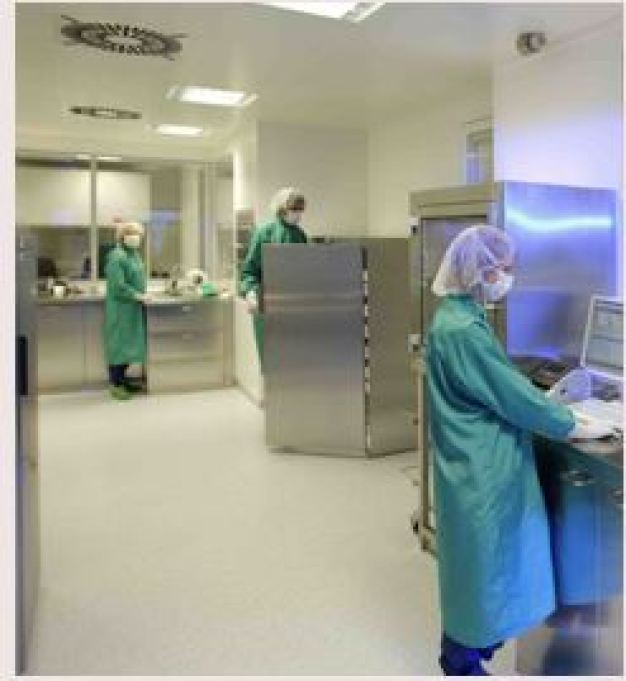
Returning to cleanroom technology, it must be acknowledged that in the pharmaceutical industry, which also produces its products under "clean conditions," cleanroom clothing is partly used as product protection and protection for personnel.
Here, the production of parenterals will also be discussed. (Meaning: (Greek) pará = beside, éntéron = intestine, literally: "bypassing the intestine" or "bypassing the gastrointestinal tract").
The pharmacopoeia notes the following: "Sterile preparations intended for injection, infusion, or implantation into the human or animal body" and cytostatics: a group of active substances used in cancer treatment (chemotherapy) or for immunosuppression (e.g., in autoimmune diseases). In the manufacture of these two preparations, not only product protection (prevention and avoidance of contact with toxic substances and their release into the environment) but also personnel protection (prevention and avoidance of contamination of the manufactured medication with foreign substances such as particles, microorganisms, other active substances from the environment) is a very important requirement.
Important regulations for aseptic drug manufacturing are indispensable; some laws and regulations are listed here:
In pharmacy operations:
• Pharmacy Act (ApoG)
• Medicines Act (AMG)
• Pharmacy Operating Regulations (ApBetrO) new!
• Guidelines and comments of the Federal Pharmacists' Chamber (BAK-LL) new! Pharmacies with manufacturing license according to AMG (§ 13) additionally:
• Medicines and Active Substance Manufacturing Regulation (AMWHV)
• EU Guidelines on Good Manufacturing Practice (GMP guidelines) additionally:
• PIC/S Guide to Good Practices for the Preparation of Medicinal Products in Healthcare Establishments
Since pharmacists are now also permitted to produce parenterals, cytostatics, and perform secondary packaging, these are bound by the pharmacy operating regulation ApoBetrO. Here are some essential excerpts from ApoBetrO § 35.
Manufacture of medicines for parenteral use (intended for injection, infusion, or implantation into the human or animal body)
Prerequisites:
- Only qualified and trained personnel may be employed
- Production takes place in a separate manufacturing room
- Access to the manufacturing room is only permitted via an airlock
- The room should have an appropriate size (specific work areas)
- Ventilation of the room is only allowed through filter media with adequate effectiveness
- The room must also be easy to clean on floors, walls, and surfaces
Additional requirements (excerpt):
Preparation and filling may only be carried out in specific zones or areas:
• Local zone of cleanliness class A
• Surroundings of cleanliness class B
or
• Surroundings of cleanliness class C
with proven assurance of medicine quality and corresponding
validation of the process
or
• Surroundings of cleanliness class D when using an isolator
ReinraumTechnik-Jochem
66538 Neunkirchen
Germany