



- Industry 4.0
- Translated with AI
Fraunhofer IPA and UiPath initiate strategic partnership
The next step towards Industry 4.0
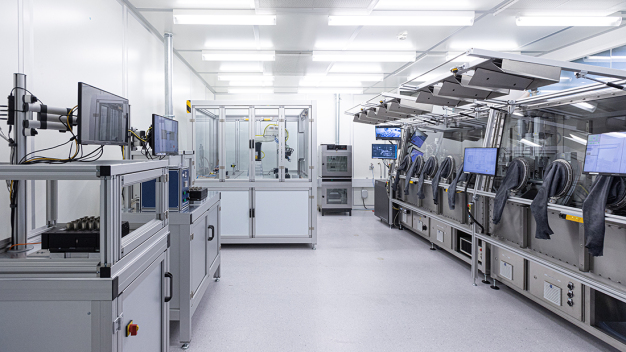
In the cleanroom, processes are automated with RPA to optimize quality control. © Fraunhofer IPA / Photo: Rainer Bez
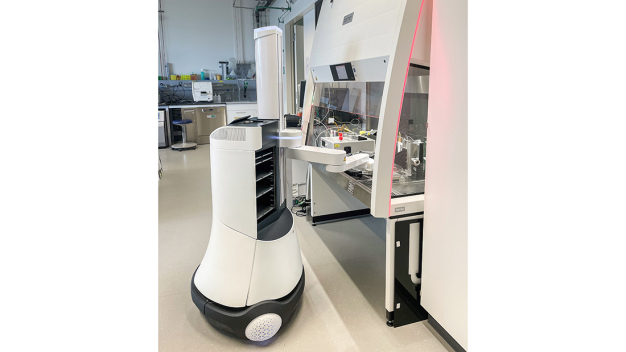
The mobile robot Kevin from Fraunhofer IPA in a cell culture process. © Fraunhofer IPA / Photo: Sina-Helena Gross
Experts in automation software as well as production technology and automation are working together to expand the application areas of Robotic Process Automation for industrial production. Current use cases include quality control in cleanrooms and monitoring a process for cell cultivation.
The Fraunhofer Institute for Production Technology and Automation IPA and UiPath, a provider of automation software for companies, have initiated a strategic partnership to further advance digital transformation in industry. The goal of the collaboration is to jointly research, develop, and implement use cases for Robotic Process Automation (RPA) in industry. Fraunhofer IPA and UiPath are developing joint use cases around process automation for controlling and monitoring a cleanroom as well as overseeing a process for cell cultivation.
Quality Control in the Cleanroom
The first project will be carried out in the cleanrooms of Fraunhofer IPA. During production, processes and environmental conditions in the cleanroom must be constantly monitored to ensure optimal product quality and to detect potential negative influences early. The challenge lies in simultaneously capturing data from various sources (environment, process, product) and providing it flexibly for further analysis. To enable this, the two partners consolidate and process the data on the UiPath platform. The information and models obtained should in the future provide a good overview of the current situation in the cleanroom without employees needing to enter it. Additionally, they should be able to detect changes in the production process early and support decision-making in problem situations. Next, analyses and models will be developed to make historical data easier to compare with the current situation. Based on this, predictions will also be enabled to inform employees early about potential product influences and quality risks.
Monitoring by Bots
The second RPA implementation will be carried out by the partners in a bioscience laboratory at Fraunhofer IPA, where cell cultures are cultivated. The challenge here is that there is not enough high-quality data available for process control and optimization. Existing data also come from various sources and could only be integrated with significant effort so far.
The cells are cultivated in a repetitive process. The development focuses on a bot, a computer program that digitally connects the necessary devices and collects information about ongoing processes. After each cycle, the bot checks based on the collected data whether the cells are ready for further processing. This way, the bots learn with each cycle and can determine the optimal cultivation parameters.
The staff predicts that the laboratory at Fraunhofer IPA can increase productivity by 33 percent if it is fully automated. They save time on repetitive tasks. At the same time, throughput increases through optimized process control, and the error rate decreases. Thanks to continuous monitoring, there is also a seamless documentation of the process.
Automation of industrial processes is an important step toward the digital transformation of manufacturing. "While physical robots and software already automate many tasks, there is often a lack of software that monitors all processes and, where possible, optimizes them. This gap is now to be closed by the collaboration between Fraunhofer IPA and UiPath," explains Malte Volkwein, project manager at Fraunhofer IPA.
Following these ongoing projects, the team from Fraunhofer IPA and UiPath plans to develop solutions for and together with industry and to support their partners in implementation. Ultimately, the aim is to establish a network of industry, science, and research to expand the new application area of software automation in industry. "Our common goal is to support companies with solutions for sustainable growth. Process automation is essential for efficient operation. Therefore, we welcome the opportunity to develop new solutions for industry together," says Sebastian Seutter, Global Manufacturing Lead at UiPath. Annette Maier, Area Vice President Central & Eastern Europe at UiPath, adds: "Automation will become a central part of companies' strategies in the future. It allows them to act more flexibly and operate more profitably. The intelligent collection and analysis of data will thus become an immediate advantage in the transition to Industry 4.0."

Fraunhofer-Institut für Produktionstechnik und Automatisierung IPA
Nobelstraße 12
70569 Stuttgart
Germany
Phone: +49 711 970 1667
email: joerg-dieter.walz@ipa.fraunhofer.de
Internet: http://www.ipa.fraunhofer.de