
- Universities
- Translated with AI
First green laboratory at TU Berlin
A total of one-third of its total electricity costs will be saved by the Department of Applied Biochemistry. Certification through the "My Green Lab" project
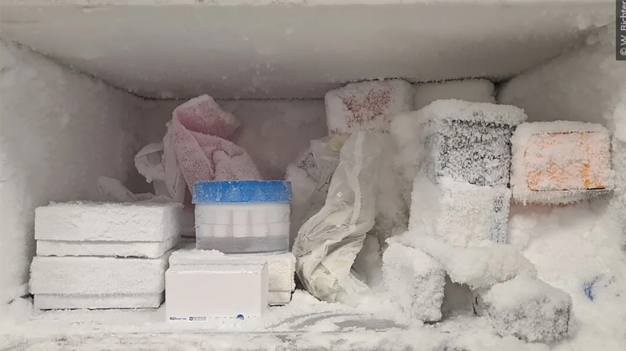
This ultra-deep freezer does not need to be defrosted. At minus 80 degrees Celsius, carbon dioxide from the air freezes out and forms fine crystals.
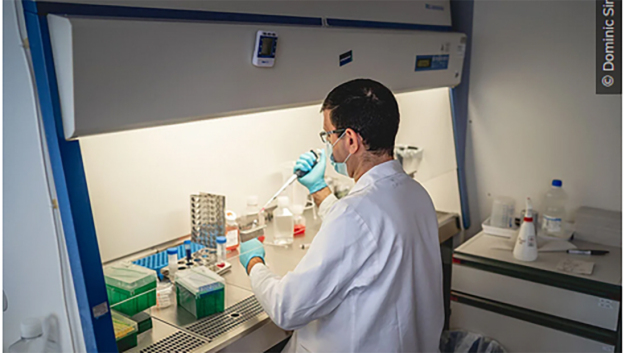
Six of these safety cabinets (clean benches) are available at the department. If you put the benches into standby mode when not in use and turn them off during extended breaks in work, you can save about one-third of their electricity consumption. For six benches, this is almost equivalent to the annual consumption of a four-person household.
The Applied Biochemistry Department is the first at TU Berlin to be certified in the "Green Lab" program. The certifying organization is the non-profit organization My Green Lab in the USA. It was named one of the main actors by the United Nations in their "Race to Zero" campaign, aiming to make medical-pharmaceutical companies and laboratories climate-neutral by 2050. Three laboratories in Berlin have already been certified by My Green Lab. Three more – including the one led by TU Professor Dr. Jens Kurreck – are in the certification process.
"In the initial evaluation, we already achieved a bronze status, but that's only the first round," says department head Prof. Dr. Jens Kurreck. My Green Lab does not only want to recognize existing efforts but also encourage changes in every laboratory. "To this end, the organization anonymously surveyed all lab staff with an online questionnaire, summarized the results, and derived suggestions."
Energy Saving at Low Temperatures
An example where energy can be saved is in the cooling and freezing units in the laboratories. Two of these devices are so-called ultra-low freezers, which preserve viruses and other biomaterials at minus 80 degrees Celsius. They account for a quarter of the total electricity consumption of the department. Jens Kurreck and his team conducted an energy consumption measurement of all electrical devices, which revealed the energy-intensive freezers. They identified two ways to save energy: First, for less sensitive samples, the temperature in one of the freezers can be raised to minus 70 degrees. This already leads to significant savings, as decreasing temperature causes the power consumption to increase exponentially. "The second savings opportunity should actually be impossible in an ideal laboratory," says Kurreck. It is simply "cleaning up." "If you search for samples with the door open for minutes, a lot of heat escapes. Also, you have to do this by hand because of the small tubes, which is no fun at minus 80 degrees."
"Freezer Challenges" at My Green Lab
Cleaning out the sample freezers was not a one-time measure. The department has now devised a classification and organization system to find samples particularly quickly. The energy-saving aspect of the ultra-low freezers has also been recognized by the My Green Lab initiative, which regularly hosts "Freezer Challenges" among its members, where laboratories compete to have the most optimized freezer.
Half Saved
But not only the freezers have been scrutinized by Jens Kurreck and his "Sustainability Group," which meets once a month. They can also report savings in the use of autoclaves: large, washing machine-like devices that sterilize biological waste at 134 degrees Celsius and two bar of overpressure. Previously, waste was disposed of immediately after generation, and the autoclave was turned on right away. Now, waste is collected until an autoclave can be fully loaded. After more than a month with this new regulation, it was shown that half of the runs could be saved. With an annual consumption of about 5,000 kWh of electricity, this is a significant portion of the department's total consumption of 70,000 kWh.
Potential Savings: The Annual Consumption of a Four-Person Household
The sterile workbenches in the laboratory also have high energy consumption, about 1,000 kWh per device per year. With six devices in the department, that’s around 6,000 kWh annually – and there are nearly 50 of these workbenches across the entire TU Berlin campus in Wedding. A continuous airflow creates an invisible barrier in front of the actual work surface, preventing germs from escaping or entering. "Turning the workbench to standby mode when not in use consumes only a tenth of the power. For longer interruptions, it can also be turned off completely," explains Jens Kurreck. He estimates that this could save about one-third of the energy used by the workbenches, roughly 2,000 kWh. "That’s only slightly less than the annual consumption of a four-person household."
Imitation Welcome
Jens Kurreck and his team want to encourage other laboratories to join the My Green Lab initiative. Many measures have already been adopted through the "collective intelligence" of the sustainability group, including using a portable power meter. However, some tips from My Green Lab were still new to the researchers – for example, collecting consumables to minimize packaging and transportation energy. Without much effort, they suggest starting with lighting: replacing fluorescent tubes on the ceiling with LED lamps at the workstations. Overall, they hope to save about a third of the department's total electricity costs through all measures. Kurreck emphasizes that this not only benefits the environment and the fight against climate change: "Even if it doesn't affect our own budget, we ultimately benefit because when the university saves money, it secures our basic funding."
My Green Lab Project
Already three laboratories in Berlin have been certified by My Green Lab. Three more – including the one led by Jens Kurreck – are in the certification process. The Applied Biochemistry Department is the first at TU Berlin. Nationwide, 62 laboratories are certified or in the process, and worldwide over 1,400.
Further information provided by:
Prof. Dr. Jens Kurreck
Technical University of Berlin
Department of Applied Biochemistry
Tel.: +49 (0)30 314 – 27582
Email: jens.kurreck@tu-berlin.de
Technische Universität Berlin
10587 Berlin
Germany