



- Translated with AI
Gloria Marini
Energy-efficient cytostatic isolator for secure process weighing of toxic substances
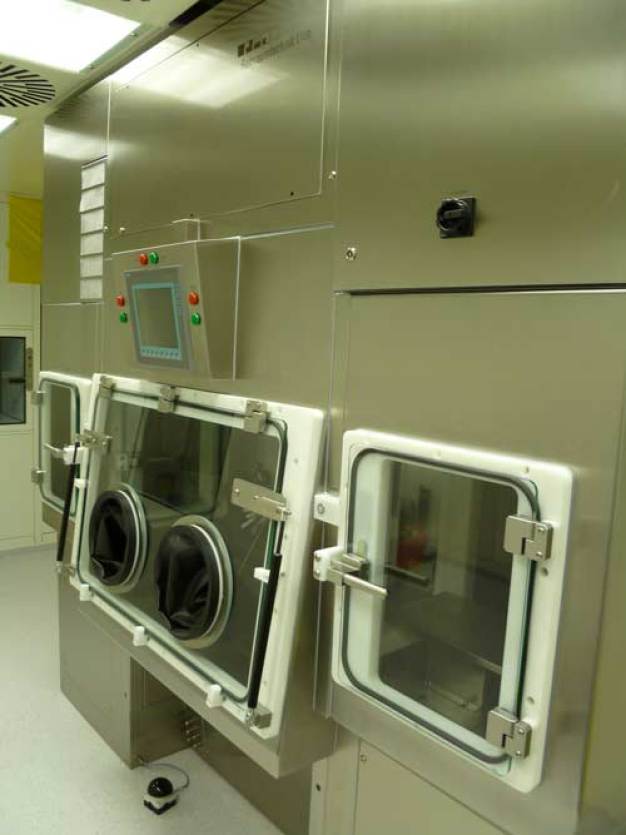
Isolator
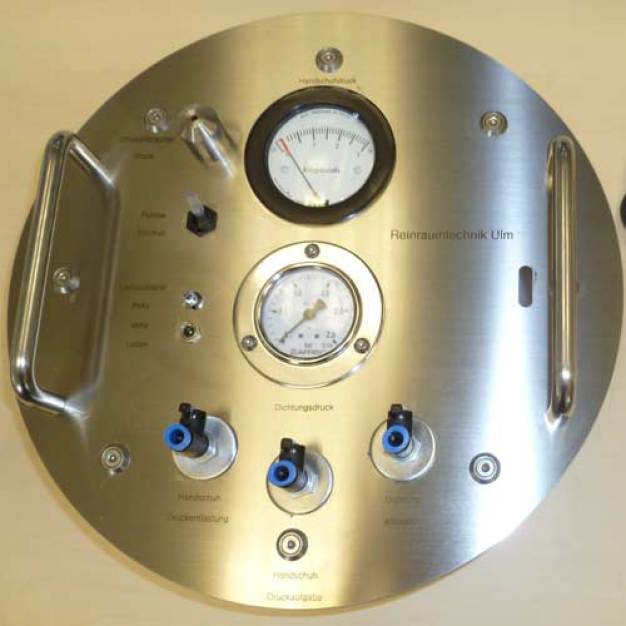
Glove testing device
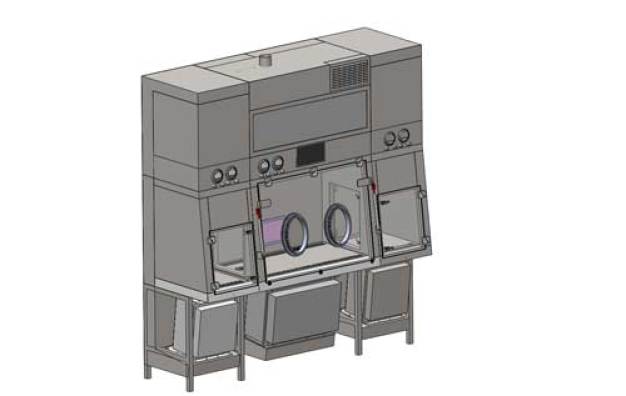
Drawing of an insulator
According to forecasts from the Robert Koch Institute, in 2012, 258,000 men and 228,000 women were expected to be newly diagnosed with cancer. Since there are still types of cancer for which the currently approved medications show no effect, the pharmaceutical industry is working intensively to develop new cytostatics. To this end, increasingly autonomous cytostatic isolators are being used in the laboratory setting, which, through the use of special airflow management and handling via glove ports, provide a strict separation between the working person and the working material. Hospital pharmacies are also increasingly investing in the purchase of cytostatic isolators for preparing patient-specific medications.
As part of the "ZIM" project ("Central Innovation Program for SMEs"), an isolator was developed under the theme "Development of an energy-efficient cytostatic isolator for process-safe, gravimetric weighing of toxic substances," which can be used both as a cytostatic isolator under negative pressure and as an isolator for other substances requiring maximum product protection under positive pressure. The following article first discusses the functionality of the cytostatic isolator and then the isolator for other substances.
The current DIN standard 12980 "Laboratory equipment – Safety cabinets for cytostatics" already provides considerable guidance for the design and configuration of cytostatic safety cabinets.
Cytostatics are natural or synthetic substances used in the treatment of cancer and tumor diseases. Their effect lies in inhibiting cell division and growth by interrupting, inhibiting, or altering the metabolic processes of the cells.
Since cytostatics are cell toxins that must under no circumstances enter the surrounding area of the isolator, as they are classified as highly active substances hazardous to workers, the cytostatic isolator is operated exclusively under negative pressure and only allows access via glove ports integrated into a partition wall. It is standardly equipped with two independently ventilated material lock chambers with interlocked doors for loading and unloading, and a working chamber for the safe handling of highly active substances and cytostatics.
To prevent cross-contamination or product mix-ups, one lock chamber is used for loading or unloading material. The cytostatic isolator is equipped with a special control system to operate different pressures and operating modes via various selection buttons. To load the product, the door selection button at the entry lock chamber is pressed. This activates the recirculation mode in the lock until the pressure inside the lock adjusts to the ambient pressure of the isolator. Once this ambient pressure is reached, a release from a built-in PLC (programmable logic controller) permits the lock door to be opened manually. After introducing the material via a material chute for easier transfer, the chute is closed, locked, and the so-called recovery time begins, during which the material is ventilated. After this rinsing period, once the working area, which remains under negative pressure (-50 Pa to -120 Pa) during all operating modes, is ready for material insertion, the pressure equalization between the lock and the working area is initiated using a foot switch. The lock is then brought to a negative pressure of approximately 0 Pa to -50 Pa via a volume flow regulator. This pressure cascade prevents the escape and carryover of cytostatics from the working area. When the negative pressure is achieved, the door between the lock and the working area is unlocked, and the material can be introduced into the workspace via glove ports, whose positions are set during previous mock-up studies. For removing finished material, the pressure increase and decrease are performed in reverse. This procedure ensures, as required by DIN 12980, that no harmful environmental influences can impair the cytostatic preparations. Both material lock chambers and the working space are equipped with Safe-Change filter boxes, which allow filter replacement without contamination risk through Bag-In-Bag-Out technology.
Within the working space, work is carried out with turbulence-free displacement airflow in recirculation mode, additionally with adjustable partial exhaust. Like most cleanroom technical systems, the supply air flows vertically, controlled by a monitored volume flow regulator. The workspace is further equipped with an automatic cycle for pressure monitoring. During a period set by the operator, it checks whether the isolator can maintain a specified test pressure for a certain time. Passing this pressure hold test confirms the integrity of the isolator.
For decontaminating the cytostatic isolator, it can also be equipped with connections for H2O2 decontamination.
To "protect the operating personnel (...) from harmful influences caused by aerosols released inside from cytotoxic and other highly effective substances" [DIN EN 12980], it is also the operator's duty to test the basic functionality of the cytostatic isolator before each use. The weakest point of closed systems remains the gloves themselves. Therefore, it is essential to subject the gloves to a glove leak test before each use. Special glove testing devices are available that can check the gloves on-site and without removal. The leak test involves applying and maintaining pressure; the test pressure must not decrease significantly within a specified period.
The special feature of the isolator described here is its operational flexibility. On the one hand, it can be operated as a pure cytostatic isolator under negative pressure, as described in detail above. However, in hospital pharmacies and laboratory systems, it is often necessary to process various substances within short periods, but the budget does not allow for two separate systems. This isolator can switch between negative pressure operation for optimal personnel protection and positive pressure operation for optimal product protection. Through numerous tests and trials during the "ZIM" project, a system was developed with exactly this function. After handling cytotoxic substances, if substances that pose no significant risk to personnel but must remain absolutely pure are to be processed, the isolator can be switched to positive pressure. Of course, the isolator must first be fully decontaminated, which is done via H2O2 decontamination. Gaseous H2O2 is injected into the isolator, which is then thoroughly cleaned through air circulation. After a predetermined period during which the aerosol acts, the isolator is fully decontaminated and ready for use with new substances.
This energy-efficient isolator now enables smaller operations and pharmacies to work quickly and flexibly with various products. The simple switching of operating modes from negative to positive pressure ensures that the isolator provides full product protection and/or full personnel protection at all times.
Reinraumtechnik Ulm GmbH
89079 Ulm
Germany