



- Lasertechnology
- Translated with AI
Correctly labeled for sure: What matters in the labeling of medical devices
Laser marking plays a crucial role in traceability, UDI compliance, and product safety. But what truly makes a marking "secure"? The article provides answers from different perspectives and through practical examples.
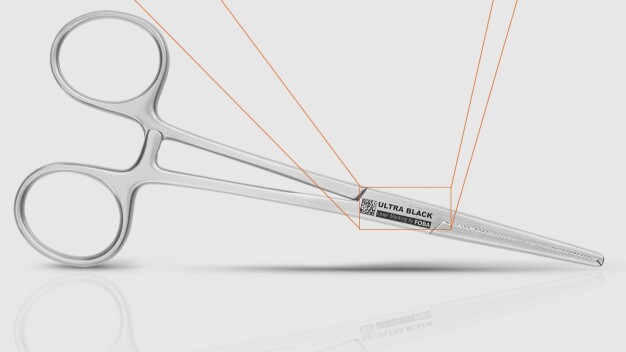
"Black Marking" on a medical clamp, marked with an ultrashort pulse laser. (Copyright: FOBA Laser Marking + Engraving)
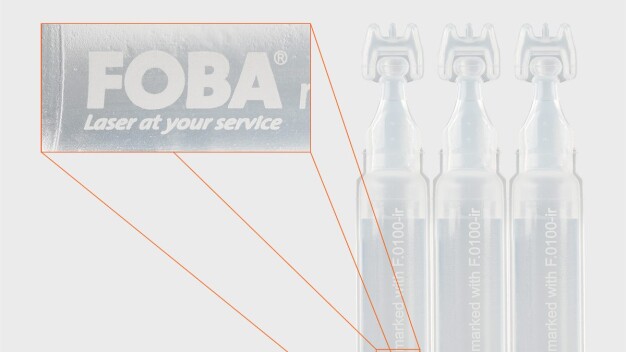
Lasers enable the safe, scratch-resistant marking of plastics. (Copyright: FOBA Laser Marking + Engraving)
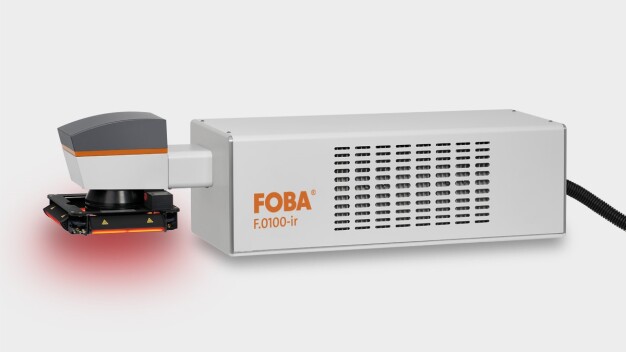
Ultrashort pulse laser FOBA F.0100-ir for Black Marking. (Copyright: FOBA Laser Marking + Engraving)
Safety takes top priority in medical technology: Every process step must meet the highest requirements – from patient safety to compliance with standards and regulations. Since product labeling plays a key role in ensuring safe, seamless traceability and UDI compliance, it is crucial that manufacturers of laser marking equipment also possess a solid understanding of the processes, standards, and industry-specific challenges. In this way, they contribute significantly to the safety of medical devices and become partners for medical device manufacturers in the secure implementation of labeling requirements. When forward-looking technology meets expertise, laser marking becomes a real game changer for increased safety and efficiency in the production process.
But what matters when we talk about a "safe labeling"? And how can maximum safety be integrated into laser marking of medical devices from the outset? What aspects must be considered when marking? How can the marking be designed to be reliable and compliant?
Uncompromising corrosion resistance: Can a laser mark withstand 1000 reprocessing cycles?
A central safety criterion for marking medical devices is corrosion resistance. This applies to metal medical devices, such as surgical instruments made of stainless steel or implants made of titanium. When products are reused multiple times, the labeling must withstand reprocessing cycles without corrosion forming and without impairing readability.
The Tuttlingen-based medical technology service provider add’n solutions and FOBA Laser Marking + Engraving, manufacturers of laser marking equipment for medical technology, conducted long-term tests where the corrosion resistance and quality of laser markings were rigorously examined: Laser-marked instruments were cleaned and passivated 1000 times in fully automatic systems, then autoclaved, and additionally subjected to periodic high-alkaline cleaning. It was demonstrated that markings made with the ultra-short pulse laser FOBA F.0100-ir remain durable and reliable even after over 1000 cleaning and sterilization cycles: "The marking is still highly legible. It endures the entire lifespan of an instrument. The material of the test instruments failed before the marking did," explains Dominik Pfeiffer from add’n solutions.
For particularly high requirements regarding marking quality, readability, and material integrity, the so-called "Black Marking" effect is ideally suited. Using ultrashort laser pulses creates a nanostructure that appears as a deep black mark. For Black Marking, ultrashort pulse lasers like the F.0100-ir from FOBA are used. This laser delivers pulse durations in the femto- and picosecond range with high pulse energy to the material. The continuously adjustable pulse width allows for maximum precision and optimal parameter adaptation to the marking requirements. The energy input is so focused and minimally short that the exact structures, referred to as "Black Marking" or "Black Marking," are created practically without heat input, preserving the surface integrity. This way, the material is maximally protected while producing a mark that is durable, reliable from every angle, corrosion-free, biocompatible, biostable, and UDI-compliant.
Advanced laser technology provides all the prerequisites for the safe labeling of medical devices. With the highest accuracy and maximum material integrity combined with optimal readability, it makes a decisive contribution to product safety and regulatory compliance.
What remains is safety: Direct marking of sensitive medical devices
Through continuous innovation, laser marking is increasingly used on products and materials where other marking methods had to be employed in the past. This includes both very sensitive materials, such as many medical plastics, and delicate products like pacemakers or other active implants. Traditionally, ink-based processes such as pad printing are used for such products. However, inks and dyes are increasingly viewed critically in sensitive areas like medical technology concerning safe readability and biocompatibility. Additionally, there is a high rejection rate due to faulty print results, such as smudging or fading. Extensive quality controls and drying processes hinder an efficient, smooth production flow.
In contrast, laser marking is a highly efficient contactless process. Without the use of potentially critical foreign substances, laser markings on heat-sensitive products can be reliably permanent, durable, and scratch-resistant. Besides the aforementioned ultrashort pulse lasers, highly developed UV lasers also enable extremely gentle marking. They are ideal for high-contrast marking of sensitive medical plastics. Since the marking occurs through a photochemical effect and without significant thermal load, it is also called "cold marking." The material surface remains smooth and hygienic, while the marking remains clearly readable and scratch-resistant. "The latest technological advances in UV laser technology enable reliable marking of materials that were previously difficult to mark with lasers: The broad application spectrum and versatility of our V-series with wavelengths of 355 nm (UV laser) and 532 nm (green laser) impress our customers and continually excite our laser experts in application laboratories. This benefits especially companies in medical technology, which often rely on direct laser marking due to strict regulatory labeling requirements. We can offer them a reliable, safe marking solution for the most challenging materials," explains Philipp Febel, Director of Product Management, Marketing & R&D at FOBA Laser Marking + Engraving.
From installation to quality control – process safety with system
However, the best marking alone is not enough for maximum safety in medical technology. The marking process itself and its qualification are also crucial factors and central components of quality assurance. When the laser manufacturer supports qualification, medical device manufacturers benefit significantly. Knowledge about the optimal setup and adjustment of all parameters enables a more efficient validation process, as Philipp Febel from FOBA explains: "Successful support of the IQ/OQ/PQ/MQ process is a core part of our service for medical device manufacturers. As laser experts, we bring our expertise into our customers' processes. This creates synergies that enable smooth, timely installation and device qualification, forming the basis for highly efficient, scrap-free, long-term stable production processes."
Documented quality and stable manufacturing processes that enable reproducible marking results are central elements of validation and crucial for product safety and UDI compliance. The camera-based marking process HELP (Holistic Enhanced Laser Process) is tailored to these regulatory and production requirements. The laser-integrated camera system IMP (Intelligent Marking Positioning) captures the position and geometry of the component before marking and automatically aligns the mark precisely. This ensures that the labeling is exactly at the designated spot—regardless of the positioning of the product in the marking field. This function is especially important given the trend toward miniaturization in medical technology: particularly when space is limited, such as on dental implants, minimally invasive instruments, or catheters, highly precise positioning of the mark is critical for safe readability. With automatic alignment and precisely adapted parameters, micro-markings can be achieved in optimal quality.
After marking, the marking result is checked "inline," directly within the laser marking device, regarding content and code quality, and the results are documented. The efficient workflow reduces manual inspection effort, minimizes rejects, and enables seamless documentation of marking quality. A mature camera-based marking process like HELP offers a significant added value in product labeling: increased safety, greater efficiency, and reduced risk.
From A for Application Tests to Z for the Future: Safe laser marking in medical technology
Laser marking is much more than just a marking method for medical technology. It forms the basis of regulatory compliance, quality, and traceability. Comprehensive consulting, application testing, and precise parameter tuning are essential for the optimal implementation of complex requirements. Through the interplay of expert knowledge, technologically advanced, validated processes, camera-assisted precision, and documented quality, laser technology makes a decisive contribution to product and patient safety. Furthermore, the efficient labeling process is future-proof: with extremely compact marking systems, intelligent interfaces, and digital and automated process solutions, laser marking meets the demands of modern production environments.
FOBA Laser Marking + Engraving
23923 Selmsdorf
Germany