



- Cleaning | procedures, devices, agents, media (Wipers, Swaps,...)
- Translated with AI
Joachim Ludwig / Theresia Fasinski
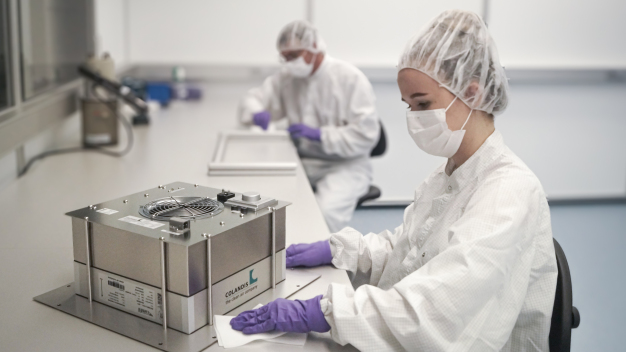
Component cleaning under cleanroom conditions
Cleaning

Cleaning steps

Cleaning time point
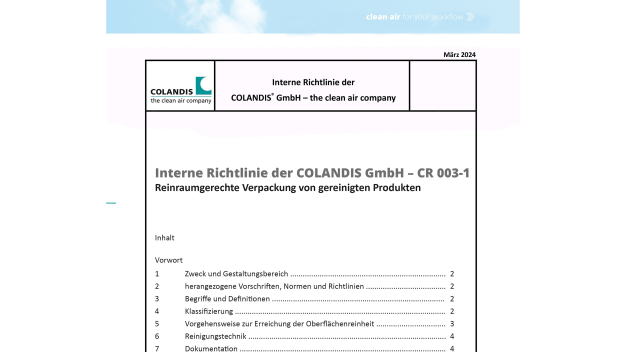
Internal Policy (Source: COLANDIS GmbH)
Customer requirement: "Clean the part in the ISO 6 cleanroom." We insert the part into the cleanroom, briefly blow over it, and have fulfilled the customer requirement!
Where is the mistake?
Problem Statement
The cleaning of individual parts, assemblies, and machines under cleanroom conditions is a complex topic. From formulating the task to providing proof of cleaning, packaging, and shipping, a closed process chain is required that unambiguously describes and guarantees the cleaning procedures.
More and more products are manufactured under cleanroom or clean environment conditions. This is done with machines and systems that produce in the cleanroom. To ensure the purity of the products produced and the processes taking place on them, a sufficiently high level of cleanliness of these machines is necessary.
Definition of cleanliness requirements
If you search for standards or guidelines on the topic "Process chains in the cleanroom," you will find very little. Usually, as in DIN EN ISO 14644-9, this important aspect is excluded: "… The following aspects are not considered in this standard: - Procedures for cleaning surfaces; …" This results in a number of company standards that are not compatible or interchangeable across a broad range of applications and are only tailored to a few products. These company standards are also only accessible to a selected group of users.
Furthermore, industry-specific specifications describe a state of the art that does not always align with current knowledge. These are mainly standards from the semiconductor sector and the automotive industry.
There is also a large number of internal company standards and guidelines describing cleaning and packaging processes. Incorporating these into a general overview for creating universally applicable instructions often fails because all company standards are preceded by confidentiality agreements. Almost all of these regulations are based on many years of experience and, of course, on mistakes made. Only a few are preceded by in-depth scientific research. These regulations remain current until limits are reached where existing procedures are no longer sufficient, and processes are iteratively further developed.
If the customer does not specify requirements or general standards, then the company's own established guidelines should be referenced in consultation with the customer.
Solution
It is not sufficient to superficially clean the machine or system at the end of assembly. The necessary process chain begins with cleaning individual parts before assembly, cleaning of assemblies after final assembly, followed by cleaning at the end of assembly with immediate packaging in appropriate packaging material, qualified transportation to the customer, unpacking before the cleanroom, re-cleaning of surfaces, and installation in the cleanroom. Regular maintenance cleaning is also carried out to maintain the cleanliness of each machine.
Summary
It is difficult to establish universally applicable procedures for cleaning individual parts, assemblies, and machines. The variety of parts is too great, and the requirements are too different. Fundamentally, the individual cleaning steps should be performed under well-documented environmental conditions with well-trained personnel. Quality control helps to continuously improve the processes.
The cost factor is reflected in this consideration by the so-called 10-rule. This means that neglected efforts at the beginning of a production chain, which later become highly necessary—such as surface cleanliness—require ten times higher costs at each subsequent processing step than in the previous step. In other words, if at the start of a technological chain 10 cents per component are saved, by the second step of reuse, an additional €1 in costs must be incurred per component. So, those who save at the beginning produce more expensively!

COLANDIS GmbH
Im Camisch 34
07768 Kahla
Germany
Phone: +49 36424 76940
email: info@colandis.com
Internet: https://www.colandis.com