




- Service
- Translated with AI
Jörg Dressler
Calibration of cleanroom particle counters according to ISO Standard 21501, Part 4

Jörg Dressler_new_web
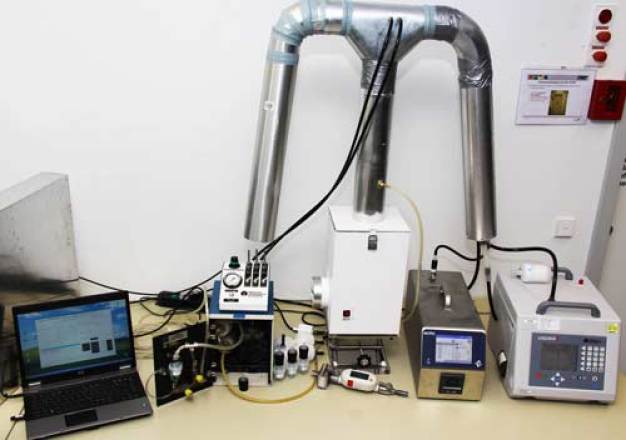
Calibration stand for particle counters according to ISO 21501-4 (Photo: PMT Particle Measurement Technology GmbH)
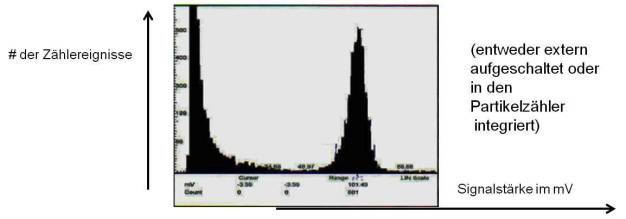
Typical impulse distribution of a particle counter - recorded using pulse height analyzer
The particle measurement of airborne contamination is firmly anchored both in ISO standards (ISO 14644) and in pharmaceutical guidelines. The measurement basis for all cleanroom standards is the use of optical scattered light particle counters (OPC). Often unnoticed by many users, a standard has been established in recent years that defines the performance parameters of particle counters and describes the calibration of this type of measuring device.
This article deals with the core statements of this standard, ISO 17025 and its Part 4. In particular, the aim is to explain the perhaps still unfamiliar definitions and the fundamental calibration mechanisms.
Introductory and basic calibration work
All calibration work on a particle counter should generally begin with the determination of the zero count rate. An "ideal" filter is switched into the sampling path, and it is recorded whether the device under test shows measurement values greater than zero. Significant measurement values are often an indicator of contamination in the measurement cell and could possibly pose a fundamental problem for subsequent calibration work.
Furthermore, before calibration work on the device's measurement physics, the sample flow through the particle counter should be compared with the measurement value of a reference flow meter. Deviations from the reference value should not exceed ± 5%.
First overview of the essential ISO 21501 calibration contents
As the basis of any calibration, ISO 21501-4 requires the size calibration of the particle channels (size calibration) with possible adjustment. This also includes the verification of the associated channel setting error (size error).
The quality with which a particle counter internally reproduces a given distribution of test particles is quantified by determining the size resolution. Additionally, the counting efficiency in the smallest particle channels must be determined.
Calibration and adjustment of the particle channels
The calibration of the size channels is based on the historical foundation of the ASTM F 328 standard. The basic concept involves using monodisperse latex particles (PSL particles) with a known mean value and known distribution. These particles are fed as standards, while simultaneously recording the response signals at the detecting photodiode.
A so-called Pulse Height Analyzer (PHA) analyzes these raw signals and records the frequency of counting events depending on the signal intensity (or particle size). The amplifier circuits of the particle counter are to be adjusted so that a symmetric PHA distribution is present. This makes the OPC fundamentally calibrated to a particle size channel. This procedure must be carried out for each channel of the particle counter. (see diagram of pulse distribution of particle counters)
Further, the definitions of ISO 21501 now allow quantifying the quality of the channel setting, based on the ASTM basic principle. For this, PSL particles from the adjustment process (particle size xr) are again fed. The PHA now determines the center of gravity of the particle distribution xs.
The size error (size error) ε is calculated by the following expression:
ε(%) = (Xs - Xr) / Xr × 100
ε should meet the acceptance criterion of ± 10%.
Determination of the size resolution
ISO 21501 raises the question of how much the device's construction alters the certified latex standard distribution. For this, the well-documented standard distribution of the particle standard Ïp (referring to the standard with center xp) is compared with the actual recorded standard distribution at the PHA.
The percentage measure R f for the enlargement of the particle distribution is called the size resolution (size resolution).

should be a maximum of 15%.
Determination of counting efficiency
An essential part of every calibration according to ISO 21501 is the determination of the counting efficiency. In this test, the two smallest particle channels are compared with the counting results of a reference device.
The larger of the two channels should be 1.5 to 2 times the size of the smallest channel. Naturally, the reference device must demonstrate a counting efficiency of nearly 100% in the comparison channels.
The counting results of the device to be calibrated, C1, are compared with those of the reference device, C0.
The ratio of C1 to C0 then yields the counting efficiency η in a specific channel
η (%) = (C1 / C0) × 100
η should be 50% (± 20%) in the smallest channel and 100% (± 10%) in larger channels.
![PMT_Logo_4C [Konvertiert]](/uploads/images/_scale/pmt_logo_4ckonvertiert_122x39.jpg)
PMT Partikel-Messtechnik GmbH
Schafwäsche 8
71296 Heimsheim
Germany
Phone: + 49 7033 53740
Fax: + 49 7033 537422
email: info@pmt.eu
Internet: http://www.pmt.eu