- Automation
- Translated with AI
Assembly of medical tubes in the smallest (clean) room
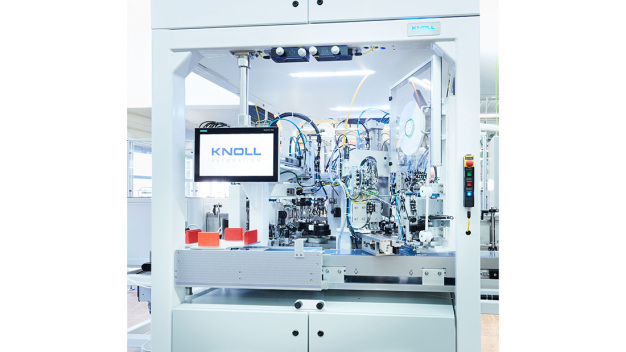
In the new, compact system from Knoll Feinmechanik, everything needed for the assembly of standard disposable hose sets is accommodated within 1.6 m x 1.6 m. (Source: KNOLL Feinmechanik GmbH)

The assembly process on the Knoll Automation system begins with feeding the hose, here from the roll. It is also possible to separate and feed pre-assembled hoses from a bundle. (Source: KNOLL Feinmechanik GmbH)
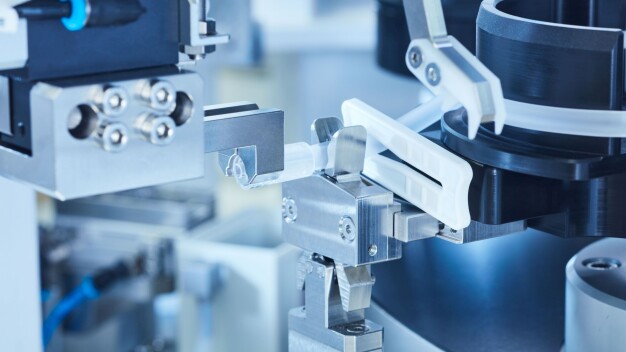
Assembly of medical disposable tube sets with the solution from Knoll Automation: One clamp is already inserted, and a Luer-lock end piece is currently being assembled. (Source: KNOLL Feinmechanik GmbH)
The automation experts at Ernst Knoll Feinmechanik GmbH have managed to fit all the traditional process steps required for the assembly of medical disposable items into their new system, on the smallest possible footprint. Especially when these systems – as is often the case – are installed in cleanrooms, every square meter saved is advantageous.
The assembly of medical disposable hose sets is often still done manually. Automating this process requires certain prerequisites. Firstly, hoses are classified as flexible parts, so handling and assembly automation require appropriate experience. Secondly, the assembly usually takes place in a cleanroom. These areas are many times more expensive than standard production spaces. "A recurring request we receive is: This area in the cleanroom is still free. Can you build a system there for us?" explains Matthias Ruh, member of the management and head of Knoll Automation. "This has shown us that we can support our customers precisely here: save space, save costs, and add value in the smallest area." Translated into system design, automation solutions are needed that reliably and verifiably assemble hoses along with other components, while occupying as little space as possible.
Everything needed included
The Knoll Automation team has repeatedly implemented its expertise in small spaces, gaining extensive experience in designing compact systems. Building on this, a standard system designed for minimal space requirements was developed. It measures 1.6 m x 1.6 m and accommodates up to six processing stations, each capable of performing multiple process steps. This allows for the assembly of standard medical disposable hose sets: uncoiling the hose, cutting, feeding, forming a coil, attaching additional components, or mounting them (with or without solvent). Based on this, the system can be adapted as needed, depending on the required process steps and space, doubling or halving its installation footprint.
Some customer-specific adjustments are unavoidable
Whether standard or not – each system is adapted to the specific conditions and the assembly group to be produced, and integrated into the process. This includes topics such as suitable grippers for the hose diameter or whether the hose is fed from a roll or a bundle, etc. "Additionally, we can provide process information that can be useful for validation or system monitoring if needed," says Ruh. "For example, during a fitting process, we can monitor the insertion or assembly depth via torque curves and image documentation."
From November 17 to 20, 2025, Knoll Automation will present its solutions at the Compamed in Düsseldorf.
Ernst KNOLL Feinmechanik GmbH
79224 Umkirch
Germany