

- Vertaald met AI
Kunststofonderdelen met CO2-sneeuw in een proces droog ontbramen en reinigen
CO2-sneeuwstraaltechnologie als efficiënt ontbramen
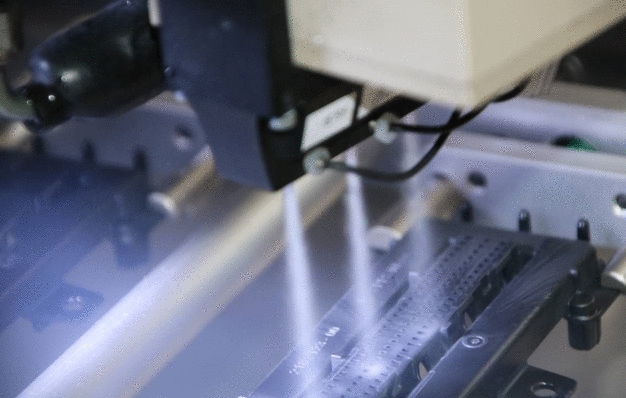
Harde en brosse kunststoffen zoals PEEK en PPS kunnen met de quattroClean-technologie in één proces worden ontbramd en gereinigd. (Beeldbron: acp systems AG) / With the quattroClean technology, hard and brittle plastics such as PEEK and PPS can be deburred and cleaned in a single process. (Photo source: acp systems AG)
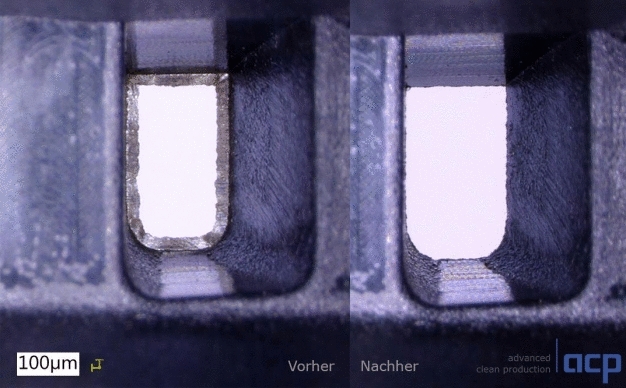
De na het spuitgietproces aanwezige rafels worden op een procesveilige en reproduceerbare manier verwijderd. (Beeldbron: acp systems AG) / The burrs on parts after the injection molding process are removed reliably and reproducibly. (Photo source: acp systems AG)
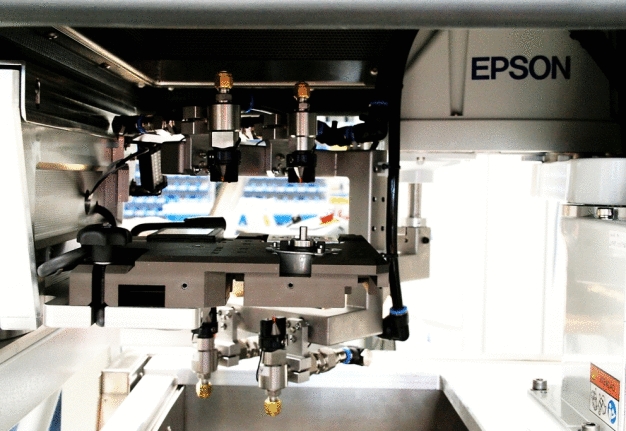
Afgestemd op de specifieke eisen aan ontbramen, reinheid en cyclustijd worden op maat gemaakte systeemconcepten ontwikkeld. Hierbij wordt het proces gelijktijdig van boven en onder uitgevoerd. (Bron afbeelding: acp systems AG)
Plastic components typically show flash after injection molding or mechanical processing. As an efficient and inline-capable deburring and cleaning alternative, the quattroClean technology of acp systems AG has proven effective for hard and brittle plastics such as PEEK and PPS. Deburring and cleaning are carried out dry in a single process.
Today, the use of plastics knows practically no limits. From medical technology, automotive manufacturing, and electronics to household and leisure sectors, polymer all-rounders enable innovative solutions. However, regardless of whether components are injection-molded or mechanically processed, residues on the surface must be removed to ensure high-quality further processing or flawless function of the parts and components. When it comes to burrs and residues from machining media, the quattroClean technology of acp systems AG offers an effective and efficient deburring and cleaning alternative for hard and brittle plastics such as polyphenylsulfide (PPS) and polyetheretherketone (PEEK).
Environmentally friendly, effective, and dry processing
The modular quattroClean system operates with liquid and practically unlimited shelf life carbon dioxide, which is produced as a byproduct in chemical processes and biomass energy generation. Therefore, the CO2 is considered environmentally neutral, non-flammable, and non-toxic.
For the deburring and cleaning process, the carbon dioxide is guided through the wear-free two-component ring nozzle of the quattroClean system, relaxes upon exiting the nozzle, and is transformed into fine CO2 snow. This is condensed into a ring-shaped jet of compressed air and accelerated to supersonic speed. When the highly focused, -78.5°C cold snow-jet strikes the surface of the part to be processed, a combination of thermal, mechanical, solvent, and sublimation effects occurs.
The deburring effect is based on two mechanisms: on the one hand, the shock cooling disperses the burrs. On the other hand, during the phase transition of the CO2 snow from solid to gaseous, there is about a 600-fold volume expansion. This creates micro-pressure waves that propagate at high speed. The resulting force is sufficient to remove burrs from the parts.
The combination of these four mechanisms results in an effective and homogeneous cleaning performance. It removes particle-like contaminants such as detached burrs, dust, and particles as reliably and reproducibly as film-like contamination, such as residues of release agents and silicones. Deburring and cleaning are gentle on the material, allowing even sensitive, very delicate, and finely structured surfaces to be processed.
Detached burrs and contaminants are removed from the surface of the component by the aerodynamic force of the compressed air and transported away by an integrated extraction system within the processing cell. Since the CO2 sublimates, the parts are dry after processing and can be immediately further processed or packaged.
Cost-effective solution – also for manufacturing integration
The scalable quattroClean process can be efficiently and space-savingly adapted to different component geometries and allows for partial or full-surface processing. Process parameters such as volume flows for compressed air and carbon dioxide, spray area, and spray time are precisely matched to the specific application, material properties, and the burrs and contaminants to be removed through trials in acp systems' technical center. They can be stored as part-specific programs in the system control.
Adjusted to the respective deburring, cleanliness, and cycle time requirements, acp systems develops customized system concepts based on standard modules, which can operate as standalone solutions or be integrated into production or linked in connected manufacturing environments. The latter enables the industry 4.0 capability of the quattroClean system. The system can be easily integrated into higher-level control units via standardized interfaces and operated accordingly. For comprehensive documentation and traceability, all process parameters are automatically recorded and transmitted to the control unit.