


- Transport
- Translated with AI
Why the drive technology makes the difference
Energy-efficient conveyor belts
Energieeffizienz_Wirkungsgrad
Energy efficiency doesn't start only with replacing a conveyor belt but with the question of how well drive technology, motor generation, and system design fit the respective application. Modernizing your conveyor technology can reduce energy consumption and optimize the profitability of the system.
With the TB30 and TB40 conveyor belts, Montech offers systems that rely on electronically commutated motors, combining energy-efficient design with high practical applicability. Many companies primarily evaluate conveyor technology based on its function: if the belt runs, it fulfills its purpose. However, from a technical perspective, this view is too narrow. A conveyor belt can reliably transport materials while working energetically inefficiently. Especially older conveyor lines were often planned under different conditions. Energy prices, CO₂ targets, and efficiency requirements did not have the same importance then as they do today. At the same time, maintenance efforts often increase with longer operational periods: components wear out, belt alignments need readjustment, and spare parts or service work become more complex.
The role of the motor in energy efficiency
The energy consumption of a conveyor belt is significantly influenced by the drive technology used. The primary factor is the motor type: mains-powered electric motors and electronically commutated motors differ in design, controllability, and efficiency. Examples of electronically commutated motors include BLDC motors. Traditional three-phase asynchronous motors can be operated directly from the mains or via speed control. Depending on the drive concept used, energy requirements for the same conveying task can be reduced. Electronically commutated motors enable demand-driven and low-loss power delivery, thereby reducing energy consumption. An upgrade lowers energy and maintenance costs. Modern conveyor belts benefit from optimized system design and can operate especially energy-efficiently—depending on the drive technology used. Energy consumption is only one aspect of overall economic efficiency.
Older conveyor systems often also incur higher indirect costs. These include more frequent maintenance, readjustments, downtime risks, and increasing efforts for service and spare parts. Upgrading to current conveyor line models can optimize these points. Modern systems use current components, are designed more efficiently, and can be better integrated into existing production processes. This not only reduces power consumption but also makes operations more predictable. This is crucial for production managers, as unplanned downtime usually costs significantly more than maintenance alone. When a conveyor system runs more stably, the risk of process interruptions and subsequent costs decreases.
Energy-efficient conveyor belts from Montech
For companies looking to reduce the energy consumption of their conveyor technology, Montech's conveyor line offers an efficient solution. The Swiss technology company has specialized for over 60 years in the industrialization and standardization of advanced conveyor belts, transfer systems, and aluminum profile systems. Its TB30 and TB40 conveyor belts are designed to reliably, precisely, and energy-efficiently support conveying processes. An important factor is drive technology with electronically commutated motors, which can offer significant efficiency advantages over traditional mains-powered electric motors.
Drive technology for higher energy efficiency
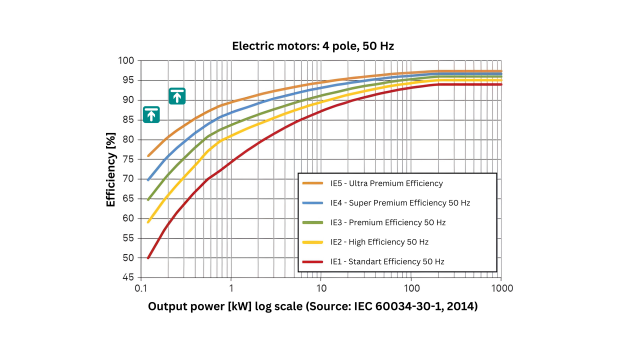
The BLDC motors in Montech's conveyor belts can achieve up to 25 percent higher efficiency than the minimum requirement IE2 compared to mains-powered electric motors. In the graphical comparison with IEC efficiency classes IE1 to IE5, the efficiencies of Montech's drives are above the IE5 curve. This addresses a crucial aspect of production: conveyor systems often run for many hours a day. The more efficiently a conveyor's drive operates, the greater the potential for energy savings over the entire operational period.
TB30 and TB40 conveyor belts: flexible solutions for various conveying tasks
The TB30 conveyor belt from Montech, due to its modular construction, is suitable for individual requirements in assembly and logistics technology and can be adapted to changing needs. This allows for precise design of conveyor routes tailored to each process. In contrast, the TB40 conveyor belt is particularly compact. The motor is integrated into the drive roller, enabling use even in limited space. It is powered by a 24 V BLDC motor and can transport loads up to 200 kilograms.
Energy efficiency as a technical and economic lever
Existing or older conveyor belts are not automatically inferior. However, they are often not designed to meet today's demands for energy efficiency, operational safety, and cost optimization. Modernizing existing conveyor systems can reduce energy consumption, lower maintenance costs, and improve system availability. Montech offers systems with the TB30 belt featuring brushless DC motors and the TB40 belt with integrated brushless 24 V BLDC motors that combine efficient design with high practical usability. Conveyor belts should not only be viewed as transport solutions but as active components of an energy-efficient and economically stable production process.

Montech AG
Gewerbestrasse 12
4552 Derendingen
Switzerland
Phone: +41 326815500
email: info@montech.com
Internet: https://www.montech.com