




- Buildings & Rooms
- Translated with AI
Marco Heufemann
When things get tight again ...
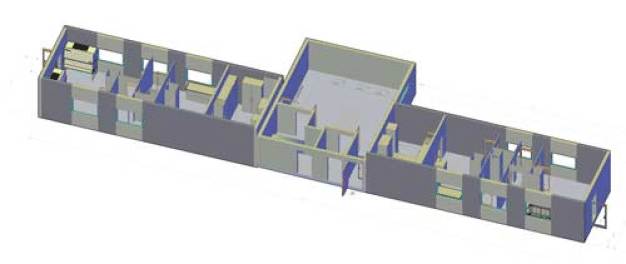
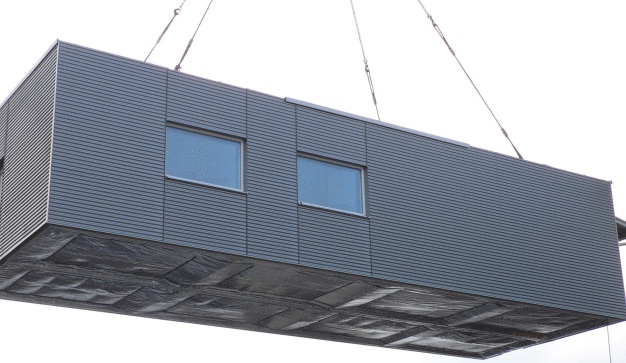
Unloading of a cleanroom module
Cleanrooms or laboratories lead to investments that are indispensable when the process or regulations require it. Therefore, all possibilities that are long-term and sustainably sensible should already be considered during the preliminary planning stage.
New rooms require the appropriate space. And not infrequently, the need for a cleanroom begins with a lack of space in the existing building. When searching for suitable premises, compromises are often made; existing room structures are dismantled, re-planned, or repurposed, or locations are found that are actually more than unsuitable environments.
If a more or less suitable site has been found, the usual internal planning process begins with adapting to the existing conditions. During this process, the next major technical questions often arise, which in turn involve new people in the circle of stakeholders. Two example questions that often occur in practice:
1) Is a ventilation unit necessary, or can the existing building technology be integrated? If not, where do you place the necessary technology, given the limited space?
2) Do penetrations cause problems in the structural integrity and fire protection concept, and which specialist can answer these questions?
Once such points and similar issues have been circumvented and mastered, a technically competent plan for the cleanroom is completed, and one often faces the next challenge: "Managing construction measures during ongoing operation, or better: managing the operation during ongoing construction."
Construction noise, dirt and dust, external personnel, obstructed corridors and areas, and unfortunately sometimes insensitive installers are the challenges that must be mastered.
Proving that it can be done more easily has been demonstrated by Kelvin GmbH from southern Germany for over ten years now. The decisive factor for a groundbreaking development was precisely this space problem of a manufacturer of medical implants (ISO and GMP regulations).
The only resource was the limited space in front of the company building. The time until commissioning played a major role. Overall, these were not factors that appeared on the builders' or executing companies' wish lists.
The conceptual solution on the tightest space in the shortest possible time to set up a turnkey, functional building with a fully enclosed cleanroom of classes ISO 7 and 6 was quickly found: Build – Load – Drive – Unload – Qualify – Produce. With the help of a strong partner company, a concept became reality in just 16 weeks.
This scenario was repeated at the aforementioned implant manufacturer. Eight more times, a cleanroom module of 70m² was delivered at a stretch. This corresponded to the growth rate of its product lines worldwide in just four years. This was the birth of turnkey cleanroom modules.
What technology is behind it, and what are the advantages and disadvantages of modular construction?
The advantages are clear. Small building blocks can be closed, the execution is customer-specific with small components, monitoring, media, and equipment, all thoughtfully designed and manufactured. Traditional building scaffolding is practically not used at all. And there is no longer any talk of a drawn-out planning and construction phase, because the entire service comes from a single source. The perhaps greatest interruption in the normal operation of the client occurs during delivery, because no one can escape the spectacle when a gigantic special transport arrives at the doorstep and is unloaded by an apparently even larger crane. When flashes of lightning illuminate a majestically rising building over the site, usually no more than four months have passed since the order was placed.
Where there is light, there must also be shadow. Every technology reaches its limits, and so the modular building is subject to certain restrictions. Road transport has clear limits, and thus a width of 5.5m, a height of 3.5m, and a length of 23m are initially the maximum. Because then you first have to navigate a 35m long special transporter around the bend.
If spatial requirements exceed these dimensions, you receive exactly as many segments as needed, which are connected on-site until the space requirement is met. If necessary, also multi-story.
Meanwhile, the "cleanrooms off the hook" have proven so successful that a second product line has been considered to meet an equally high demand. For a more affordable but by no means cheap variant, modified container structures form the basis. These structures must ultimately comply with standards such as EnEV, fire protection regulations, and customer-specific requirements after completion.
The practical difference is obvious. Road transport takes place on standard trucks at any time of day without the watchful eyes of escort vehicles and police escorts. Cranes are significantly smaller, and delivery times are further shortened. The downside here, however, is the completion phase on-site. Because what is delivered in parts must be assembled and finished on-site. But even here, there is no limit to the total area, only after the third floor does it become restricted.
A small exception in the portfolio is a standardized nine-meter-long container module, which, with a personnel lock and a cleanroom of up to ISO class 7, covers almost all application fields due to its all-round basic equipment. This module can be expanded by docking additional containers.
While large modular buildings and container modules can be handled via purchase or leasing, container modules can also be negotiated for return, especially if it is a temporary deployment.
The aforementioned standard containers even offer a rental basis.
Kelvin GmbH thus offers not only turnkey cleanrooms but also turnkey cleanroom solutions. Precisely when space becomes tight again.

Kelvin Reinraumsysteme GmbH
Gubener Straße 13 1/2
86156 Augsburg
Germany
Phone: +49 821 2070810
email: info@kelvin-rrs.de
Internet: http://www.kelvin-rrs.de



