- Science
- Translated with AI
When light hits matter: Kaiserslautern researchers visualize the efficiency of optical excitation in solids
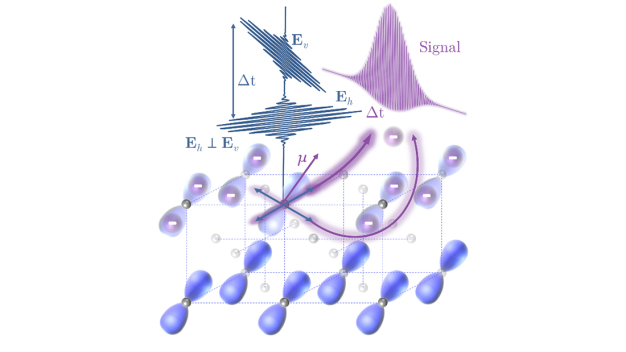
Optical excitation in the solid with subsequent interference of the photoemitted electrons. Below are the orbitals whose orientation with respect to the atomic positions (small white spheres) is responsible for the orientation of the transition dipole moments. The curves illustrate the optical excitations incident from above through two crossed pulses. Above that is the shape of the expected experimental measurement signal. (Photo: Nature Communications)
The interaction of light and matter is responsible, for example, for plants conducting photosynthesis and solar cells generating electricity. The efficiency of light absorption in matter is determined on a microscopic scale by so-called transition dipole moments. The research group of Prof. Dr. Martin Aeschlimann and Dr. Benjamin Stadtmüller at TU Kaiserslautern (TUK) has now developed a method to make the orientation of these dipole moments visible in solids. It is based on the coherent superposition of electrons that a solid emits via photoemission when optically excited. The results have been published in the journal Nature Communications.
How efficiently can light interact with matter? The answer to this question lies in two properties of the incident light: its color (wavelength) and its angle of incidence on the surface of the material. If light hits the material at an unfavorable angle, only a very small amount is absorbed. In other words, the light can hardly transfer its energy to the solid. On the other hand, there are directions of incidence along which there is extremely efficient light absorption in the material. This directional dependence of light absorption is described on the microscopic scale by the aforementioned transition dipole moments. These reflect the symmetries of the electronic states of the material and are thus also determined by its structure.
In dye molecules, such as those used in photosynthesis, the orientation of the optical transition dipole and the associated angle-dependent light absorption are almost fully understood. If such molecules have a particularly pronounced structural symmetry, for example through a linear chain of carbon rings, the dipole moment aligns along or perpendicular to this symmetry axis. If the electric field of the light is parallel to the dipole moments, it is absorbed efficiently.
In metallic or semiconducting solid systems used for energy harvesting in photovoltaics, this intuitive logic cannot be applied. The reason is that many electronic states overlap in these systems.
These challenges have now been overcome by the Kaiserslautern researchers. They analyzed the optical excitation on a silver surface using photoemitted electrons. The special aspect of the new approach is the experimental setup: instead of two identical light pulses, the scientists use a sequence of two light pulses with mutually perpendicular, "crossed" electric fields to investigate the sample. "With this special arrangement of the electric light fields, we were able to realize a very sensitive optical sensor for the orientation of dipole moments in materials," explains Tobias Eul, the first author of the study. "The orientation of the dipole moments can be more or less deduced from the height of the measurement signal for different alignments of the crossed laser pulses relative to the sample surface." The universality of this method was additionally confirmed through detailed numerical simulations.
As part of their experiment, the researchers made the transition dipole moments of two different optical excitation channels visible on the silver surface. They could also draw conclusions about the overlap of electronic states within the volume of the silver solid. Their method and the underlying theoretical considerations can therefore be generally applied to solid-state systems. This makes it possible in the future to gain further insights into the relationship between the symmetries of the structure of matter and the efficiency of optical excitation.
The work for this study was conducted within the framework of the Collaborative Research Center Spin+X ("Spin in its collective environment"), in which TUK, together with Johannes Gutenberg University Mainz, is funded by the German Research Foundation. The results of the measurements and simulations, as well as a description of the experimental setup, have been published in the renowned journal Nature Communications: "Coherent response of the electronic system driven by non-interfering laser pulses"; Tobias Eul, Eva Prinz, Michael Hartelt, Benjamin Frisch, Martin Aeschlimann & Benjamin Stadtmüller.
The English-language article is available free of charge: doi.org/10.1038/s41467-022-30768-9
Questions answered by:
Dr. Benjamin Stadtmüller
Department of Ultrafast Phenomena at Surfaces / TU Kaiserslautern
Tel.: 0631 205-2817
Email: bstadtmueller@physik.uni-kl.de
Technische Universität Kaiserslautern
67663 Kaiserslautern
Germany