

- Measurement
- Translated with AI

Dr.-Ing. Udo Gommel
Ventilation systems tested
First findings of the "Healthy Air Initiative"
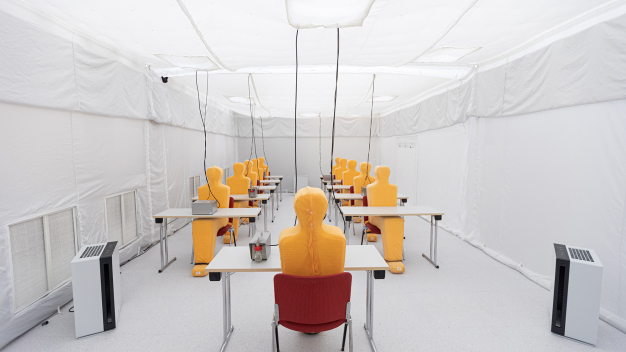
Ventilation systems in test © Fraunhofer IPA
Leading aerosol researchers agree: the greatest risk of infection with Covid-19 occurs in enclosed indoor spaces. Therefore, the following questions must be answered to prevent infection: Can ventilation and air purification systems protect against the virus? How must they be designed for this purpose? And how should hygiene and ventilation concepts be structured to reduce virus transmission through aerosols? Since February of this year, a research team from the Fraunhofer Institutes IBP, IGB, and IPA has been investigating these questions as part of the "Healthy Air Initiative" [https://www.initiative-gesunde-raumluft.de/].
"We are pleased with great interest from the industry," reports Dr. Udo Gommel from Fraunhofer IPA. So far, nearly 200 inquiries have been received at the advisory center of the "Healthy Air Initiative" regarding testing and consulting services from manufacturers (2/3) and users of air purifiers (1/4). About one-third of the inquiries resulted in consulting services, and two-thirds in technical evaluations under reference conditions. In addition to companies, engineering firms, authorities, and public institutions have also contacted us, mostly from Baden-Württemberg.
Conducting Tests of Air Purifiers
In addition to consulting services, a variety of around 40 products have been tested in the dedicated testing environment [Read more about this in the article "A Cape for All Cases"] at the Fraunhofer campus in Stuttgart. Most of the tested air purifiers are mobile devices that operate using various technologies to make airborne Corona viruses harmless to humans. They are considered quick-to-implement alternatives to fixed building ventilation systems. To filter particles (including aerosols) from indoor air, these devices often contain highly efficient suspended particle filters. These filters are sometimes combined with activated carbon filters, germicidal irradiation (mostly UV-C and far UV-C), ionization technologies (plasma irradiation), ozone treatment, or heating of the airflow.
Before analysis and evaluation, the submitted air purifiers are categorized based on their performance profile, operating principle, and requested service packages by the manufacturers. The evaluation includes the efficiency of virus removal, particle separation rate, noise emissions and sound pressure levels, as well as chemical byproducts such as ozone, VOCs, and aldehydes. The spatial analysis of aerosol dispersion in the room is conducted using up to twelve optical particle counters placed at different points and heights within the room. To analyze the influence of people in the room, who affect aerosol dispersion through their heat emission, specially prepared dummy mannequins are used in furnished real rooms.
Expert Paper in Progress
To draw conclusions about whether the use of air purifiers (generally and specifically) effectively contributes to reducing infection risk, extensive work is currently underway on cross-cutting testing procedures and standardized evaluation methods. These and other questions are being examined and assessed both theoretically and experimentally in an expert paper by Fraunhofer IPA and IBP. Over 600 literature sources have been researched so far, and various simulations have been conducted, which are currently being validated through comparison with empirical results. "Our goal is to ultimately provide consumers and users with the most representative and meaningful assessment possible," explains Gommel.
Free Air Purifier Evaluations Until the End of the Year
The research project of the "Healthy Air Initiative," in which device manufacturers and operators can receive cost-neutral or heavily subsidized services from Fraunhofer experts and infrastructures of the involved institutes IPA, IBP, and IGB, is only running until the end of this year. Both on-site consultations with companies and firms and via the initiative's hotline are free of charge for inquiries, as the Baden-Württemberg state government covers all costs in full.
For conducting air purifier evaluations in the testing and evaluation environments of the Fraunhofer Society in Stuttgart, there are no costs for companies and operators from Baden-Württemberg for the comparative cross-assessment either. If more detailed, company-specific documentation of the test results is desired for clear communication or device optimization, these can be prepared individually and budgeted accordingly. The temporary infrastructure of the approximately 100 m² testing environment will only be available until the end of the project in December of this year. "Device manufacturers still have the opportunity to contact us to have their air purification devices evaluated. We look forward to inquiries and the allocation of the last remaining testing slots," says Gommel.

Fraunhofer-Institut für Produktionstechnik und Automatisierung IPA
Nobelstraße 12
70569 Stuttgart
Germany
Phone: +49 711 970 1667
email: joerg-dieter.walz@ipa.fraunhofer.de
Internet: http://www.ipa.fraunhofer.de