- Cleanroom
- Translated with AI
The cleanroom - Technical cleanliness in assembly
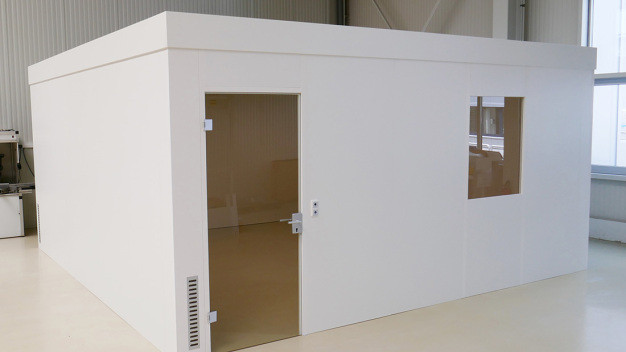
Cleanroom made from modular system walls (CleanEasyCell by SCHILLING ENGINEERING)
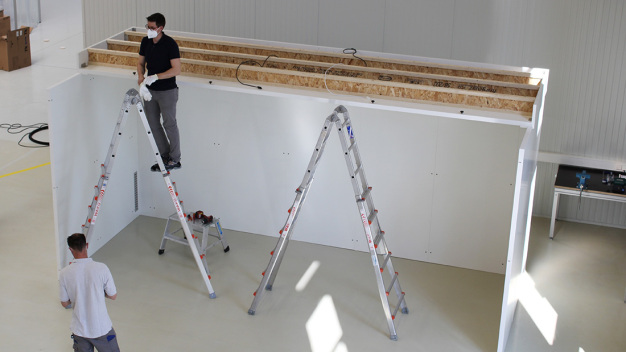
The video shows the construction of a cleanroom in time-lapse.
The production of sensitive products requires a high level of cleanliness in all manufacturing processes. Even the smallest contaminants can cause damage to the products and lead to high rejection rates. Many manufacturers therefore invest in cleanrooms.
A cleanroom is a controlled production environment in which contamination is avoided and cleanliness is monitored. The purpose of cleanrooms is to protect sensitive components and parts in industrial manufacturing from quality loss due to dust and dirt.
With "VDA 19.2 – Technical Cleanliness in Assembly," the Association of the Automotive Industry published a guideline in 2010 that serves as a helpful resource for re-planning or optimizing processes and procedures in cleanliness-sensitive assembly areas. The goal of this guideline is to assist users in avoiding critical particle contamination at sensitive points.
The guideline classifies different levels of cleanliness. Manufacturing in a "clean zone" requires lower purity standards than in a "cleanroom." The highest level of cleanliness is considered to be a "cleanroom."
Cleanrooms and clean zones primarily differ in the specification of permissible particle sizes. While in a cleanroom, airborne particles up to a maximum size of 5 micrometers are filtered out, the goal in a clean zone is to prevent contamination by particles with a size of 50-1000 micrometers. The permissible particle sizes are determined based on the specific product, with manufacturing methods and the nature of the product playing a decisive role.
As with cleanrooms, preventive measures are also taken in clean zones to prevent contamination and carryover caused by the transfer of materials and personnel. The basic structure of clean zones also differs little from that of cleanrooms. In both cases, a sealed, self-supporting room with integrated filter and ventilation systems is usually constructed. The number of airborne particles is reduced through filtered supply air.
Since the purity requirements in a clean zone are much lower and classified as the lowest cleanroom class, the construction effort for a clean zone is significantly reduced. Ventilation and filtration technology are much less elaborate, and often no climate control or airlocks are required. A very practical solution is the flexible construction of a cabin from modular system walls (e.g., the CleanEasyCell cleanroom from Schilling Engineering), but dry construction panels or existing rooms can also be converted into a clean zone. For the production of sensitive industrial components, clean zones often prove to be reliable and cost-effective solutions that enable a controlled environment without expensive cleanroom technology.

Schilling Engineering GmbH
Industriestraße 26
79793 Wutöschingen
Germany
Phone: +49 7746 927890
email: info@schillingengineering.de
Internet: http://www.schillingengineering.de