
- Company
- Translated with AI
Roche opens gene therapy development center in Penzberg: A key technology for the future of the Germany site
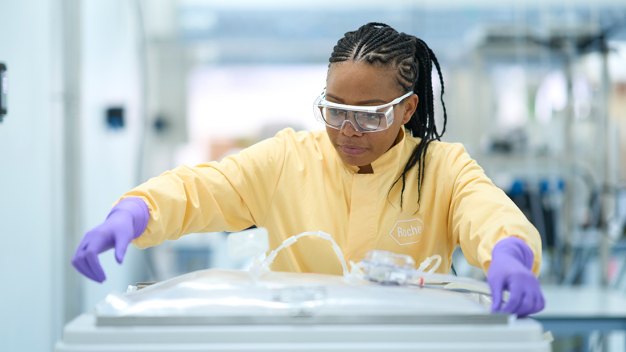
With an investment of around 90 million euros in a modern gene therapy development center, Roche affirms its commitment to the Penzberg site. In the future, approximately 100 employees will develop gene vectors for innovative gene therapies and produce them for clinical trials on approximately 2,500 square meters.
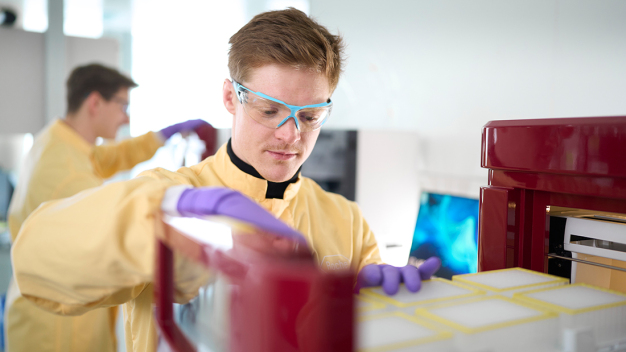
Gene therapy offers the tremendous potential to cure numerous serious diseases that are currently only inadequately treatable. In the future, on approximately 2,500 square meters, around 100 employees will develop gene vectors for innovative gene therapies and produce them for clinical trials on an industrial scale.
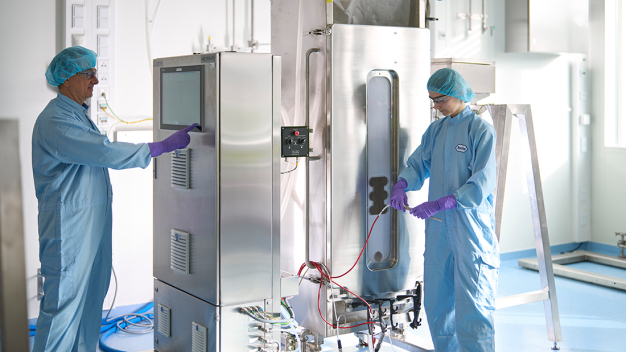
In the new high-tech facility at Roche in Penzberg, approximately 100 employees will develop gene vectors for innovative gene therapies on around 2,500 square meters in the future, as well as produce them for clinical trials on an industrial scale.
With a ceremonial event, Teresa Graham, Global Pharma Head of Roche, Prof. Dr. Hagen Pfundner, Executive Board Member of Roche Pharma AG in Germany, Paul Wiggermann, Plant Manager at Roche in Penzberg, and numerous employees of the company celebrated the official inauguration of the new gene therapy development center in Penzberg near Munich. The event took place on March 19th in virtual presence of Bavarian Prime Minister Dr. Markus Söder and internationally renowned representatives from science and research. With an investment of around 90 million euros, Roche once again affirms its commitment to the innovation location Germany and contributes to the federal government's "National Strategy for Gene and Cell Therapies." The company will develop highly innovative active substances for gene therapies, so-called gene vectors, at this site, and produce them for clinical trials.
Gene therapy is considered a key technology of modern medicine with enormous potential to cure numerous serious diseases. Roche therefore began planning and constructing the new gene therapy development center at the Penzberg site in 2021. In this high-tech facility, Roche will further advance the development of gene vectors for innovative gene therapies. Additionally, these will be produced here on an industrial scale for clinical trials. These gene vectors, also called "gene carriers," open up entirely new possibilities as transport vehicles for DNA, enabling the treatment and future cure of the causes of various serious diseases at the DNA level.
The new Roche gene therapy development center is currently unique in Germany. "In modern medicine, gene therapy is poised to trigger a revolution. Here in Penzberg, Roche will develop completely new and targeted therapies for patients using this technology," says Dr. Claudia Fleischer, Managing Director of Roche Diagnostics GmbH in Germany.
The federal government has also recognized the importance of this future technology. "Our investment of 90 million euros in Penzberg contributes to the 'National Strategy for Gene and Cell Therapies' of the federal government," says Prof. Dr. Hagen Pfundner, Board Member of Roche Pharma AG in Germany. He adds: "With our investments at various sites, we strengthen the value chains in the field of gene therapy in Germany — from technical development and production to national supply and export. In this area, Roche in Germany is becoming an international hub, supplying clinics worldwide."
A future technology for the Germany location
The goal of the "National Strategy for Gene and Cell Therapies" is to strengthen the Germany site in the international competition for the development of this important future technology. Due to the medical-technical complexity of gene and cell therapies, as well as the high investment sums and entrepreneurial risks, this field is particularly suited for a coordinated, interconnected approach between politics, authorities, science, healthcare, societal actors, and research companies. "I am very pleased that Roche has been part of the 'National Strategy' from the beginning," says Pfundner. "We are convinced that the innovation location Penzberg will be strengthened by this investment and our collaborations with academic and non-university institutions, benefiting Germany and Bavaria." Pfundner refers to the Bavarian Innovation Strategy, which already identified the Life Sciences and Health sector as a focus area in 2021. "The Bavarian state government recognized early on that a strategy for future industries in Germany is needed so that medical innovations are more frequently 'Made in Germany' again and we can strengthen our technological sovereignty."
A new and targeted therapy approach for patients
Many serious diseases arise from malfunctions or mutations in human genes. To treat these, DNA segments or therapeutic genes with correct genetic information are manufactured in the laboratory and inserted into the affected body cells of patients. Gene vectors, such as recombinant adeno-associated viral vectors (rAAV), serve as safe and efficient transport vehicles to deliver these DNA segments precisely to the cells that need repair. This way, gene therapies have the potential to permanently improve the course of diseases and thus significantly enhance patients' lives. The special aspect: a genetic defect can be specifically treated with gene therapy, so that not only the symptoms of a disease are alleviated but its cause can be directly addressed. Thus, gene therapies offer the possibility of entirely new treatment forms with the potential to cure diseases through a one-time treatment. "Gene therapy is still at the beginning of its possibilities today," says Fleischer. "Roche is continuously developing it with a consistently implemented innovation strategy so that it can realize its high benefit for patients who currently have no or only inadequate treatment options." This benefits families, relatives, healthcare, and society equally.
According to the American Society of Gene & Cell Therapy (ASGCT), more than 2,000 gene and genetically modified cell therapies were researched worldwide by the end of 2023. In the EU and thus in Germany, currently 15 gene therapies are approved (Source: Association of Research-Based Pharmaceutical Companies, VfA, February 2024). Roche's innovation strategy focuses on innovative, integrated gene therapy solutions for serious diseases with high unmet needs. Currently, Roche is researching in Switzerland and the USA with partners on new gene and cell therapies for patients with neurological, ophthalmological, hemophilia, and oncology conditions.
Roche Deutschland Holding GmbH
79639 Grenzach-Wyhlen
Germany