




- Temperature
- Translated with AI
Reference body for secure monitoring of blood products
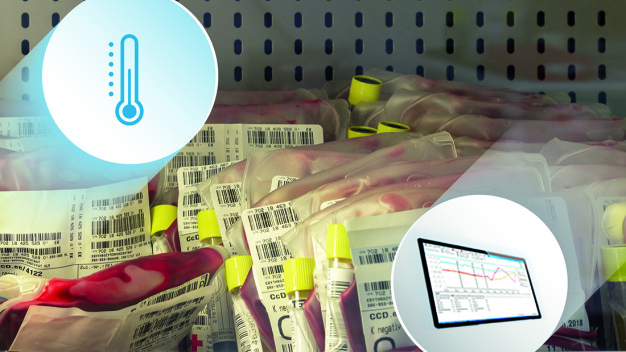
(Image rights ©PRILL Mediendesign - stock.adobe.com)
For the safe storage of blood products in refrigerators, the temperature within the product is crucial. A suitable reference body is needed for reliable temperature monitoring.
Blood banks and hospitals typically store blood in specialized refrigerators. According to standards, the blood products should be stored at four degrees Celsius ± two Kelvin. If this value is exceeded or fallen below, it can damage the product.
"Temperature fluctuations occur firstly due to the two-point control of the refrigerator, which switches it on and off continuously," explains Joachim Keller, qualification engineer at BRIEM Steuerungstechnik GmbH in Nürtingen near Stuttgart. "Secondly, staff repeatedly open and close the device's door to store or remove concentrates." The World Health Organization (WHO) states in a guideline that medicines – including blood products – must be stored with particular attention to temperature or relative humidity. Medical facilities should facilitate this, but also be able to verify, monitor, and record it.
However, this requirement is relatively vaguely defined, says the BRIEM expert. "Should the user monitor the storage conditions or those of the product?" The goal is the secure storage of blood products and thus the guarantee that they can be used without concerns. "From our perspective, the temperature within the product is decisive, not the ambient temperature," says Joachim Keller.
With different thermal properties
Since measuring inside the blood product is excluded for safety and hygiene reasons, users often only monitor the air inside the refrigerator in practice. However, due to the thermal properties of air, the user can only infer the temperature of the stored products imprecisely from this measurement. "While the air temperature changes through continuous switching on and off and opening and closing the cabinet door, the temperature of the blood product remains almost constant," describes Joachim Keller. "The thermal conductivity of air is about 20 square millimeters per second, compared to approximately 0.13 square millimeters per second for human blood." The propagation speed of temperature change in air is thus about 150 times faster. This means: in practice, the air in the refrigerator takes just under five minutes to warm from four to six degrees Celsius. The blood, however, takes about two hours and 45 minutes. Therefore, the temperature of the blood product does not match the air temperature inside the refrigerator during temperature changes.
The DIN 58371 blood product refrigeration devices precisely define how to monitor erythrocyte concentrations. In addition to the temperature controller, a safety device must be present, whose measurement sensor is located in at least one reference body, ensuring that the entire product still has the permissible temperature.
Which reference body is suitable?
And what properties must this reference body have? "The material should exhibit the same or a very similar temperature profile as the blood products to be cooled," explains Joachim Keller. The measurement results would then have high significance regarding the actual temperature in the product. BRIEM Steuerungstechnik conducted various tests to find the suitable material for the reference body. "For the test setup, we stored the blood products in a refrigerator operating at exactly four degrees Celsius ± two Kelvin with a net capacity of 130 liters. Six PT1000 sensors were used."
The blood product was in a 210-milliliter bag. BRIEM specialists inserted a sensor to directly measure the erythrocyte temperature. "For the reference body, we had various materials to choose from, whose thermal properties are very similar to blood," reports Joachim Keller. BRIEM decided on the liquids glycerin and propylene glycol, as well as the solid thermoplastic polyoxymethylene and aluminum. The sensors were also placed in the different liquids. The solids, on the other hand, were in block form, with the sensor inserted into a drilled hole. "To compare the different temperature profiles, we recorded all sensor data over the entire duration of the experiment with BRIEM monitoring software," describes Joachim Keller. The test lasted two days.
The temperature changes of glycerin and propylene glycol were each too high to serve as reference bodies for blood products. At the time of the greatest warming, the temperature difference was about one and 1.5 Kelvin, respectively. For aluminum, it was around 0.7 Kelvin during the same period. Much different, however, was polyoxymethylene. Its temperature profile is very similar to that of the blood product. "Using the sensor readings in the plastic block, we could determine the blood temperature with a maximum deviation of 0.3 Kelvin," reports Joachim Keller. During the period of the steepest temperature increase, the temperature curves almost overlapped. "Polyoxymethylene is therefore suitable for reliably determining the temperature of blood products without compromising product safety," explains Joachim Keller. Based on these findings, BRIEM Steuerungstechnik has incorporated the tested reference bodies made of polyoxymethylene into their product range.
Conclusion
Secure monitoring is possible. The storage temperature specified for blood products ranges between two and six degrees Celsius. For monitoring, the warning threshold could be set, for example, at 5.5 degrees Celsius. As soon as this value is reached in the reference body, a warning is triggered. "When this warning value is reached, the user still has about 30 minutes to take appropriate measures," says Joachim Keller. "This ensures they are always on the safe side."

BRIEM Steuerungstechnik GmbH
Lauterstraße 23
72622 Nürtingen
Germany
Phone: +49 7022 60920
Fax: +49 7022 609260
email: info@briem.de
Internet: http://www.briem.de



