




- Products, devices, systems, plants for applications
- Original text
Francesco Della Marca
Qualifying stability chambers under ICH Q1
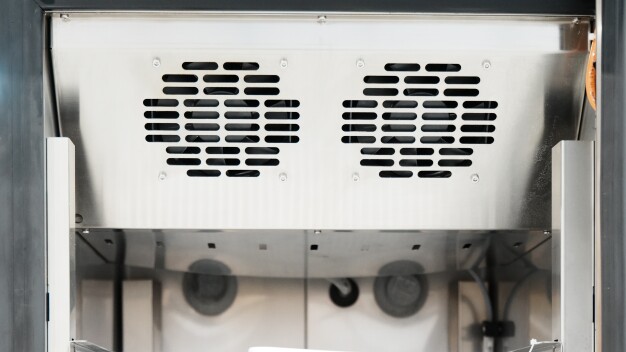
Upper part of the test space of a stability chamber, with the air-circulation fans behind the stainless-steel panel. © FDM Environment Makers
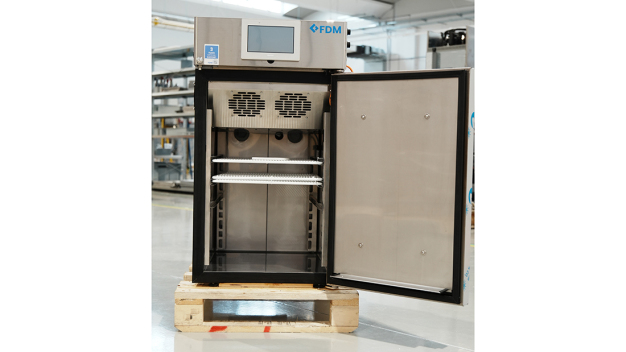
Compact climatic chamber for stability testing with the door open, showing the stainless-steel test space and adjustable grid shelves. © FDM Environment Makers
A stability study can run for years, and every data point depends on the chamber holding its condition for the whole of that time. ICH Q1A(R2) sets the storage conditions and their tolerances, but it does not say how a chamber proves that it can hold them. That proof comes from qualification, and much of it is decided inside the chamber: where the air flows, how the samples are placed and what happens when the door opens.
What the guideline asks of the equipment
ICH Q1A(R2) defines the conditions under which stability data for new drug substances and products are generated: 25 °C ± 2 °C / 60 % RH ± 5 % RH or 30 °C ± 2 °C / 65 % RH ± 5 % RH for long-term studies, 30 °C / 65 % RH for intermediate studies and 40 °C ± 2 °C / 75 % RH ± 5 % RH for accelerated studies. Products intended for a refrigerator are studied at 5 °C ± 3 °C, products intended for a freezer at −20 °C ± 5 °C. At submission, long-term data must cover at least twelve months, and the study then continues up to the end of the proposed shelf life.
What the guideline says about the equipment itself is brief. Its glossary states that the equipment must be capable of controlling the storage condition within the defined ranges, that actual temperature and humidity should be monitored during storage, and that short-term spikes due to opening the door are accepted as unavoidable. Excursions caused by equipment failure must be assessed, and those beyond the tolerances for more than 24 hours should be described in the study report together with an evaluation of their effect.
How that capability is demonstrated, with how many sensors and under which load, is left to the general GMP framework for qualification: in Europe, Annex 15 of the EU GMP guidelines.
From specification to performance
Annex 15 describes qualification as a sequence of documented stages. It starts with the user requirements specification and design qualification, and continues with installation qualification (IQ), operational qualification (OQ) and performance qualification (PQ). For a stability chamber, IQ confirms that the unit, its sensors, utilities and documentation match what was specified. OQ shows that the empty chamber reaches and holds the required set points and that the alarms work. PQ demonstrates that it does so in routine use, with a representative load.
The user requirements are where most later problems can be avoided. A specification that lists the conditions actually needed, the expected load, the sampling frequency and the monitoring and data requirements gives every following stage a clear acceptance criterion.
The set point is not the whole volume
A recurring source of misunderstanding is the meaning of the set point. The displayed value is the reading of the chamber's control sensor, which the controller uses to regulate heating, cooling, humidification and dehumidification. It does not mean that every position in the working volume, or every sample, is at that value at every moment.
Two quantities describe how the condition is distributed. Stability, or fluctuation, is the variation over time at a single point. Uniformity is the difference between points of the working volume at the same time. Data sheets usually give both, measured in an empty chamber, and reading them requires care: some reports express uniformity as the largest deviation from the centre point, others as the difference between the highest and the lowest reading. On the same chamber the second figure is larger. Before comparing a specification with the ± 2 °C tolerance of the guideline, it is worth asking which definition has been used.
Mapping: where and how to measure
EN IEC 60068-3-6, which deals with confirming the performance of temperature and humidity chambers, is a practical reference for mapping an empty chamber. It calls for at least nine temperature sensors, one in each corner of the working volume and one in the centre, and at least fifteen for chambers larger than 2,000 litres. Humidity is measured at the centre, and the values at the other points are derived from the local temperatures, on the assumption that absolute humidity is the same throughout the volume. After stabilisation, at least ten readings are taken at equal intervals over at least 30 minutes, and fluctuation, gradient and spatial variation are calculated from them.
For a stability chamber, mapping is carried out at the conditions that will actually be used, for example 25 °C / 60 % RH, 30 °C / 65 % RH and 40 °C / 75 % RH, rather than across the whole operating range of the equipment.
Empty-chamber results describe the chamber, not the study. Once samples are loaded, heat exchange and airflow change: dense loads obstruct the air, large masses take longer to stabilise and closed containers lag behind the air temperature. For this reason mapping is repeated in PQ with a representative load (IEC 60068-3-7 covers measurements in loaded chambers), and the load configuration is recorded and kept constant in routine use: shelf positions, distances from the walls and free space in front of the air inlets and outlets. A mapping report is valid only for the conditions it documents.
Door openings, recovery and excursions
Every sampling time point means opening the door. The guideline accepts the resulting spikes, but qualification should show how long the chamber needs to return within tolerance after a defined opening, and how much longer it takes when the chamber is full. Recovery depends on the air handling and conditioning capacity of the chamber and on the load, so it is best measured in the configuration used in practice. At 5 °C and below, defrost cycles of the refrigeration system can also produce short peaks, and mapping at these set points should include at least one complete defrost cycle.
Excursions caused by faults are a separate matter. To assess them as ICH Q1A(R2) requires, the monitoring system must make it possible to reconstruct the start, duration and size of each excursion. In practice this means continuous recording of temperature and humidity, alarms on high and low limits, and data stored in a form that can be retrieved for the study report. Where the records are electronic, EU GMP Annex 11 and, for data submitted in the United States, 21 CFR Part 11 add requirements on audit trails and data integrity.
Requalification and what comes next
Qualification is not a one-off event. Annex 15 expects equipment to be evaluated periodically to confirm that it remains in a qualified state, and changes such as relocation, major repairs, replacement of the controller or a new set point go through change control and may call for partial requalification.
The regulatory basis is also moving. ICH has prepared a single Q1 guideline that brings together Q1A to Q1F and Q5C; the draft was published in April 2025 and the final version is planned for December 2026. The draft includes 30 °C / 75 % RH, the condition for climatic zone IVb. Laboratories that expect to run this condition can already include it in their user requirements and mapping plans, rather than requalifying later.
Conclusion
A carefully qualified stability chamber gives quality assurance more than a certificate. It gives a documented picture of how the condition behaves across the volume, under load and after a disturbance, and that picture is what makes a data set collected over several years defensible.
Infobox: standards mentioned
– ICH Q1A(R2) – Stability testing of new drug substances and products
– ICH Q1 (Step 2 draft, April 2025) – Stability testing of drug substances and drug products
– EU GMP Guidelines (EudraLex Volume 4), Annex 15 – Qualification and validation
– EU GMP Guidelines (EudraLex Volume 4), Annex 11 – Computerised systems
– 21 CFR Part 11 – Electronic records; electronic signatures
– EN IEC 60068-3-6 – Confirmation of the performance of temperature/humidity chambers
– IEC 60068-3-7 – Measurements in temperature chambers for tests A and B (with load)
Guide to IQ/OQ/PQ qualification of climatic chambers: https://fdm-makers.com/en/chamber-qualification-established-iq-oq-pq-guide/
FDM Environment Makers
00071 Pomezia, Rome
Italy