- Battery
- Translated with AI
No gripper, no e-mobility
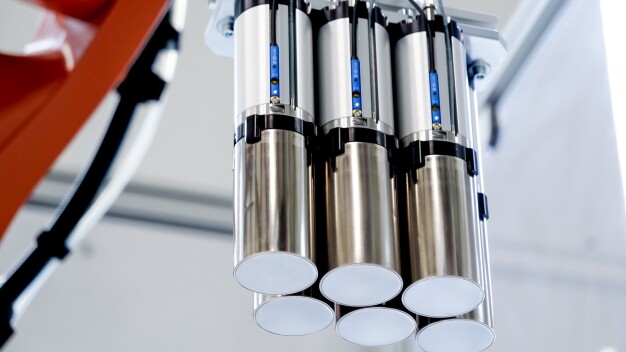
The magnetic gripper SGM-SV-BY moves round cells with a diameter of 46 millimeters both in cell production and in module assembly. (Image: J. Schmalz GmbH)
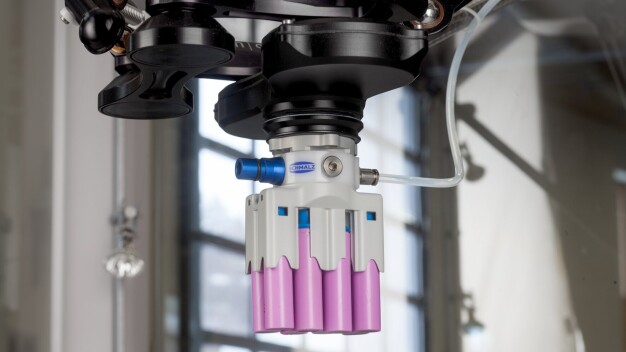
Thanks to modern 3D printing technology, Schmalz manufactures custom grippers starting from a batch size of one, tailored entirely to customer specifications. (Image: J. Schmalz GmbH)
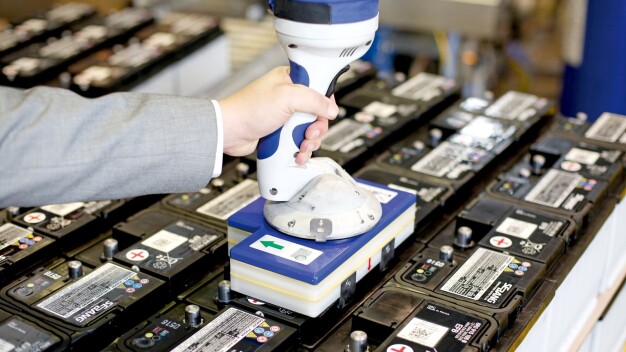
With surface grippers, large, heavy, and structured housing parts can be handled safely. (Image: J. Schmalz GmbH)
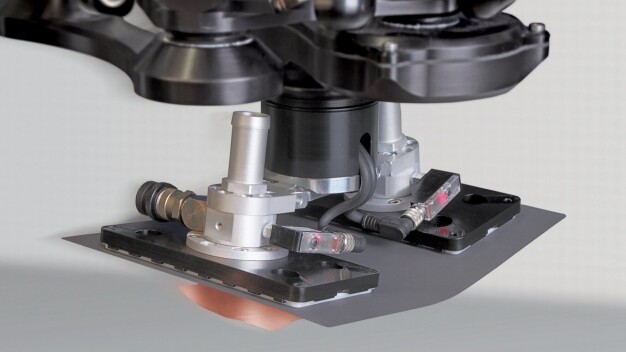
Special gripper STGG for fast and precise pick & place of thin electrodes and separators. (Image: J. Schmalz GmbH)
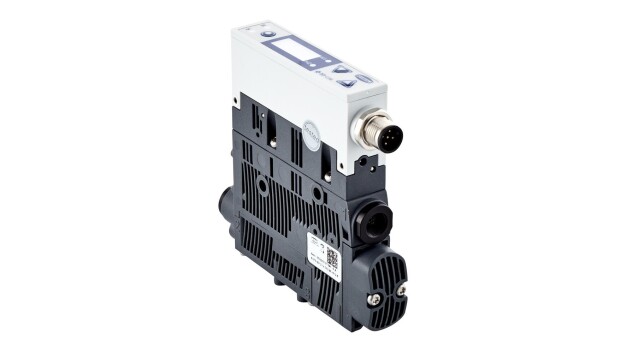
Thanks to integrated air savings control, the compact ejector SCPSi-BY operates particularly efficiently. (Image: J. Schmalz GmbH)

Patrick Schneider, International Industry Segment and Key Account Manager for Batteries at Schmalz in Glatten. (Image: J. Schmalz GmbH)
The battery is evolving into a key technology for the automotive industry. It determines range, costs, and competitiveness of electric vehicles. At the same time, pressure is mounting on Europe to develop its own production capacities. Schmalz offers highly precise vacuum technology, secure automation solutions, and efficient processes along the entire battery value chain.
The battery industry has recently experienced significant growth. However, depending on the region and metric, the growth rates vary considerably: individual markets like Germany have seen a massive increase over the past five years, and global production capacities have also expanded rapidly. At the same time, the development of new cell manufacturing facilities has recently slowed, mainly due to project delays, cancellations, and increasing market consolidation in Europe and North America.
Despite these short-term setbacks, the long-term outlook remains positive. Continued demand for batteries is expected in the coming years, driven primarily by electromobility, stationary energy storage, and industrial applications. By 2030, the share of battery-electric vehicles (BEV: Battery Electric Vehicle) in new registrations worldwide could reach about 30 percent or more, and in some regions, significantly higher. The growth remains strong but is somewhat more moderate in many current forecasts compared to earlier projections. Simultaneously, the demand for internal combustion engines continues to decline, albeit more slowly than in the most optimistic scenarios.
The market in China is developing particularly dynamically: by 2025, the BEV share of new registrations was already at a much higher level than in Europe. Chinese manufacturers are already looking at international markets and significantly expanding their export presence, while the ramp-up of many European projects still requires time.
The Race for the Key Technology: Battery
The battery determines the future of the automotive industry. It influences range, charging time, and costs of an electric vehicle. At the same time, it is becoming a strategic power factor for entire economies. Those who produce batteries secure industrial value creation, technological competence, and jobs. Europe is therefore under pressure. The continent must build its own production capacities if it wants to remain competitive globally.
“The battery is a key technology,” says Patrick Schneider, International Industry Segment and Key Account Manager for Battery at Schmalz in Glatten. “Depending on the model, it accounts for a significant portion of vehicle costs. For the European industry, this is about much more than just individual factories. It’s about resilience, supply security, and the ability to actively shape the mobility transition.” At the same time, the battery plays a central role in the European Union’s climate goals. Without widespread adoption of electric vehicles, decarbonizing transportation will be difficult to achieve.
Precision Determines Cell Quality
However, the path to high-performance batteries goes through highly precise manufacturing processes. This is where Schmalz comes into play. The specialist in vacuum technology views battery production as a continuous value chain: from cell manufacturing through module assembly to finished packs. Each step demands maximum accuracy, high safety, and efficient automation.
Cell manufacturing is particularly demanding. During stacking, anode, separator, and cathode are positioned exactly on top of each other. Even the smallest errors later reduce the battery’s performance, as electrodes are sensitive to pressure points or damage. Schmalz’s specialized surface and suction grippers move the components accurately and with minimal imprint.
Another often overlooked risk is metallic contamination. Tiny particles of copper, nickel, or zinc can impair the quality of a battery cell. Therefore, Schmalz has reduced these metals to a technical minimum in its ejector series SCPSb, SCPSc, and SCPSi-BY. This lowers rejection rates and increases process safety in sensitive production environments.
From Module to Heavy Battery Pack
Schmalz also relies on robust and practical systems for module and pack assembly. For cylindrical cells with a diameter of 46 millimeters, many manufacturers use the bistable magnetic gripper SGM-SV-BY. The technology works reliably and proves itself under demanding conditions. Additionally, there is the battery module gripper, a plug-and-play system that moves complete modules and inserts them from above into the battery case. This enables a particularly high packing density and potentially more range for electric vehicles.
The requirements continue to increase when moving entire battery packs. Schmalz offers systems ranging from manual handling to fully automated robot integration. Energy-saving functions in the ejectors also help reduce operating costs. Finished battery packs weighing up to 400 kilograms are transported reliably and precisely by specialized grippers.
Europe’s Opportunity Lies in Smarter Automation
Safety is of utmost priority. “There can be no compromises when it comes to batteries,” emphasizes Patrick Schneider. “Errors not only threaten production processes but also endanger people and equipment. That’s why Schmalz works with redundant vacuum supplies and develops systems for critical loads with maximum protection against failures.”
For Europe, this presents an opportunity. Asia, especially China, currently dominates battery production. However, European companies can leverage their strengths in intelligent automation, sustainability, and resource-efficient manufacturing. Every efficiently produced battery strengthens Europe’s industrial competitiveness and advances the mobility transition step by step.
J. Schmalz GmbH
72293 Glatten
Germany