

- 3D printing
- Translated with AI
Less CO₂ emissions, no toxic chemicals: Fraunhofer IPT develops a new process chain for functionalized thin glass
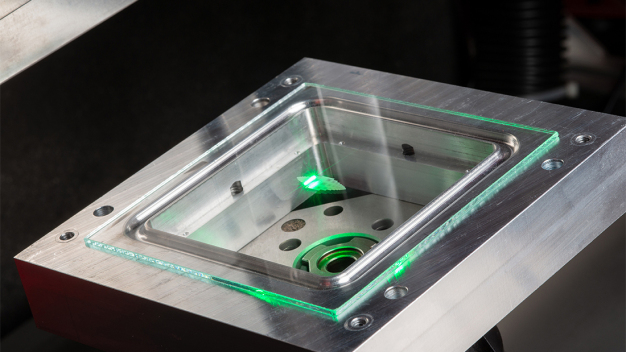
The Fraunhofer Institute for Production Technology IPT in Aachen, together with project partners, has developed a process chain for manufacturing 3D thin glass with functionalized surfaces. The process chain combines laser structuring with subsequent forming and reduces energy consumption as well as CO₂ emissions. The use of environmentally hazardous etching chemicals is also no longer necessary.
Thin glass can be used in a variety of applications. It is especially used where components need to be made thinner or of higher quality, such as for high-end components in automotive or parts in electronics, semiconductor industry, or sensor technology. In consumer electronics alone, more than one billion components made from thin glass are used annually, along with around 75 million units in automotive manufacturing, sensor technology, and architecture. A large proportion of these glasses feature intentionally added micro- and nanostructures on their surfaces, for example for anti-reflective coatings, controlling wettability, or for tactile feedback.
New process chain: First laser structuring, then forming
Currently, two main methods are used for surface structuring of thin glass: In industrial practice, chemical structuring is the most common. This method achieves good results but involves the use of environmentally harmful etching agents, such as hydrofluoric acid. The second method is replication through molding. Structures can also be introduced into the glass surface at very high temperatures using a mold tool while the glass is shaped into its final form. This method also yields good results. However, the production costs, raw material, and energy requirements are significantly too high to be economically attractive and ecologically sustainable.
In the research project "EffF3D," the Fraunhofer IPT developed and tested various process chains for the mass production of complex-shaped, functionalized thin glass. They consist of two steps: structuring flat glass blanks with an ultrashort pulse laser (UKP laser) and subsequent forming.
Laser structuring: High throughput using polygon scanners and UKP laser
The structuring of flat glass blanks is performed with the UKP laser and pulse durations of less than ten picoseconds. The low heat input allows for particularly gentle processing of the material, enabling the creation of micro- and nanostructures on glass that are effective visually and tactilely.
The project team tested two complementary processing concepts. In one, the laser beam is directed via two motor-driven mirrors. These mirrors are continuously accelerated and decelerated, which limits the processing speed. In the second method, the beam is deflected by a very rapidly rotating mirror with many small facets. Due to this continuous rotation, the laser can process large areas in a very short time. With both configurations, the researchers were able to produce anti-glare, anti-reflective, and anti-fingerprint structures.
Glass forming: comparison of different methods
To reshape the structured glass blanks, the researchers compared two variants of hot forming: isothermal and non-isothermal forming. In the isothermal process, the tool is heated together with the glass. This method achieves particularly high dimensional accuracy but has very long cycle times.
The non-isothermal process, developed at Fraunhofer IPT, separates the steps of heating, forming, and cooling. The glass blank is first placed on a preheated forming tool and then transferred into an oven. Due to its lower mass, the glass heats up faster than the forming tool and is shaped accordingly. Afterwards, the still hot glass is removed from the forming tool and cooled outside the tool. The tool is then ready for the next cycle. This approach allows cycle times of under 100 seconds per component.
Digital process monitoring and compensation of structural distortions
In the "EffF3D" project, various example components, including functionalized center consoles and windshields, were manufactured on series-like equipment. Since pre-structured glass blanks were shaped for the first time in this way, determining the optimal process temperature was a central challenge: it must be high enough to enable forming but not so high as to unintentionally affect the microstructures embedded in the glass. The researchers used various sensors, such as temperature sensors, for process monitoring.
The forming process alters the previously embedded microstructures. To ensure that the structures end up with the desired shape and position, the researchers developed a compensation method that uses computer simulations to predict the expected distortions in advance. These distortions are taken into account during the structuring of the glass blank, so that the correctly shaped structures are located at the right position after forming.
Life Cycle Assessment demonstrates the potential of the new process chain
As part of a Life Cycle Assessment (LCA), the process chains were analyzed based on key ecological criteria such as energy and material consumption. The analysis revealed that the combination of laser structuring and non-isothermal forming is very efficient regarding CO₂ emissions. Since both processes—laser structuring and non-isothermal forming—are fully electrically operated, their respective CO₂ emissions depend directly on the electricity mix used and will continue to decrease with ongoing decarbonization.
Project partners
– Fraunhofer Institute for Production Technology IPT (Coordination)
– Saint-Gobain Sekurit Deutschland GmbH, Herzogenrath
– FLABEG Automotive Germany GmbH, Nuremberg
– ModuleWorks GmbH, Aachen
– LPKF SolarQuipment GmbH, Suhl
– Vitrum Technologies GmbH, Aachen
Funding
The research project "EffF3D – Efficient Functionalization of 3D Shaped Thin Glass" was funded by the Federal Ministry for Economic Affairs and Climate Action (BMWK) within the framework of the 7th Energy Research Program of the German government.
Fraunhofer-Institut für Produktionstechnologie IPT
52074 Aachen
Germany