- Furnishing & equipment
- Translated with AI
Angelika Schimmel/OTZ
If it should be especially clean
Companies in East Thuringia
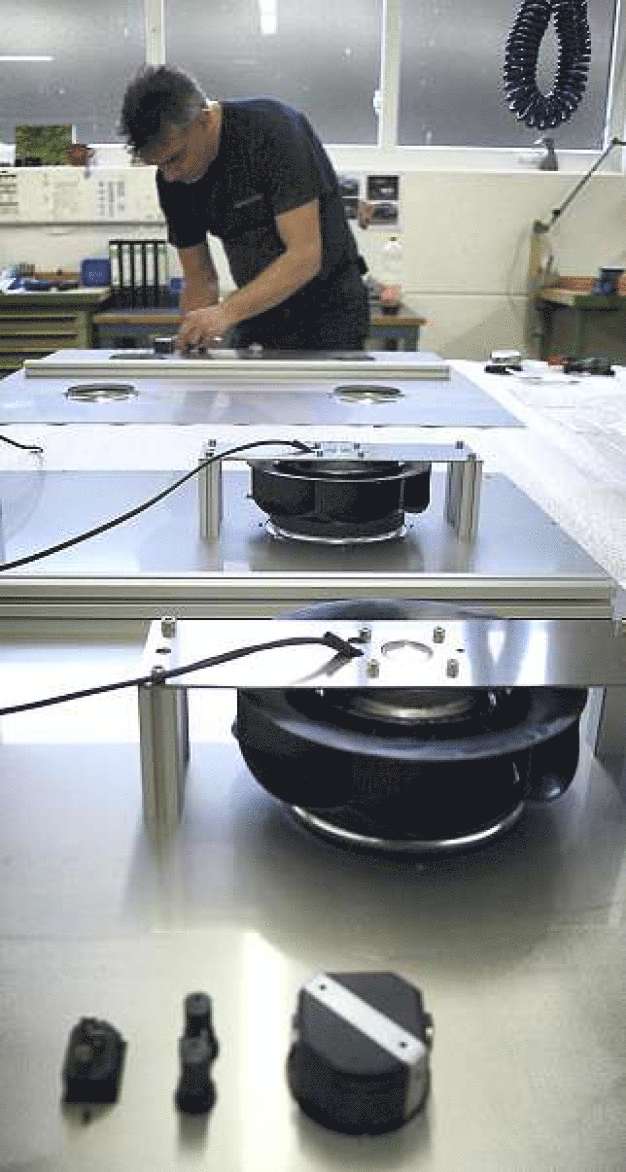
Andreas Voigt carries out assembly work. (Photo: Angelika Schimmel, OTZ)
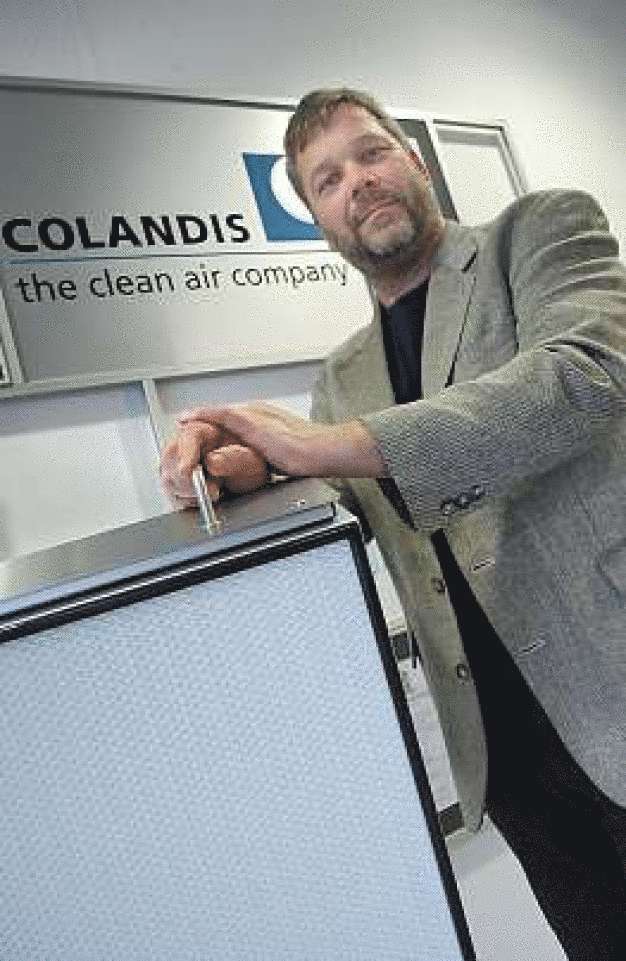
Colandis-Gründer and Managing Director Joachim Ludwig. (Photo: Angelika Schimmel, OTZ)
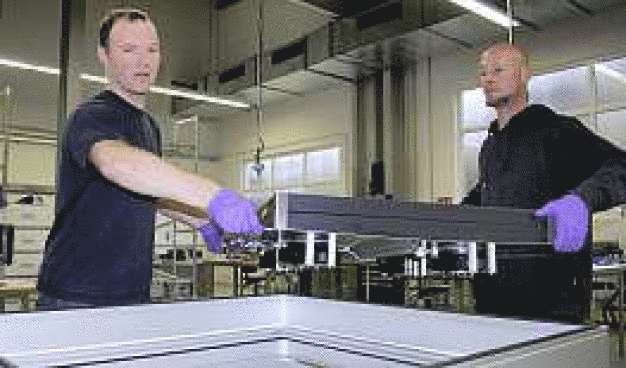
Torsten Sander and Ralf Kügler install a fan panel with a pre-filter. (Photo: Angelika Schimmel, OTZ)
It is not only the big names that shape and define the business landscape in East Thuringia. Many small, tiny, or medium-sized companies also contribute remarkably to the economy. Sometimes, even secret winners, known as Hidden Champions, are among them. The OTZ (East Thuringian Newspaper) features companies and service providers from East Thuringia weekly. On February 9, 2015, OTZ published a report about Colandis GmbH from Kahla.
The name Colandis sounds good. Not only to horse enthusiasts. Although the Westphalian stallion of the same name is quite successful in show jumping competitions, it has not yet achieved the same level of international recognition as Colandis GmbH. "Our name is also, in a way, a unique selling point," says Joachim Ludwig with a smile.
For what this small, medium-sized Thuringian company can do, it certainly deserves this quality rating. Because: Reiner can hardly be matched. Specifically, this refers to air—the air in a room that must meet special purity standards. For example, in the "backend" area of chip manufacturing, when ultra-fine gold wires are bonded onto microchips, or where micromechanical elements are mounted for tiny sensors. Every dust particle can become a dreaded grain of sand in the gear. Also, for some contactless control measurements, a dust- and particle-free environment is required. And exactly that is created by Colandis, the "clean air company," for its customers.
"Imagine a cube of one cubic meter containing ten particles of only 0.1 micrometers in size. Or better, take the Earth. If there are ten cubes of one cubic meter each hidden inside it—we find them. All ten," describes founder and managing director Joachim Ludwig what his products can do. The highest class of air purity.
In the manufacturing hall in the Im Camisch industrial park on the outskirts of Kahla, 26 employees design and build cleanroom technology, enabling customers from industries such as surface coating, optical industry, microsystem technology, biotechnology, or automotive industry to later test, produce, or package their products. "We have specialized in technical industry, medicine, pharmaceuticals, and food are not our topics," admits the 53-year-old managing director. "We are not among those who want to do everything."
Customized solutions according to customer wishes
The rooms that are cleaned with Colandis technology and equipment are very different. "We built a nine-meter-high cleanroom for a subsidiary of Airbus, into which a crane system had to be integrated," Ludwig recounts. That was quite a challenge. But a cleanroom from Colandis can also be as small as a typical microwave oven. "It always depends on what problem the customer wants to solve."
It is not always necessary to keep an entire room "particle-free"; sometimes, a local unit is sufficient, explains the expert. And so, the company also manufactures cleanroom modules and so-called mini-environments, in which processes can be conducted in isolation from the environment at the highest level of cleanliness. This also achieves cost savings, as the entire cleanroom does not always need to be maintained at the high required level of purity. The developers of Colandis have even designed a cleanroom tent that can be used anywhere where repairs to sensitive equipment parts are needed, but environmental conditions are unsuitable, and disassembly would be too costly.
"Our technical know-how, experience, and flexibility undoubtedly benefit us," says Ludwig. Instead of off-the-shelf products, he offers his customers very individual and specific solutions.
And the Kahla specialists for pure air have also found a practical solution for customers who only need a cleanroom for a limited time. They can rent it from Colandis. This high-tech product variant fits into two transport containers and can be set up where needed by two Colandis employees in less than half an hour. "Once the Colandis fans and filter technology are installed, the air in the rented room becomes pure in no time," he explains. Due to high demand, Colandis has now built the fifth rental cleanroom called "Clean air to go."
With this product and company philosophy, Colandis has established a good reputation among those who produce under cleanroom conditions. Both domestically and internationally, in Russia, the USA, or Malaysia. "In the past fiscal year, we achieved a turnover of 3.6 million euros, the highest we've ever had," Ludwig states proudly. Compared to 2013, this represents a 50 percent increase.
It was rather by chance that Ludwig came into contact with cleanroom technology. "When I started at Carl Zeiss in 1988 as a development engineer after my studies, not much was asked about where I wanted to go. I was assigned to PCB development—not exactly my dream area," Ludwig recounts. But then, a transfer to another department became possible. "There were different work areas offered, including cleanroom technology. I didn't know what it was, so I took it," he recalls. Ludwig then worked on tasks related to photolithography. "We already achieved the highest purity within a defined scope," he says.
Restart after the upheaval of reunification
But during the upheaval after reunification, it was also the end for the Zeiss employee Joachim Ludwig. With the "last wave of layoffs in 1995," he had to leave. He quickly founded an engineering office because he was convinced that cleanroom technology would play an increasingly important role. "In our Jena apartment living room, there were two large desks and a cutting board, where I designed the first solutions for customers. The children always found it exciting," Ludwig says.
Perhaps that’s why it was quite normal for his daughter Ina to join the family business after school and training. Today, she manages the customer and project department, while his wife Andrea Ludwig keeps the threads together in the office.
Initially, Ludwig managed the business alone. Then he brought in a former colleague, and gradually the staff grew. A garage and a 40-square-meter office were the next company stations, and two years later, they moved into a 200-square-meter facility. "And even there, it quickly became too small," reports Ludwig. The decision to build in the Jena-Maua industrial area was made in 2001. "We negotiated for a long time, but ultimately the project failed because the city did not want to support us," he admits.
The journey to Kahla was not far—"and there, we were treated very differently than in Jena," the entrepreneur recounts. "Mayor Leube personally opened the town hall door for us at 8 a.m. on a Monday, we presented our plans—and a week later, we signed the land contract."
With the company premises, the business grew step by step. However, Ludwig does not hide the fact that the financial and economic crisis of 2009/2010 also affected the Kahla company. Orders decreased, and employees had to be laid off.
During that time, the company established a second pillar as a service provider in the field of cleanroom suitability testing. The number of companies manufacturing materials or products used in cleanroom environments increased. And they must provide proof that their own products and materials are suitable for this purpose," Ludwig describes this service. "Cleanroom suitability is increasingly becoming a quality feature." Besides Colandis, there is only one other competitor capable of conducting the relevant tests and issuing a certificate—a Fraunhofer Institute in Stuttgart.
And Colandis has also ventured into a new business area: cleaning machinery and equipment. "A cleanroom is constantly cleaned—but the machines inside are often forgotten. Just think about how much dirt a computer fan attracts—and naturally, redistributes," he emphasizes. With a small vacuum cleaner, you cannot tackle this as easily as at home.
To be prepared for current and future tasks, Colandis trains apprentices. "Today, it’s not so easy to find suitable applicants," says Ina Henze-Ludwig. But the Kahla company has a lot to offer. Exciting tasks and challenges are also available for young people in other Thuringian companies. But free English courses and a weekly back school during working hours, where even the boss works out when he’s not abroad, as well as a company pension scheme, are already unique selling points.
And a businessman who invites his customers once a year and personally cooks for them is probably not so common either. Joachim Ludwig, however, did not use his culinary skills at the 2014 Mittelstand Prize. Still, he became a finalist.
COLANDIS GmbH
Im Camisch 34
07768 Kahla
Germany
Phone: +49 36424 76940
email: info@colandis.com
Internet: https://www.colandis.com