



- New building
- Translated with AI
How the cafeteria was transformed into a cleanroom
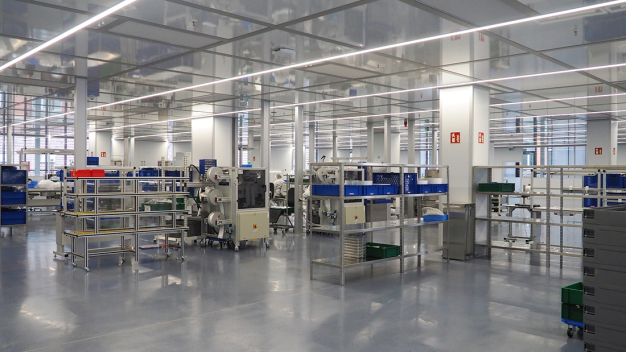
Quiet filter systems, bright lighting, and plenty of space create a good working atmosphere.
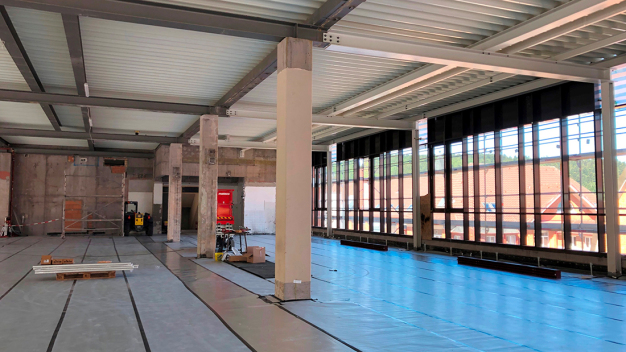
The former cafeteria on the 3rd floor has been completely gutted for the construction of the cleanroom.
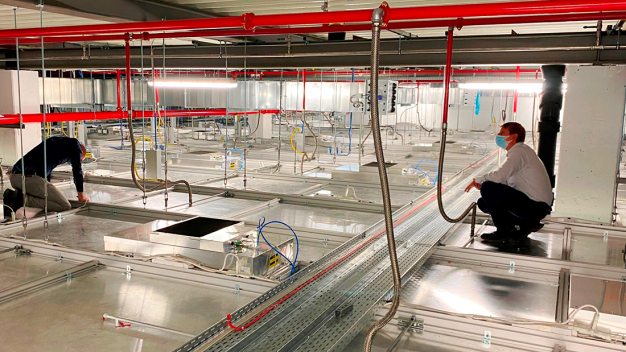
Through walkable ceilings, the media supply of the modular cleanroom can be adjusted during expansions without significantly interrupting production.
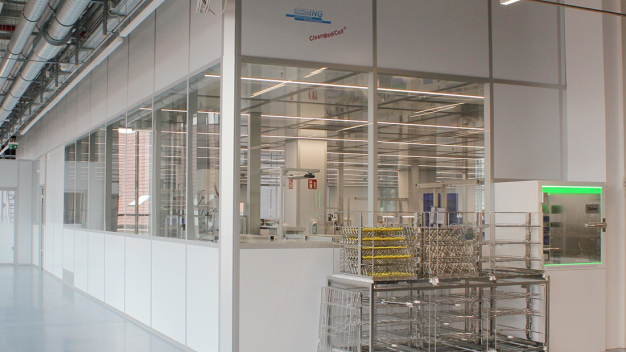
The CleanRoom CleanMediCell® in exterior view. On the right, a document pass-through with LED lighting.
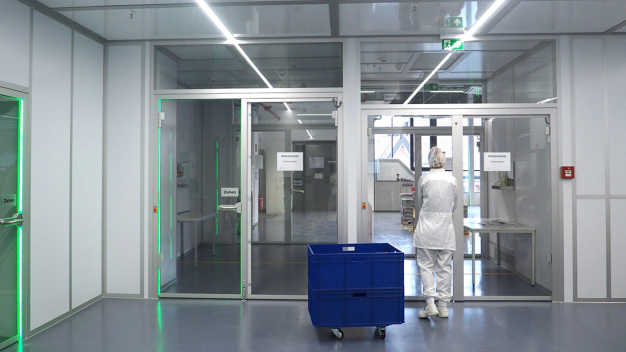
Parts delivered suitable for cleanroom use are introduced into the cleanroom through room-sized material sluices.
How a cafeteria became a cleanroom. The B. Braun subsidiary Aesculap commissions a new cleanroom after collaborating with the cleanroom company Schilling Engineering. The 1200 m² facility for the assembly and packaging of sterile surgical instruments and neurosurgical implants is the largest cleanroom at the company's Tuttlingen headquarters and is already designed for the future.
When you enter the premises of Aesculap AG, you feel a bit like taking a time trip. Or rather between two worlds. In one part of the premises, historic buildings with brick facades house state-of-the-art offices and production facilities. The family-owned company was founded over 150 years ago in Tuttlingen and has remained loyal to its location ever since. Aesculap has been part of B. Braun since 1976, one of the leading manufacturers of medical technology, pharmaceutical products, and services worldwide. With around 3,400 employees, Aesculap is the largest employer in the city, which is also known as the global center of medical technology.
1200 m² cleanroom with 88 filter fan units
Aesculap carefully preserves the old building structure. This requires the development of new occupancy concepts repeatedly. This is now also evident in the rooms of the former company cafeteria. Eating is now strictly prohibited there, and even speaking is minimized. Because the former cafeteria is now a highly modern cleanroom.
For the final assembly of sterile surgical instruments and medical components, Aesculap AG invested in the largest and most modern cleanroom system on the premises. Nearly 1200 m² of controlled environment was created to protect sensitive products from contamination during production. The cleanroom system achieves ISO classes 7 and 8 and is operated with 88 filter fan units, equipped with ULPA 15 high-performance filters for the intake and circulation of the purest air.
Pure production in three shifts
In the cleanroom, employees work in up to three shifts. Their protective clothing must never be removed, must fit properly, and sudden or quick movements should be avoided. Conversations are also minimized. All of this aims to reduce particle emission from personnel.
Ralf Ketterer, Segment Manager at Aesculap, is responsible for the smooth operation of the cleanroom production and knows that, besides technology, the staff are especially important for safe production: "Often, little attention is paid to the working atmosphere when planning a cleanroom. We deliberately wanted to change that, and our employees' feedback confirms it. Everyone feels very comfortable. The room is bright, the surfaces are optimally utilized, and it operates very quietly above all."
Modular system with expansion options
Before work could begin on-site, a long period of planning and remodeling was necessary for all involved. Initially, the rooms were completely stripped and expanded.
The new cleanroom is spacious and designed for growth. An expansion possibility has already been planned and equipped with the necessary connections. The cleanroom company Schilling Engineering was commissioned for detailed planning, delivery, and construction of the cleanroom. Thanks to the modularity of their self-developed system CleanMediCell®, requirements for future expansions can be met without extensive structural modifications. Media columns supply the large cleanroom with connections via the ceiling. During an expansion, the connections can be prepared in the accessible ceilings, so the cleanroom only needs to be briefly opened, minimizing production interruptions. For flexible expansion, the cleanroom walls were also double-lined, allowing easy installation of extended media supply through the walls. "We have planned the cleanroom for the next 10-15 years. About a third of the space is not needed yet. Thanks to the modular system of the cleanroom, we are very flexible here, which was very important to us," explains Ralf Ketterer.
LED signaling in personnel and material airlocks
In a cleanroom of this size, the entry and exit of personnel and materials are crucial. The gender-separated personnel airlocks occupy 165 m². Various material airlocks, designed even for transporting new machines and complete systems, ensure the safe introduction of materials at the same time. The finished parts are then transported via a conveyor belt with automatic sliding doors leading to a vertical feed shaft. The final packaging takes place outside the cleanroom on a lower level.
The material airlocks and entrance doors of the bright cleanroom feature a special characteristic. From a distance, you can see the green LED lighting, which signals that the system is operating without errors and that a door can be opened. If the airlock needs to be flushed after entry, the light turns blue; if a door is open, the intelligent lighting switches to red. Ralf Ketterer is convinced of this feature: "It actually makes entering and material loading easier because employees can see from a distance whether the airlock is free. I can even see the green light from other buildings, so I know everything is okay. It has become quite reassuring for me," says the segment manager.
Construction with distancing rules
The cleanroom system at Aesculap is so far the largest project undertaken by Schilling Engineering. Initially commissioned for engineering, the service technicians from the Swabian family business were able to be scheduled precisely according to plan after the order was placed and carry out the construction without delays. The large profile parts had to be brought to the third floor via a crane over the windows. After several months of intensive installation work, the cleanroom was handed over ready for operation with final qualification. Ralf Ketterer is fully satisfied with the entire process: "One must not forget that the construction began in March 2020, right at the start of the COVID-19 pandemic. However, Schilling's service technicians adapted flexibly to the new situations at all times and worked diligently to ensure the project was completed on schedule."

Schilling Engineering GmbH
Industriestraße 26
79793 Wutöschingen
Germany
Phone: +49 7746 927890
email: info@schillingengineering.de
Internet: http://www.schillingengineering.de