



- EDP, Hardware, Software
- Translated with AI
Historical heatwave endangers hard drives, SSDs, and smartphones – Attingo warns of hidden data loss risks

DI (FH) Markus Häfele
Austria and Germany are currently experiencing an extraordinary heatwave: On June 28, 2026, in Vienna-Innere Stadt, the temperature reached exactly 40.0 degrees Celsius, marking the first time in the 250-year measurement history of the federal capital that the 40-degree mark was surpassed. The following day, Bad Deutsch-Altenburg recorded 40.1 degrees – a new Austrian record for June. According to the German Weather Service (DWD), Neißemünde probably set a new record on June 28 with 41.7 degrees. What is already a stress test for people is often the beginning of the end for technical devices and their data carriers: hard drives, SSDs, NAS systems, and smartphones react to extreme heat with increased failure rates – risking the loss of irreplaceable data.
"On hot summer days, data recovery specialists are called to help up to twice as often," explains Markus Häfele, Managing Director of Attingo Data Recovery. "The current record temperatures drastically amplify this effect. What many don't realize: The permissible operating temperature for most devices is already reached at 35 degrees Celsius – and we have just significantly exceeded that."
Mechanical Hard Drives: Precision in the Nanometer Range Fails Under Heat
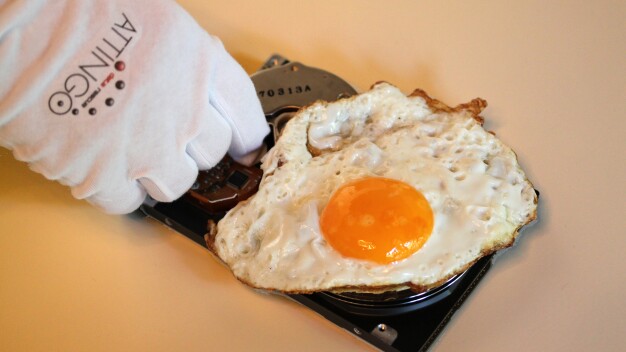
The interior of a magnetic hard drive (HDD) operates within a physical limit that leaves little tolerance for thermal influences. The read/write heads glide in normal operation just a few nanometers above the rotating magnetic disks – without ever touching them. Even minimal thermal expansion of metal components can alter this distance and lead to the feared head crash: the heads hit the magnetic layer, irreversibly destroying the data surface and leaving so-called "scratches" in the micrometer range.
An often underestimated secondary risk is also present: devices that still function under heat may fail after cooling because the expanded material does not return precisely to its original position when cooled. Write/read heads that were correctly positioned when hot can be permanently misaligned after cooling – the drive may no longer be recognized or only produce read errors.
"In these cases, our technicians can restore the data by precisely adjusting the write/read heads under a microscope in a cleanroom," explains Peter Franck, Technical Director at Attingo. "It is crucial that affected devices are immediately disconnected from power – any further operation after heat damage increases mechanical damage and complicates later recovery."
The specified maximum temperatures from manufacturers are often hardly known: For many external USB drives, a maximum operating ambient temperature of 35 degrees Celsius applies – a value easily exceeded in non-air-conditioned offices or parked cars on hot days like the current ones.
SSDs and Flash Memory: No Mechanical Damage, But Silent Data Errors
Solid-State Drives and flash memory in smartphones, tablets, and USB sticks have no moving parts – leading to the common misconception that they are more heat-resistant than HDDs. In reality, NAND flash cells respond to increased temperatures with altered charge distribution: sustained heat can cause stored bits to "drift" – meaning the charge held in floating-gate transistors changes thermally, which can lead to silent read errors that users only notice weeks or months later.
Furthermore, the error rate during writing increases at higher temperatures: ECC algorithms (Error Correction Code) in the flash controller can correct many of these errors, but above the operating temperature, the error rate increases disproportionately and eventually exceeds the correction capacity. The result can be corrupted files or – in particularly unfavorable cases – a total failure of the flash controller.
This situation is especially critical with modern 3D NAND memory: The stacked cell layers significantly increase the thermal density within the chip. Under load and simultaneous ambient heat, temperatures can rise to levels that significantly shorten the lifespan of the memory cells according to the manufacturer's specifications.
The Underestimated Extreme Scenario: Heat Build-Up in Cars
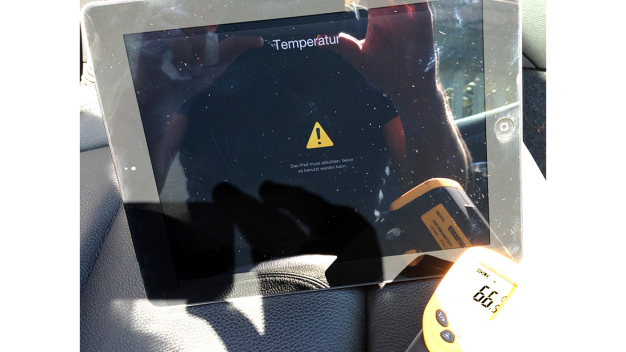
One of the most common causes of damage in summer is the careless leaving of devices in parked vehicles. A rule of thumb: Direct sunlight increases the interior temperature by about one degree per minute. With outside temperatures currently reaching 38 to 40 degrees – as measured in Vienna and Lower Austria in recent days – interior temperatures of 70 degrees or more are possible, and even higher on the dashboard due to direct sunlight.
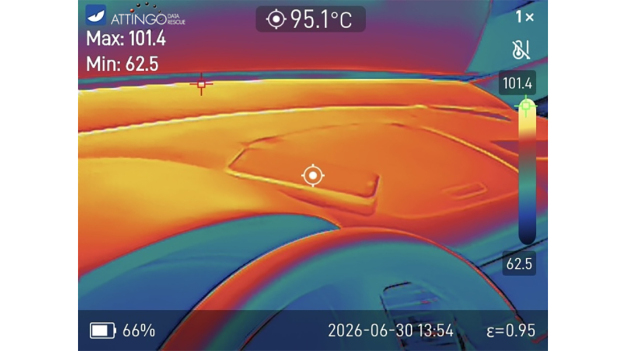
An internal infrared test measurement by Attingo showed temperatures of up to 90 degrees Celsius on car dashboards at noon. Hard drives and SSDs exposed to such conditions even briefly can sustain permanent damage – even if the device is turned off during exposure.
For smartphones, two additional damage mechanisms come into play: Lithium-ion batteries irreversibly age faster from 45 degrees Celsius; at around 60 degrees, chemical processes can initiate that, in the worst case, lead to thermal runaway – an uncontrolled chain reaction resulting in bulging, gas development, or in extreme cases, a battery fire. At the same time, NAND flash chips for internal smartphone storage are subjected to the same thermal stresses as standalone SSDs, with the difference that users receive no status information about the condition of the storage.
Corporate Infrastructure: The Silent Risk in Non-Air-Conditioned Server Rooms
Non-air-conditioned office and server rooms are more the rule than the exception, especially for small and medium-sized enterprises (SMEs). While a single hard drive failure in a RAID system can still be tolerated – as redundancy is designed for that – the simultaneous degradation of multiple drives caused by heat can cause a RAID group to collapse without the system warning in time. The combination of increased ambient temperature, aging drives, and lack of monitoring is a classic scenario for the high season of the data recovery industry.
"Particularly in summer, the number of our high-priority cases increases, where we work around the clock on very urgent data recovery cases," explains Markus Häfele. "Many companies do not realize that high temperatures can quickly disable their IT infrastructure. The result is often a shutdown – but we can often reduce downtime to just a few hours."
Immediate Actions in Case of Suspected Heat Damage
The most important thing first: Turn off the suspicious device immediately and disconnect it from power. Any further operation after heat damage increases mechanical damage in HDDs and can cause damaged areas in SSDs and flash memory to be overwritten. Under no circumstances should affected devices be cooled in the refrigerator or freezer – condensation (sweat water) caused by cooling leads to subsequent damage through short circuits, making data recovery significantly more difficult or impossible.
Attingo Data Recovery is available around the clock with high-priority service and can recover data in over 98% of cases – even after severe heat damage.
Preventive Checklist for the Heatwave
For Private Users:
– Never leave notebooks, smartphones, and external hard drives in parked cars
– Do not operate devices in direct sunlight (window sills, balcony, beach)
– Do not operate laptops on soft surfaces (couch, bed) – ventilation slots will be blocked
– Keep backups up to date – especially before vacations
For Companies:
– Monitor server room temperature – ideally below 25 degrees, maximum 30 degrees
– Clean ventilation slots on servers, NAS systems, and PCs with compressed air
– Have the air conditioning system in the server room checked before the heatwave begins
– Check RAID status and S.M.A.R.T. values of all drives
– Consider additional fans directly on critical drives
– Immediately turn off and disconnect defective storage devices
ATTINGO Datenrettung GmbH
22525 Hamburg
Germany