

- Storage technology
- Translated with AI

Rino Woyczyk
Farewell to the wrecking ball: Laboratories as material storage
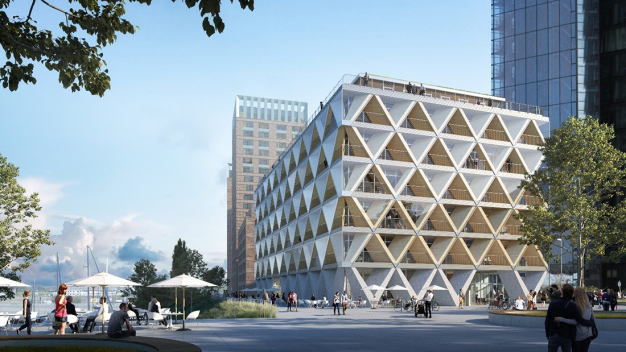
In the spirit of the cradle-to-cradle concept, The Cradle will serve as a material warehouse after its completion. © Interboden, HPP Architects, Visualization: bloomimages
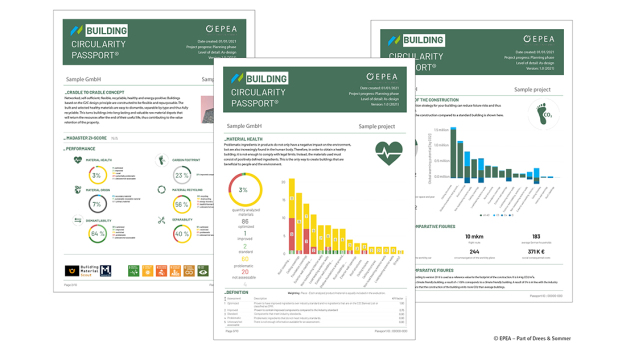
The Building Circularity Passports document all installed materials and products. This creates maximum transparency – and new assessment options for recyclability. © EPEA – Part of Drees & Sommer
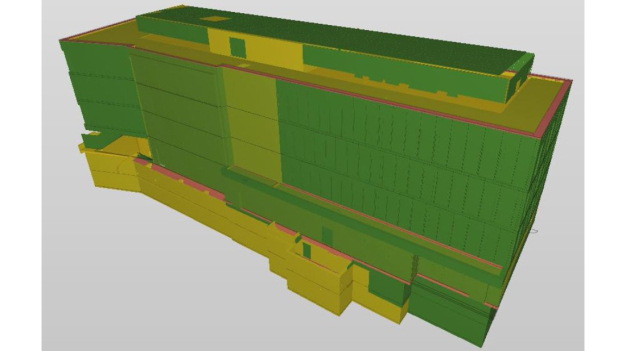
By visualizing the cradle properties in the BIM model, optimization potentials can be identified using a color scale. © EPEA – Part of Drees & Sommer
Rino Woyczyk © Drees & Sommer

Marcel Özer © EPEA GmbH - Part of Drees & Sommer
The life sciences industry is resource-intensive. Due to high standards in research and production as well as occupational health and safety, many consumables can only be used once. At the same time, awareness of resource conservation is growing in light of the climate crisis. The greatest potential for saving raw materials is not along the value chain – but in laboratory, production, and office buildings.
Of all industries, the construction and real estate sector has the greatest appetite for resources. Building consumes billions of tons of raw materials such as limestone, gravel, sand, gypsum, steel, and copper. Although materials like concrete can be partially recycled after demolition, most building products and laboratory equipment still end up as waste, despite containing a huge stockpile of raw materials. A shift in thinking – from a linear efficiency path to a circular economy – could allow these resources to continue being used.
Laboratories as Material Repositories
Cradle to Cradle is the design principle that enables a potentially endless cycle of materials. The structures and products used must be designed so that they are either fully biodegradable in the biosphere or – as is common in the construction industry – can be returned as nutrients into technical cycles.
This requires the right system and product design. Their chemical composition should ensure that no harmful substances enter recyclates or the environment later on. Which building products and materials are used, how ecological their footprint is, and what value the materials have are documented in a so-called Building Circularity Passport. Similar to an energy certificate, it contains all relevant information about the circularity of the installed products. When linked with a digital twin of the building, owners automatically receive a digital plan for later deconstruction.
Color scales reveal optimization potentials
This circularity certificate captures nearly every layer, door, and beam. To manage this amount of information, the data is ideally linked with the digital planning method Building Information Modeling, or BIM. Currently, this is done for the first time in the Düsseldorf hybrid wooden office building The Cradle: All information is digitally recorded so that the Building Circularity Passport can either be created directly from the BIM model or easily integrated into the digital twin. All materials are linked via an ID with associated component information and can thus be located at any time within the BIM model. Additionally, clear traffic light color scales help identify and evaluate different qualities. For example, if the simple separability of materials is not yet or not entirely guaranteed, the corresponding data set appears in red or yellow. Circular products appear in green. This allows all stakeholders to immediately see which elements already meet Cradle to Cradle standards and where improvements are needed. This not only simplifies planning and construction processes: when a laboratory or production building reaches the end of its useful life and is disassembled and reconstructed, a digital plan with all essential information is automatically available.
True circularity pays off
Investments in buildings designed according to the Cradle to Cradle principle may initially be higher than conventional buildings. However, when considering the entire lifecycle, these initial manageable additional costs pay off and can enable value increases of up to ten percent. This is because the capital tied up in building materials is no longer lost but is released again through reuse or deconstruction, similar to a medium- to long-term investment. The property thus becomes a material bank, whose value could continue to rise in times of increasing raw material scarcity – even above inflation. With registration on central online databases like Madaster, buildings are also connected to international raw material exchanges and sales platforms, allowing owners and auditors to see at a glance how the remaining raw material value of a building develops. Furthermore, repair, deconstruction, and disposal costs can be minimized.
Sustainability as a benchmark for economic success
Beyond these purely economic benefits, Cradle to Cradle is primarily about responsibility towards the environment and society. Climate change, rising CO2 levels, and increasing environmental pollution demand such innovative concepts. Decarbonization and resource conservation through the use of renewable energy and low-CO2 materials, as well as a focus on reusability and high recyclability, will continue to gain importance in the construction and real estate industry. Especially with the Green Deal and the associated ESG requirements, a “must-have” is emerging. To establish a true circular economy in the industry, it is not only manufacturers who are needed. Rather, the mindset of all involved must change so that the full potential of the Cradle to Cradle concept can be realized.

Drees & Sommer SE
Geisenhausenerstraße 17
81379 München
Germany
email: lifesciences@dreso.com
Internet: https://www.dreso.com/life-sciences