

- Translated with AI
Energy efficiency and safety
Energy efficiency and safety
Defined overpressures ensure product and process safety in cleanrooms. By supplementing the necessary pressure measurement with a flow sensor, such as the SS 20.400 from SCHMIDT Technology, energy efficiency in the operation of cleanrooms can be significantly improved through controlled adjustment of airflow.
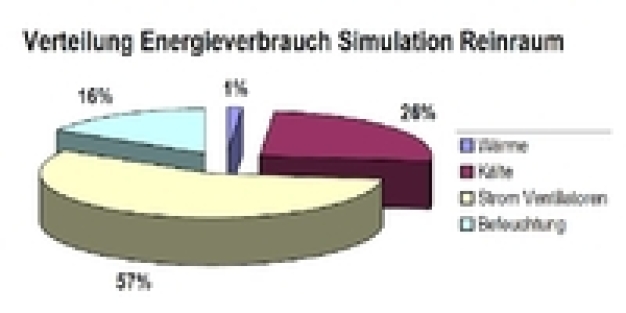
To realize pressure overshoots in cleanrooms, relatively high volumetric flows are usually required via the ventilation system. Not least for safety reasons and due to the pressures that can be reliably measured with differential pressure sensors, standards such as EN ISO 14644 specify pressure overshoots in the range of 5 to 20 Pascals. In pharmaceutical cleanrooms, these often even range between 15 to 30 Pascals or more. The air quantities needed to regulate the room pressure constitute a significant part of the energy balance of a ventilation system supplying cleanrooms. Practical experience shows that approximately 57% of energy costs are due to the power consumption of the fans. From this, it follows that the greatest energy-saving potential lies in adjusting the airflow to the actual need. To utilize this, it is advisable to reduce the room overpressure as close as possible to the minimum requirements of the standard and to keep it stably regulated with as little supply air, i.e., fan power of the ventilation system, as possible.
Reserve and Additional Safety
An additional flow measurement installed alongside pressure measurement, in a suitable wall opening of about 50 mm diameter, offers the possibility to measure a so-called excess flow, i.e., the air escaping from the cleanroom due to the prevailing overpressure, very accurately. The measurement ranges of modern flow sensors, such as the SS 20.400 from SCHMIDT Technology, start at flow velocities (WN) of 0.05 m/s. This is well below a differential pressure of 0.01 Pa and thus below the capabilities of a differential pressure sensor. Consequently, a flow sensor in an overshoot opening in the wall of a cleanroom can reliably detect excess flow even at very small differential pressures. Furthermore, SS 20.400 flow sensors from SCHMIDT Technology are capable of measuring flow directions bidirectionally, allowing detection of any backflow. The basis is a thermopile (thermocouple) sensor that operates on the principle of thermal anemometry. By wiring two semiconductor elements in parallel and determining which one is warmer, the flow direction can be reliably identified.
The thermal anemometry is described in more detail at http://schmidt-technology.testimonialsites.de/....
With precise detection of minimal airflow and bidirectional recognition, the flow sensors SS 20.400 are ideally suited for use in cleanrooms. In combination with existing differential pressure sensors, the operational safety of cleanrooms and, beyond that, their energy efficiency can be significantly improved. A simulation based on practical experience from AL-KO Therm, one of the largest manufacturers of components for ventilation and air conditioning systems, demonstrates that nearly halving the energy costs is possible.
Image: Even the power for the fans of the ventilation system accounts for 57% of the energy costs in the cleanroom (Schmidt Technology)

SCHMIDT Technology GmbH
Feldbergstraße 1
78112 St. Georgen / Schwarzwald
Germany
Phone: +49 7724 899198
Fax: +49 7724 899101
email: o.joos@schmidttechnology.de
Internet: http://www.schmidttechnology.de