

- Buildings & Rooms
- Translated with AI
Effective protection against coronavirus transmission in enclosed spaces
STZ EURO: Testing of air purifiers
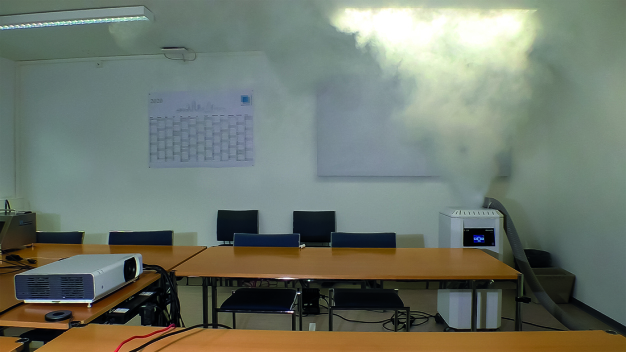
Figure 2: Flow visualization to depict the air dispersion and to check whether a short circuit is visually detectable. Air is drawn in at the bottom of this device and blown out at the top.
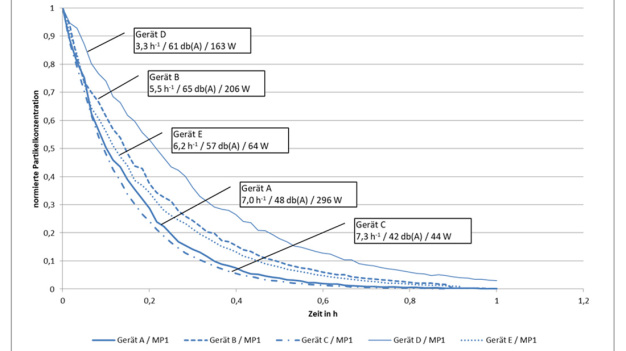
Figure 3: Course of particle concentration (≥ 0.5 µm) during the recovery time measurement. Additionally, the measurement values for air exchange rate, sound pressure level, and electrical active power consumption are provided (figure only available in web resolution).

Dipl.-Ing. (FH) Michael Kuhn, Head of the Steinbeis Transfer Center for Energy, Environmental, and Cleanroom Technology, Lecturer in Cleanroom Technology, and Chairman of VDI 2083-19.
The company F. Hoffmann-La Roche AG planned to purchase air purification devices for office and meeting rooms that lack mechanical ventilation in order to potentially reduce viruses present in the indoor air. The Steinbeis Transfer Center STZ EURO conducted a preliminary measurement analysis on five air purification devices with different filter configurations.
A suitable ventilation concept is an effective measure to reduce aerosol concentration in enclosed spaces, especially in view of the current COVID-19 pandemic. Essentially, air purifiers that operate on a recirculation principle and use special technologies to remove aerosols and viruses contained within them from the air are suitable for this purpose. Determining which devices provide optimal performance should be done through an independent manufacturer assessment by STZ EURO. The preliminary selection of devices was made by Roche.
The measurements were carried out in a selected reference room. The five devices were positioned sequentially in the room. Four of the five devices (B to E) are equipped with a suspended particle filter, while one device (A) has a high-quality fine dust filter. Devices A, B, and D also include UVC lamps, although the function of UV disinfection was not examined.
Based on advanced measurement technology with accompanying documentation, various measurements were performed: volume flow and sound pressure level measurements, including the measurement of electrical active power consumption at different speed settings, as well as a detailed recovery time measurement, during which DEHS aerosols were generated using an aerosol generator and evenly distributed in the room.
Finally, a visualization of the airflow was recorded using a test fog at the air outlet with a video camera. This allowed for a clear differentiation of how the supply air disperses in the room (see Figure 2).
The investigation showed that the selection of air purifiers depends on a variety of criteria. "From our measurements, we could conclude that the air purifiers did not reach the air volume flows specified in the technical documentation, except for one device (E). For the purpose of reducing aerosols in a meeting room, an air purifier should achieve at least a sixfold air exchange," said Michael Kuhn, head of STZ EURO, Offenburg. "Furthermore, no significant difference in the reduction of aerosol concentrations was observed between the device with fine dust filters and those with suspended particle filters."
The airflow visualization clearly demonstrates how the air distributes in the room and whether there are short circuits or drafts. Therefore, special attention should be paid to the placement of the air purifiers. The vertical blowing of supply air towards the ceiling proved to be ideal for the meeting room.
Apart from air purification, noise levels must also be considered. With a noise level of <50dB(A) combined with a sixfold air exchange, user acceptance for meeting rooms should be achieved. Only two of the tested devices met this requirement.
"The devices are a sensible improvement for rooms without mechanical ventilation," explains Michael Kuhn, and adds: "Of course, this is only effective if the AHA rules are followed, combined with sufficient outdoor air supply, ideally based on CO2 concentration measurements."

STZ EURO Steinbeis-Transferzentrum
Energie-, Umwelt- und Reinraumtechnik Offenburg
Badstraße 24a
77652 Offenburg
Germany
Phone: +49 781 20354711
email: mkuhn@stz-euro.de
Internet: http://www.stz-euro.de