- Clothing & Packaging / Films
- Translated with AI
Dipl.-Ing. (FH) Gabriele Schmeer-Lioe, Dipl. Ing. (FH) Hygienetechnik Margarete Witt-Mäckel
Early retirees? How long cleanroom wipe cloths can actually be used
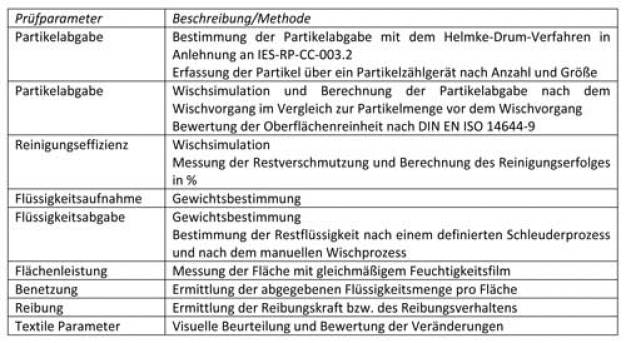
Overview of the test parameters and test methods
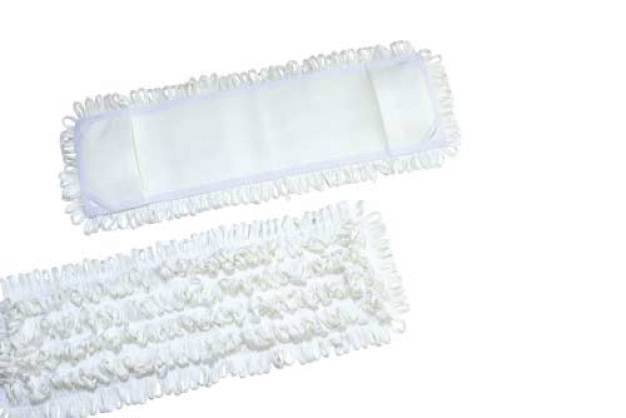
Fig. 1: Mop King GMP, close-up of the loops
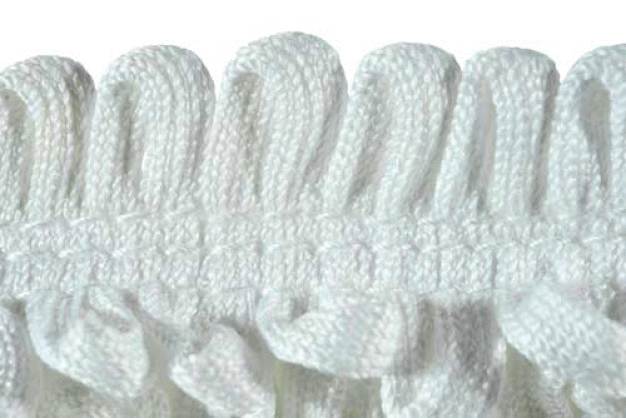
Fig. 2: Mop King GMP, close-up of the loops
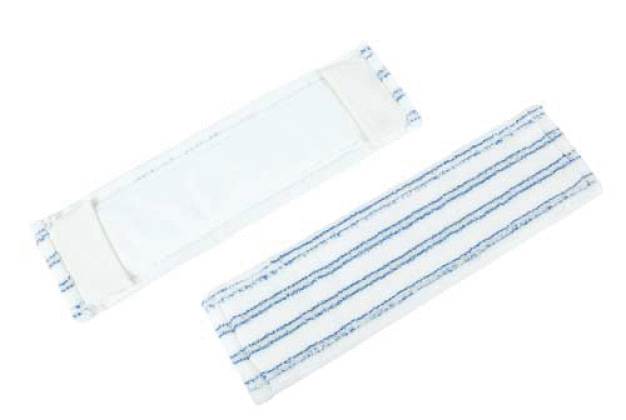
Fig. 3
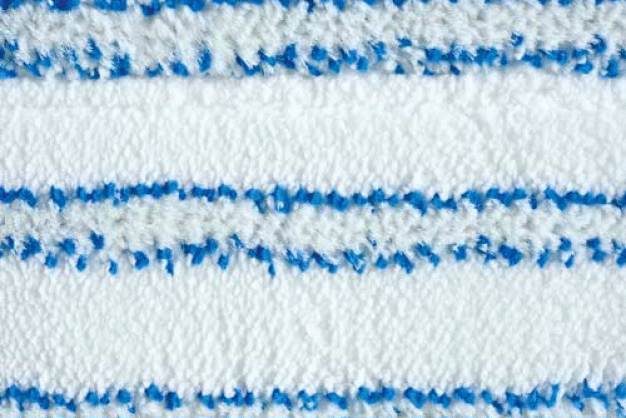
Fig. 4
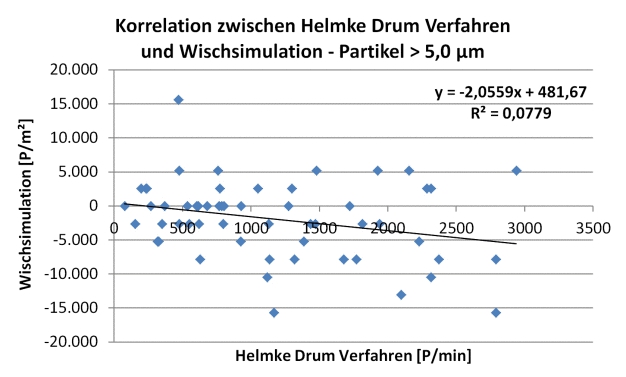
Fig. 5
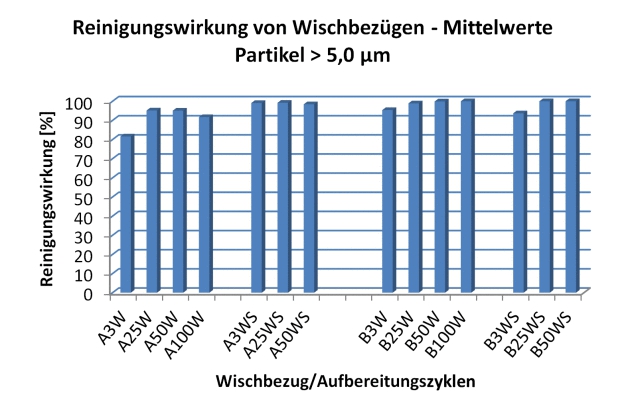
Fig. 6: Cleaning efficacy of the wiping cloths King GMP (A) and MicroSicuro CR/A (B) over the lifecycle; comparison between unsterile and sterile
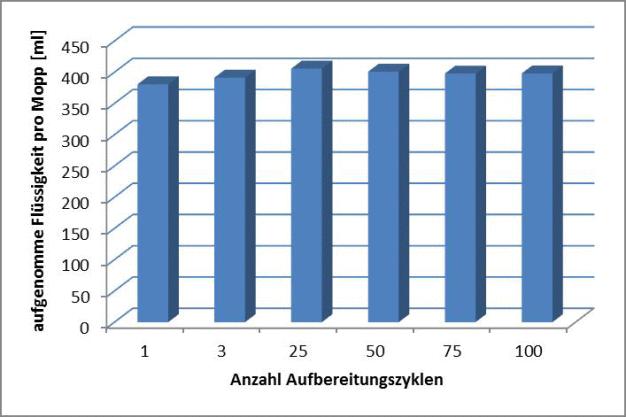
Fig. 7
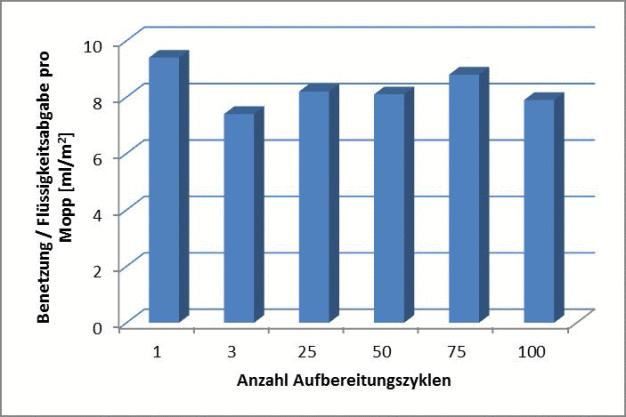
Fig. 8: Results of the surface wetting test after wiping with the MicroSicuro CR/A mop (sterile preparation): The liquid release in ml per m² is at the same level after 3 preparation cycles and remains nearly constant throughout the entire lifecycle.
Fig. 9
Highest requirements for product safety and product quality demand, especially in cleanrooms, defined production environments and special requirements for the operating resources and consumables used there. When operating resources and consumables are reused and reprocessed, the user naturally asks how long these materials can be reused. Depending on the type of operating resources and consumables, it is therefore necessary to define a period of use within which the preservation of the quality and functionality of these resources and materials can be assured.
Before making a statement about the period of use, the task of the operating resources and consumables, as well as the area of application and purpose of use, must be defined. From this, the necessary properties that describe the material are derived. These properties or parameters should not change, or only conditionally, over the period of use. If a significant change occurs, for example the loss of a desired function, the end of the period of use has been reached, i.e., the material is retired from service.
The recommendations for the usage period or lifespan of reusable wipe cloths have so far been based on experiential values from industry and internal quality checks by cleanroom laundries, due to a lack of analytical methods and evaluations. Many operators of cleanrooms in high-quality environments have therefore tended to retire textiles early.
Within the framework of an AIF ZIM research project, funded by the Federal Ministry for Economic Affairs and Climate Action based on a resolution of the German Bundestag, practical experience was tested to provide documented and quantified evidence of aging of reusable wipe cloths during unsterile and sterile reprocessing in cleanroom laundries. The goal of the practical test was to detect possible changes in the wipe cloths caused by the high load during washing and sterilization processes and by use, and to review and, if necessary, adjust the previous recommendations. In addition to testing methods known from the field of cleanroom clothing, other, as practical as possible parameters were defined and testing methods developed.
Definition of properties and testing parameters
First, the properties and thus the testing parameters were defined. These are based on the intended use of a wipe cloth in the cleanroom and describe the quality features that a wipe cloth must have to prevent impairment of the cleanliness level of the production environment as well as a loss of quality of the manufactured products. When setting the testing parameters, recommendations for cleanliness suitability according to VDI 2083, Sheet 9.2, were taken into account.
The defined parameters were tested throughout the entire lifecycle, and the results were compared over this period to detect possible changes due to aging, especially through reprocessing. A significant deterioration would mean that the cloth can no longer be considered suitable for the reprocessing process, and the endpoint of reprocessing has been reached.
Conduct of the investigation
The aging of the wipe cloths and thus the determination of their lifespan were carried out in a practical test. The reprocessing of the wipe cloths was performed in a validated washing and sterilization process in a specialized cleanroom laundry. The test samples were processed not separately but under the generally usual conditions for cleanroom wipe cloths. To capture the load during use, the cloths were used in the cleanroom and then reprocessed. The application took place in ISO 6 or GMP C cleanroom conditions under typical contamination (contaminants from humans such as skin particles and germs, fibers from clothing, residues from disinfectants and other dirt accumulated during operation) and using a disinfectant based on glucoprotamines. The cloths were moistened according to the pre-preparation method EasyMop GMP.
Two reusable cleanroom wipe cloths from Pfennig Reinigungstechnik GmbH, which have been successfully used on the market for several years, were selected as test samples. These are a so-called loop mop, consisting of longer, closed loops [Fig. 1], and a low-pile cloth, whose wiping surface is made of microfiber velour with brush strips [Fig. 2]. Both cloths are made of 100% polyester microfiber. The previous recommendations for reprocessing both cloths are 50 cycles for sterilized reprocessing and 100 cycles for non-sterilized reprocessing.
Both cloths were reprocessed non-sterile (washing) and sterile (washing and autoclaving), and both reprocessing methods were analyzed separately according to defined reprocessing cycles. The analyses were conducted by the Institute for Textile and Process Engineering Denkendorf (ITV). These investigations included, in addition to known tests for cleanroom clothing, further developed testing methods within the project. The laboratory examinations at ITV were supplemented by practical tests conducted by Pfennig Reinigungstechnik GmbH and by project work at the Hochschule Sigmaringen, Department of LEH, supervised by Prof. Dr. rer. nat. Gerhard Winter.
Description of the testing parameters
Particulate emission
Textile consumables such as wipe cloths release fibers and fiber fragments due to their base materials. The critical factors for use in the cleanroom are the size and quantity of particles released. Due to damage to the textile fibers caused by the high load during washing and sterilization processes, an increase in particle emission due to fiber fatigue is expected.
Depending on the purpose of use, particle-free operation during wiping cannot be ruled out. The mechanical application, friction between textile and surface, can lead to abrasion and thus particle generation depending on the material properties. It must be taken into account that the wipe cloth is usually moistened during use. The liquid binds the fibers and fiber fragments of the textile, preventing their release into the environment.
Cleaning efficiency
The task of the wipe cloth during cleaning is to loosen and completely remove contaminants from the surface through the interaction of active substances and mechanical removal. To evaluate cleaning efficiency, the proportion of the original contaminants remaining on the surface after wiping is measured, and the percentage cleaning success is calculated. This investigation also records the possible release of unwanted particles during the wiping process.
Application-related parameters
Under this term, the features of liquid absorption capacity, liquid release, and wetting, as well as the associated surface coverage, are summarized. Especially for inactivating microorganisms and removing contaminants, an even application of active substances on the surface is a prerequisite. Therefore, it is necessary that the cloth not only absorbs sufficient liquid but also releases it as evenly as possible. Interactions between textile and chemicals, including adhesion of active substances, must be considered.
Friction
The friction behavior influences cleaning efficiency and can affect the cleaning process due to changes in textile structures caused by reprocessing.
Textile parameters
The functionality of a wipe cloth depends critically on the textile structure of the wiping surface and the fibers. Mechanical, thermal, and chemical stresses during use and reprocessing lead to fatigue of the textiles and thus to deterioration of properties. Changes include, for example, roughening of the wiping surface, color changes, staining, and stiffness.
Test methods
The development of test methods and the establishment of evaluation criteria for the defined parameters serve in this project to determine changes over the lifecycle and to assess aging. Since standardization of the framework conditions is essential for comparison and the analysis results always refer to these standard conditions, users are always responsible for conducting suitability and compatibility tests for their specific application conditions.
Overview of testing parameters and methods
(see Table 1)
Conclusion
The test results confirmed that reusable wipe cloths for use in the cleanroom do not need to be retired early, but the recommended retirement age still applies. This means that the previously recommended cycles for the tested wipe cloths are valid under the defined standard conditions.
With this practical test, for the first time, statements and analyses about the aging of reusable wipe cloths for use in the cleanroom are available. The assertion that reusable cloths experience performance losses due to multiple reprocessing can be clearly contradicted. Furthermore, the user now has, in conjunction with the validated and batch-documented reprocessing processes of the cleanroom laundries, comprehensive process safety that meets the high requirements for documentation and validation. Through this investigation, not only can the preservation of quality and functionality of the reusable wipe cloths over their entire lifecycle be confirmed, but also the advantage of their significantly superior performance compared to disposable cloths can be demonstrated.

Pfennig Reinigungstechnik GmbH
Heubachstr. 1
87471 Durach
Germany
Phone: +49 831 561220
Fax: +49 831 61084
email: info@pfennig-reinigungstechnik.com
Internet: http://www.pfennig-reinigungstechnik.com