




- Science
- Translated with AI
Dust particles from the edge of the solar system on TU roof
Origin of micrometeorites determined for the first time using complex computer simulations and experiments.
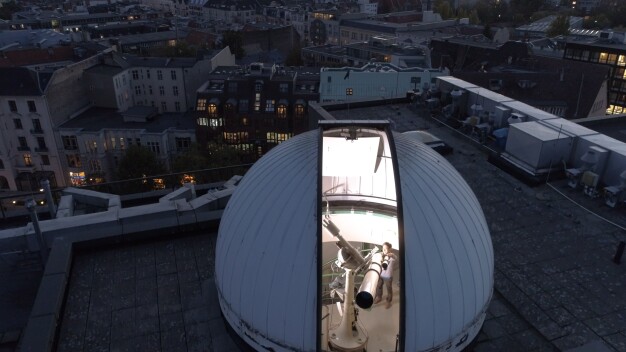
On the roof of the Eugene-Paul-Wigner Physics Building at TU Berlin, you can not only look into space with a telescope. Right next to it, researchers found two micrometeorites in the deposits on the ground. One of them is probably from the edge of the solar system.
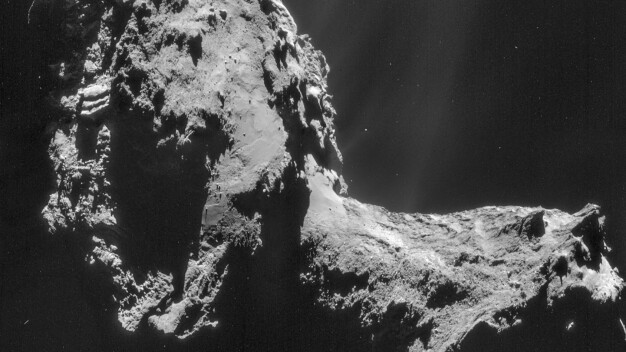
Comet 67P/Churyumov-Gerasimenko, photographed on November 20, 2014, by the European Space Agency's (ESA) Rosetta spacecraft. Rosetta was only 31 kilometers away from the comet at that time. Especially when it is near the Sun, the comet repeatedly ejects fountains of gas and dust. The dust particles could then land on Earth as micrometeorites.
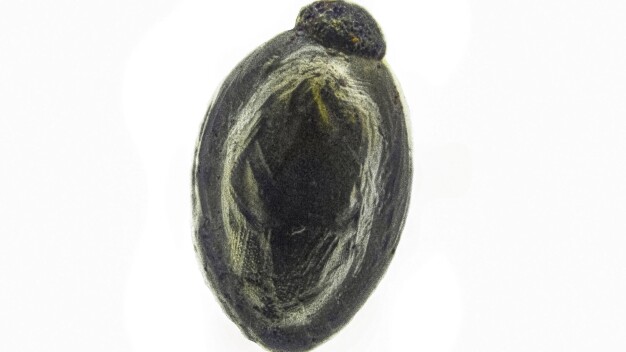
Micro-meteorite with a metallic bead on the edge. It formed after, during the melting phase in the Earth's atmosphere, the elements nickel and iron separated from the rest. When cooling, these metals then solidified into a separate small ball. From it, one can determine how the micro-meteorite entered the atmosphere, namely with the small ball leading.
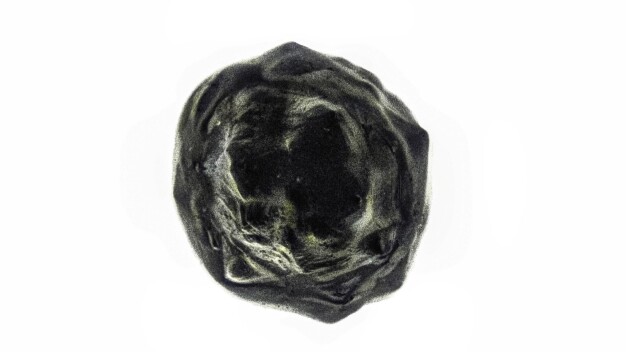
Micro-meteorite with a turtle pattern, formed through special crystallization processes in the Earth's atmosphere. It most likely originates from the outer solar system and could have separated from comets passing by Jupiter or from rocky material in the Kuiper Belt — at a distance approximately 40 times the distance from Earth to the Sun.
Citizen scientists can collect micrometeorites from their rooftops and identify them with some practice using a light microscope. The most experienced among them have now, together with a team of researchers from TU Berlin and the Museum of Natural History in Berlin, as well as other international scientists, been able to determine the likely origins of two micrometeorites within the solar system. Both were found in dust collected from the roof of the Eugene-Paul-Wigner Physics Building at TU Berlin. For the first time in this study, a computer simulation was used that considers a variety of possible orbits, particle properties, and the influence of cosmic radiation on the micrometeorites. The data from this computer simulation were then compared with measurements of the micrometeorites taken at the VERA particle accelerator at the University of Vienna to determine their origin.
Scott Peterson is a veteran of the US Army, studies chemical engineering in Minneapolis, and also takes care of his son as a house husband. Additionally, he is one of the most skilled collectors of micrometeorites worldwide. This community has been growing steadily since Norwegian jazz musician and citizen scientist Jon Larsen first demonstrated in 2015, in collaboration with Imperial College London, that micrometeorites are not only found in remote areas such as the ocean floor or Antarctic ice but also on our rooftops.
Citizen scientists identify micrometeorites
"We asked Scott to take a look at our samples because he has the best eye for identifying micrometeorites under the microscope," explains Dr. Jenny Feige, who researches cosmic dust with an ERC Starting Grant from the European Research Council. Initially at the Center for Astronomy and Astrophysics (ZAA) at TU Berlin, now at the Museum of Natural History Berlin, where additional projects on micrometeorites are also conducted with citizen scientists. Before consulting Scott Peterson, researchers from TU Berlin had climbed onto the roof of the physics building there, with its telescope dome, swept up the deposits from the corners, and collected them. "The entire sample is suspended in water to remove tiny leaves and similar debris. Then we heat the sediment to 600 degrees to completely destroy microbes and other organic material. Afterward, the material is sieved, and then the search for micrometeorites begins," says Feige.
From noses and turtle shells
The sample contained countless small spheres ranging from 100 to 500 micrometers in size, most of which, in the researchers' terminology, represented "anthropogenic contamination" — meaning they originated from human-made sources such as welding, fireworks, or simply metal debris from traffic. In the very last sub-sample, Scott Peterson actually found two micrometeorites that could be assigned to specific classes based on characteristic structures. These structures form when cosmic dust particles rush into Earth's atmosphere and are slowed down and intensely heated by friction with air molecules until they melt. After losing an average of 90 percent of their mass during this process, the remaining material crystallizes upon cooling, depending on entry angles and velocity, as well as the atmospheric conditions and surrounding environment.
One micrometeorite has a pattern resembling a turtle shell due to certain crystallization processes. The other had elements nickel and iron separate from the rest during the melting phase and then solidified into a separate tiny sphere on the micrometeorite during cooling. "From this 'nose,' you can even infer how it entered the atmosphere, namely with the sphere leading," Feige explains.
Micrometeorites can reveal conditions in the solar system
"It remains a major challenge for science to determine the origin of the micrometeorites found on Earth," says Dr. Beate Patzer, a theoretical astrophysicist at ZAA at TU Berlin. "This would be very desirable because micrometeorites can originate from very different regions of our solar system with vastly different conditions. The Earth captures about 100 tons of mostly interplanetary dust daily. Micrometeorites are thus much more common than larger meteorites, allowing us to generate much more data and learn a lot about our solar system."
Travel time to Earth
A method to determine the origin of a micrometeorite is the analysis of long-lived, radioactive isotopes formed during its journey through space by exposure to the omnipresent cosmic radiation. "Based on the ratio of different isotopes with varying half-lives and a physical model describing their formation, we can infer the flight time of extraterrestrial dust particles to Earth—and thus their origin within the solar system," Patzer explains.
First computer simulation for analysis
"For this analysis, we created a complex computer simulation that considers possible orbits of interplanetary dust particles, the size of dust grains, their composition and density, radiation profiles of the Sun and cosmic radiation from interstellar space, vaporization rates during atmospheric entry, and many other parameters," says Jenny Feige. The researchers focused on the radioactive isotopes aluminum-26 and beryllium-10.
To measure the very small quantities of these isotopes in tiny micrometeorites, the research team collaborated with the VERA particle accelerator in Vienna. The "accelerator mass spectrometry" performed there sorts chemical elements not only by their mass but also by the number of protons in the nucleus—enabling a definitive identification of the isotopes.
Turtle from the edge of the solar system
The concentrations of aluminum-26 and beryllium-10 in the micrometeorites were then compared with the results of the computer simulation, which predicts the enrichment of these radioisotopes in micrometeorites depending on their flight time and thus their origin in space. The origin of six micrometeorites collected elsewhere remained ambiguous; however, six other micrometeorites could be assigned with high probability to a specific origin, including the two found on the roof of TU Berlin: The micrometeorite with the turtle shell pattern originates from the outer solar system and could have been separated from comets passing by Jupiter or from rocky material in the Kuiper belt—at a distance roughly 40 times the Earth-Sun distance. The one with the "nose," on the other hand, comes from the inner solar system, from near-Earth objects or even from the asteroid belt between Mars and Jupiter.
"With this result, we were able to demonstrate the fundamental suitability of our method," says Jenny Feige. "It will enable us to learn even more about the cosmos using micrometeorites in the future. Especially those on our rooftops are particularly valuable because we know their residence time on Earth very precisely: it cannot be older than the roof itself. In contrast, micrometeorites found in the deep sea or Antarctica could have been lying there for millions of years, making the results less certain."
Technische Universität Berlin
10587 Berlin
Germany