
- Translated with AI
Hans Zingre
D50 value for determining the collection efficiency of air microbial samplers
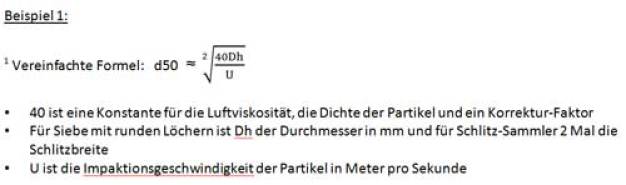
Example 1
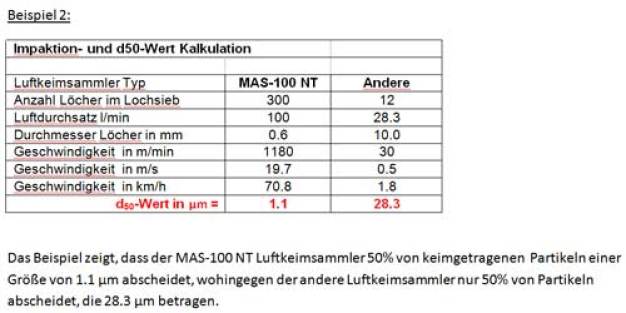
Example 2
Air microbial samplers determine microorganisms in the air at locations where aseptic, sterile, or highly pure work is performed. The pharmaceutical industry, which fills sterile media for parenteral injections, eye drops that are directly instilled into the eyes, or food and cosmetics that come into contact with microorganisms and thus spoil very quickly, are just a handful of examples where microorganisms in the air are of interest.
Microorganisms are living organisms that mostly float on dust particles in the air. When they come into contact with an organic substance, mixed with moisture, they can multiply very quickly. There are bacteria that reproduce or double every 20 minutes. Starting from an initial single bacterium, approximately 86 billion germs can develop in 12 hours.
So how can these germs be found or collected in the air? Most instruments draw in a defined amount of air. This air is then accelerated through a perforated plate, and the microorganisms carried in the air are projected onto a nutrient medium (agar). This method is called the impactor method. More than 50 different instruments are in use worldwide. Naturally, this raises the question of whether these devices can be simply compared with each other.
Unfortunately, this is not the case. When comparing the instruments in parallel tests, significant differences can be observed. One reason for this lies in the distribution of microorganisms in the air. The germs are not uniformly distributed. Therefore, highly divergent results can occur. Furthermore, the designs of the instruments vary greatly, and some models are poorly constructed. This situation calls for a standard that allows manufacturers and customers to compare the instruments. Currently, ISO standard 14698-1/2 exists, which describes a method in Appendix B for testing these devices. Unfortunately, the method is very elaborate and requires a special chamber and instruments to distribute a bacterial suspension as homogeneously as possible. Only a few laboratories in Europe have such a chamber. Hans Zingre also believes that it is very difficult to produce homogeneous bacterial or spore-air mixtures. Additionally, the reference device and the device under test operate at different intake speeds, which questions the comparability. For example, filtration on a 45 µm filter operating at 5 l/min is compared with an impact air microbial sampler operating at 100 l/min. If the same volume, e.g., 500 liters, were to be compared, the filter would need to operate for 100 minutes, while the air microbial sampler in the example would only collect the same amount of air in 5 minutes. If the samplers are controlled over the collection time, i.e., turned off after 5 minutes, then only 25 liters of air would be collected on the filter, and 500 liters on the air microbial sampler. To compare the results, either the filter result would need to be multiplied by 20 or the air sampler result divided by 20. Deviations would thus be greatly distorted.
However, a physical comparison has long been possible simply by applying the d50 value, which has already been used in some publications. The d50 value indicates the theoretically calculated size in micrometers (µm) at which 50% of the germs are deposited on the nutrient medium. For the formula below, only the number of holes in the collection head, their diameter, and the volumetric flow rate in liters per minute are needed. These specifications are usually provided by the manufacturers.
D50 = √(40dh / impact velocity)
Since germs in the air are generally attached to dust particles, they are the smallest airborne particles, found in the range of approximately 2 µm. If an air microbial sampler operates below this value, particles are not or only partially deposited.
(See Example 1 and Example 2.)
It is a fact that air microbial samplers with a d50 value of 28 µm are still in use. This proves that manufacturers are unfortunately not aware of the efficiency of their own products.
Mr. Zingre once was invited to present his air microbial samplers at a renowned pharmaceutical company abroad because the company wanted to equip a new production line with active airborne microorganism detection. He explained the d50 value to the attendees and emphasized the high efficiency of his instruments. However, the company then purchased the competitor's product, which Mr. Zingre had demonstrated to have up to 10 times lower efficiency. It was clearly evident that the responsible quality managers did not want to find anything. One can only hope that dangerous microorganisms are kept away from these products, although this is doubtful.
1 Publication: European Journal of Parenteral & Pharmaceutical Sciences 2008; 13 (4): 93-97: "Monitoring efficiency of microbiological impaction air samplers.", Bengt Ljungqvist, Berit Reinmüller, Building Services Engineering, KTH, Stockholm, Sweden.