- Planning
- Translated with AI
Ronny Töpfer
Cleanroom design for blood plasma fractionation
Planers must think through the entire concept from start to finish
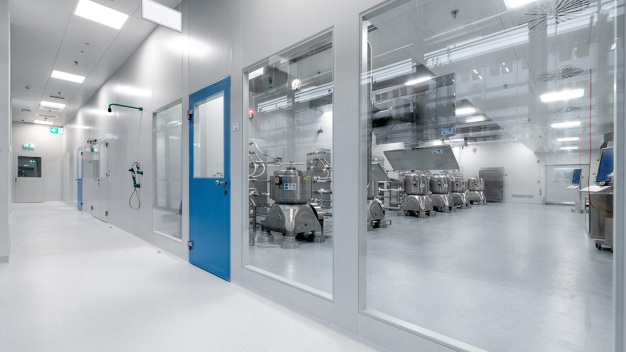
(Copyright: Jens Distelberg)
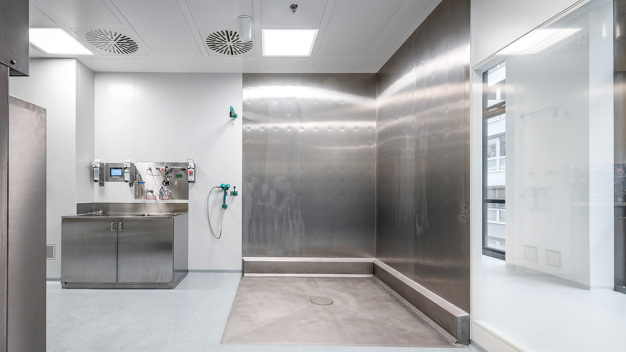
Fig. 1: Fully welded maintenance-free cleanroom wash station made of stainless steel, completely without silicone joints, seamlessly connectable to all common cleanroom wall and ceiling systems. (Copyright: Jens Distelberg)
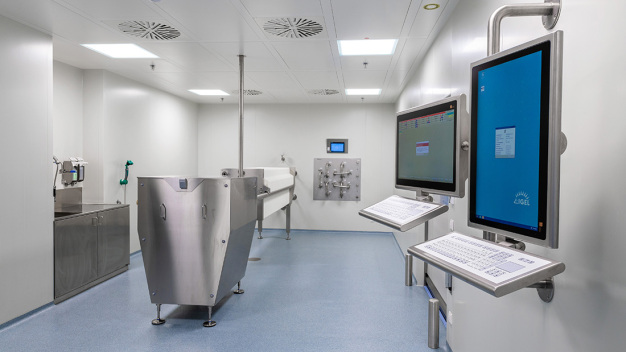
Fig. 2: Filter press in the cleanroom of a plasma fractionation: cleanroom-compatible mounting and wall-integrated installation of all control elements into the wall system. (Copyright: Jens Distelberg)
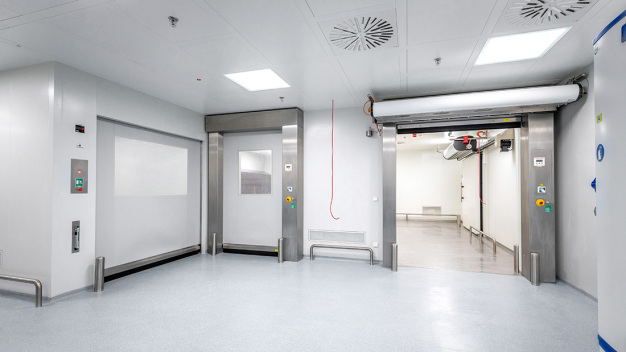
Fig. 3: Cleanroom-compatible roller shutters offer a very good alternative to other door systems for frequent opening and closing. (Copyright: Jens Distelberg)
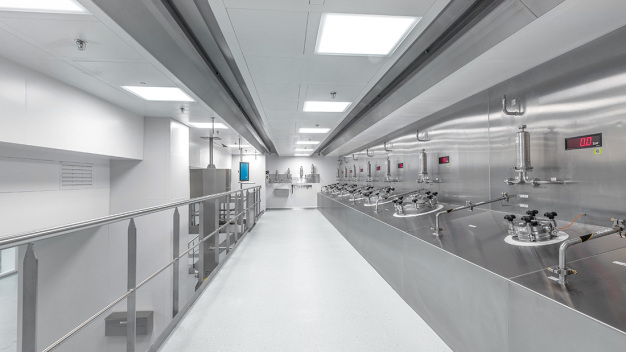
Fig. 4: Buffer approach area: Integration of a control station into the cleanroom, all installations in the technical area behind, only necessary equipment integrated into the cleanroom (e.g., hand holes for larger process containers). (Copyright: Jens Distelberg)
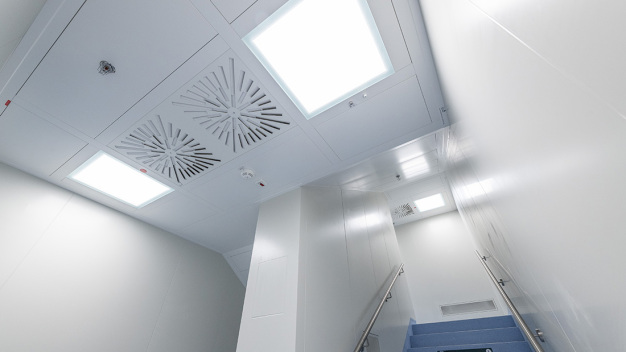
Fig. 5: Cleanroom staircase with ceiling details such as air outlets, sprinkler heads, and sensors. (Copyright: Jens Distelberg)
Blood plasma products are the foundation of life-saving therapies. The fractionation and processing of blood plasma into albumin, IgG immunoglobulin, factor VIII, factor IX, and other products are carried out using highly specialized processes and production techniques in cleanrooms. Only in a controlled environment can the requirements for contamination-free production be met. Pharmaceutical companies should therefore rely on specialists with relevant experience for cleanroom planning. Some important aspects of cleanroom construction are outlined below.
Glatt has already planned and implemented various projects in Germany and internationally for the construction of production facilities for blood plasma fractionation. These included the planning of cleanrooms in higher cleanliness classes over several 1000 m² across multiple floors and the creation of layouts with well-thought-out material and personnel flow, including sophisticated lock solutions. Cleanroom-compatible integration also included new optimized washing stations and additional equipment such as filter presses or separators (Fig. 1+2). Throughout, the interface management with all trades—from construction to process to EMSR/automation—was a key consideration. These projects led to some fundamental considerations.
When planning a cleanroom, cleanroom planners should work as closely as possible with all trades, as there are numerous factors influencing the selection of suitable systems for cleanroom walls, ceilings, and floors, as well as lock equipment and cleanroom furniture. There is a high need for coordination and consultation here. Equally important is good contact with suppliers of all equipment and systems to be installed or associated with the cleanroom, which will later be closely integrated with the cleanroom elements. It is best if the cleanroom planner is familiar with or even designs the process equipment, technologies, and systems used.
Proper cleanroom assembly: as clean as possible
Before starting any cleanroom assembly, i.e., pharmaceutical interior construction, all structural measures must be completed as completely as possible. This means that the shell construction should not only be finished and broom-clean but also as particle-free as possible, for example through suction and, if necessary, sealing of the shell surfaces. This minimizes particle entry from the building fabric into the cleanroom to be constructed from the outset. The actual cleanroom must meet the following surface requirements:
- smooth and pore-free,
- easy to clean,
- impermeable and crack-free,
- effectively and repeatedly cleanable and disinfectable,
- light-resistant,
- low joint content,
- no horizontal or vertical deposition surfaces,
- cleanroom elements must be resistant to all cleaning and disinfecting agents used.
To meet these criteria for the walls, either double-shell wall systems for interior walls and single-shell for exterior walls, or monoblock elements with a sandwich construction can be selected. Common wall systems consist of metal elements with two construction principles: stud constructions with attached wall elements (single-sided or double-sided) and monoblock systems. The desired installation level within the enclosed cleanroom determines the preferred choice. Depending on the supplier, wall elements can be manufactured up to six meters high without horizontal joints. A double-shell wall system offers flexible assembly with optimal installation options. Desired modifications to wall installations can be made easily within the grid elements. An additional advantage is that pipes with small nominal diameters and cables can be installed effortlessly in the intermediate space.
Lock systems and doors for secure material and personnel flow
In the planning phase, the planning team must analyze all work and production processes meticulously. Only then will it be clear where lock systems, clean or dirty corridors are necessary to meet the cleanroom status and prevent contamination of the final product. Since cleanroom elements are usually very sensitive, it is advisable to use bumpers and scratch protection extensively in drive areas. The market for cleanroom components is very advanced, so these elements may protrude but are easy to clean. The selection of the most suitable and cost-effective door systems depends on the spatial conditions on site and the usage frequency. Rolling doors, rotary valves, and sliding doors are common. Single or double-leaf rotary doors are preferred due to their simplicity and should be integrated as flush-mounted into the separating walls whenever possible. Cleanroom sliding doors are more expensive and more complex to clean and maintain but have clear advantages in tight spaces and handling conditions. An excellent alternative to sliding doors are automatic, cleanroom-compatible roller shutters (Fig. 3), especially when frequent opening and closing are required. Besides cleanroom-compatible surfaces and reliable mechanics, lock systems and doors in the cleanroom area must also have a robust and high-quality sealing concept to ensure long-term hermetic sealing. Sealing is an aspect that is mandatory for all penetrations of lines, installations, and necessary equipment such as filter presses or separators in cleanrooms. For a cleanroom status, all penetrations from outside must be sealed with proper sealing to be diffusion- and particle-tight. Pharmaceutical machines or systems in cleanroom technology often span different cleanroom classes. Connection details to walls or ceilings, as well as to the floor in the form of as airtight covers or seals, are necessary and must be executed by the relevant trades in coordination with the expert team in a cleanroom-compliant manner (Fig. 4).
What to consider when designing cleanroom ceilings
Cleanroom ceiling systems mainly differ in load-bearing grid ceilings, clip-in cassette ceilings, and panel ceilings, and are generally used from ISO class 8 or GMP D onwards. As with wall systems, it is essential here to ensure airtightness with minimal joint coverage through uniform grid divisions. Thanks to integrated profiles, large-format elements can also be easily attached to the raw ceiling or steel substructures. Retrofitting installations here is also possible with minimal effort. The question of whether the ceilings should be walkable or non-walkable is an important aspect. For panel and load-bearing grid ceilings, walkability can be optionally provided. This allows avoiding additional walkways or other structures. However, the load capacity of all systems is limited.
Load-bearing grid ceilings typically consist of a manufacturer-specific, flexible grid system with extruded profiles. The widths of the ribs vary depending on the manufacturer, with installations such as pressure sensors being well integrated from a width of 80 mm. Ceiling panels come in various sizes, allowing cleanroom luminaires and air outlets to be installed without additional joints. Clip-in cassette ceilings are non-walkable, suspended metal ceilings and are more suitable for lower cleanroom classes.
Similar to cleanroom walls, the joints in the ceiling reflectors can be sealed with cleanroom-compatible silicone, but dry seals are also used. It should be coordinated with the client in advance how often the ceilings need to be opened, for example. Silicone seals must be renewed each time, whereas dry seals are placed above the joints and do not need to be replaced when the ceiling is opened.
Cleanroom height: allow enough space in the plenum
A very important part of pre-planning a new building is the structural height of each floor. It often happens that only during the construction phase of the cleanroom and the installation of the above trades such as piping, ventilation, electrical, and sprinkler systems is it realized that the plenum is very tight and that only with significant engineering and increased assembly effort can all installations be accommodated. Here, a precise estimate of installation density and sizes, such as air outlets or pipe trays, must already be made in advance. Convenient maintenance access at all necessary points is a must and should be considered accordingly, especially for safety-critical components like sprinkler lines. Fire protection systems cannot be laid arbitrarily and are subject to strict regulations. If the plenum and cleanroom are to be sprinklered, the space and installation effort increase significantly. Coordinated and continuously updated 3D planning provides a remedy and planning security.
The requirements for a cleanroom that is to be smooth and surface-bonded also play an important role in these installations. For luminaires and ventilation outlets, this is less of an issue, as common cleanroom manufacturers already offer these components as surface-bonded for their ceiling systems. Sensors should preferably be integrated into the grid profiles to allow maximum flexibility for ceiling elements. Not all sensors can be surface-mounted, but there are enough cleanroom-compatible sensors and other suitable components available on the market (Fig. 5).
Cleanroom luminaires are either accessible from below or from above for maintenance. In the case of accessible luminaires from below, defective lamps can be easily replaced without affecting the cleanroom status—a significant advantage. The basic principle for lighting planning in every cleanroom project is also confirmed here: the client should be involved from the beginning to jointly find the best solution for the construction project, and all trades must coordinate closely. Ideally, all planning services are provided in a coordinated manner from a single source.
First published in ReinRaumTechnik 01/2025, Wiley-VCH.

Glatt Ingenieurtechnik GmbH
Nordstraße 12
99427 Weimar
Germany
Phone: +49 3643 471600
Fax: +49 3643 471271
email: jan.kirchhof@glatt.com
Internet: https://pharma-engineering.glatt.com/de/