




- Clothing & Packaging / Films
- Translated with AI
Margarete Witt-Mäckel, Witt-Hygienemanagement, Dietmar Pfennig, Pfennig Reinigungstechnik GmbH
Cleanroom cleaning and cleanroom disinfection – from planning to operation
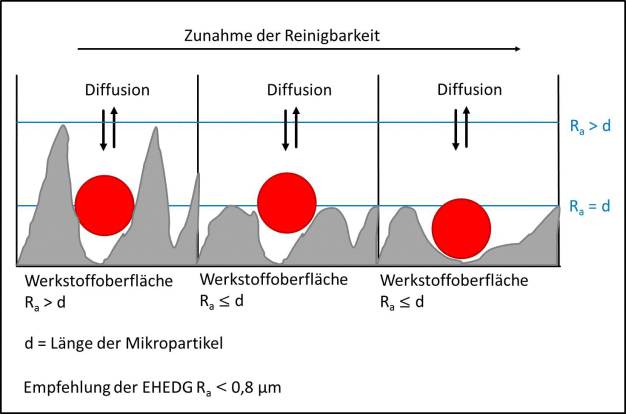
Fig. 1: Influence of surface structure on cleanability. (Source: Witt Hygiene Management, based on Doc. 13, EHEDG)
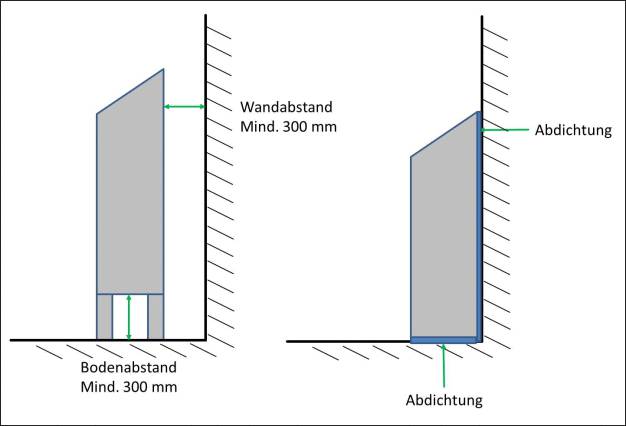
Fig. 2: Proper hygienic design, for example through sufficient clearance from floors and walls or by sealing, can facilitate floor and wall cleaning. The specified minimum clearances are recommendations from EHEDG, Doc. 13. (Source: Witt Hygiene Management, based on Doc. 13 of EHEDG)
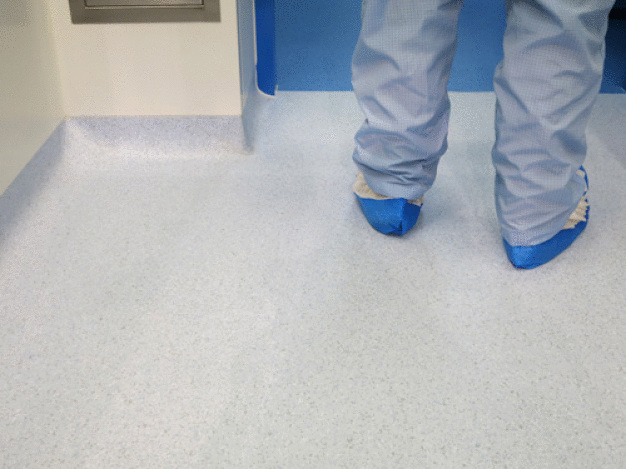
Fig. 3: Corners with 90° angles are very difficult to clean. Contaminants tend to accumulate in the corners, which cannot be reached by wiping procedures (so-called round wiping of corners and angles). An optimal design of transitions, such as between wall, door, and floor, can be easily wiped with a floor mop cover without much effort. (Source: enicos e.K. engineering and Gerflor Mipolam GmbH)
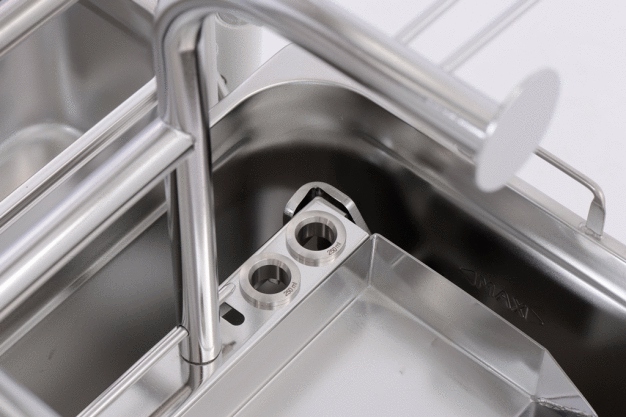
Fig. 4: The hygienically appropriate design is also applied in the implementation of qualified equipment for cleaning and disinfection of cleanrooms. Here, as an example, a drainage system developed in accordance with the recommendations of the EHEDG. (Source: Pfennig Reinigungstechnik GmbH)
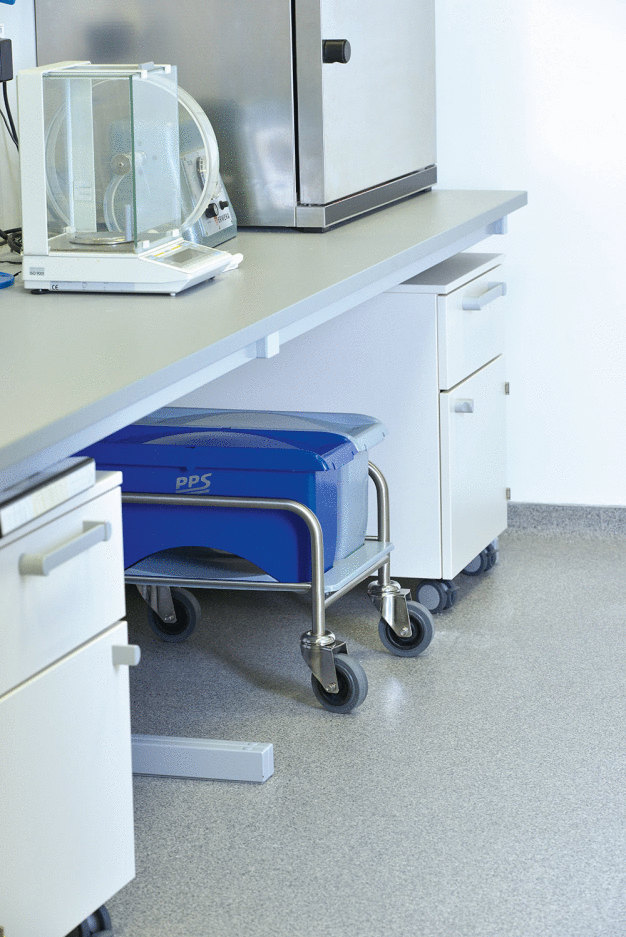
Fig. 5: This system cart for cleaning and disinfection fits under the table due to its size and can therefore be easily stored for safekeeping. (Source: Pfennig Reinigungstechnik GmbH)
First publication in TechnoPharm 7, No.6, 330-335 (2017)
Summary
Poor cleaning results or microbiological exceedances are not solely due to incorrect implementation of cleaning and disinfection measures or the use of unsuitable materials. Errors can already occur during the planning phase, for example, if the cleanability of structural facilities is not considered. The consequences of these planning and construction errors are usually only noticeable during operation and often cannot be corrected retrospectively. Therefore, effective surface decontamination requires a forward-looking and interdisciplinary approach. The following describes, through several examples, which mistakes should be avoided during planning and construction and what consequences these errors can have.
1. Consideration of processes for surface decontamination
The decontamination of surfaces of facilities and room surfaces is usually carried out by two processes, depending on the desired surface cleanliness:
In industrial sectors such as pharmaceutical manufacturing, where a defined microbiological surface purity is desired, disinfection is the primary focus. The goal of disinfection is to reduce germs to a defined level by inactivating existing microorganisms with suitable biocidal agents. Disinfection of larger surfaces is typically performed with wiping disinfection, while hard-to-reach areas can only be decontaminated with targeted spray disinfection. Sterility — the complete absence of viable microorganisms — is not considered in this publication.
Particular and chemical purity is achieved through cleaning of the surface. During cleaning, the adhesion forces between contamination and the surface to be cleaned are overcome, and the released contaminants are transported away. In cleanrooms, cleaning is generally performed using wiping methods with chemical agents. The effectiveness of this process relies on a combination of mechanical removal via the wiping textile and the chemical action of solvents, which dissolve and suspend dirt, as well as facilitate the adhesion of contaminants to the wipe to support their removal from the surface.
2. Errors in planning and during construction phases and their consequences during operation
Since cleaning and disinfection of larger surfaces (floors, walls, and ceilings) are usually performed manually using mops, errors in implementation cannot be completely ruled out. Poor cleaning results or microbiological values are often due to difficult initial conditions caused by non-hygienic or non-cleaning-appropriate design of facilities, equipment, and rooms. Not surprisingly, relevant standards such as DIN EN ISO 14644 or the EU-GMP guidelines emphasize that rooms and equipment must be planned and designed so that thorough and repeatable cleaning is always possible to prevent cross-contamination, dust and dirt accumulation, and any adverse influence on product quality [EU-GMP Guidelines, Chapter 3: Rooms and Equipment]. From the planning phase, based on the later use of rooms and equipment, the necessary decontamination procedures and their prerequisites, as well as the availability of required materials, must be considered. The following chapters illustrate, with examples, how crucial good planning and interdisciplinary cooperation between planners, manufacturers of rooms and facilities, and users are. The importance of networking interfaces between planners, equipment manufacturers, and users is also addressed in the VDI Guideline 6305, a practical guide for GMP-regulated technical projects (tGMP).
2.1 Influence of surface materials on cleaning and disinfection
Irregular macro- and microstructures of surfaces such as indentations and grooves, hidden areas, or roughness provide good adhesion points, shielding dirt and microorganisms from the action of chemical agents and complicating mechanical removal. Materials that are not chemically resistant and prone to corrosion favor particle shedding and the accumulation of microscopic contaminants in the roughened areas caused by material degradation. On materials with high porosity or defects, i.e., regular or irregular breaches in surface structure, microorganisms, product residues, and other contaminants can settle in the pores and cavities, triggering biofilm formation. The same applies to cracks, gaps, and unsealed areas between contact surfaces of components and structural elements.
To overcome the adhesion forces of dirt and to kill existing microorganisms, chemical agents must be applied in sufficient quantities to each surface to be decontaminated and the surface must be thoroughly wetted. Adequate wetting is the core of the wiping process itself, so the choice of surface structure is critical [Fig. 1]. Since surface-active substances are typically used in room surface cleaning and disinfection, the wettability of materials and their surface energy are less critical here than in equipment used in direct contact with products.
The consequences of these deficiencies include contamination of manufactured products by technical residues, product remnants, or microorganisms, and a negative impact on product quality. During planning, depending on the desired level of cleanliness, the properties of materials and their surface characteristics (roughness, structure, porosity, wettability) as well as their resistance to cleaning and disinfecting agents used later in operation must be carefully considered. The choice of chemical agents depends on the type of contamination expected on the surfaces to be cleaned or disinfected.
2.2 Influence of design and construction of facilities and rooms
Cleanability not only involves good removal of dirt through the use of suitable durable materials with appropriate surface properties (roughness, structure, porosity, wettability), but also good accessibility with chosen cleaning and disinfection methods through well-thought-out construction, processing, and design of rooms and facilities. Hard-to-reach areas, so-called dead spots, lead to insufficient routine decontamination, promoting dirt accumulation and microbial growth in these areas. Some difficult-to-reach spots can be decontaminated through elaborate post-treatment, but in other areas, contamination is effectively shielded by the structural conditions.
Routine cleaning and disinfection of floors, walls, and ceilings are typically performed using mops. The mop usually has a width of about 40 cm and a length of about 15 cm. The handle is attached flexibly depending on the system, allowing wiping underneath and behind furnishings up to a minimum distance of approximately 30 cm. When planning this minimum distance, the size of equipment or machinery must be considered to reach the entire floor area beneath the equipment. Both the European Hygienic Engineering Design Group (EHEDG) and DIN EN 1672 or DIN EN ISO 14159 provide recommendations for minimum floor and wall clearances or for avoiding gaps through continuous, sealing connections [Fig. 2]. Care must be taken to prevent cracks, gaps, or inaccessible dead spots. If the minimum distance cannot be maintained, extensive re-cleaning with a cloth or smaller mop holder is necessary.
Additional examples of non-hygienic design include protruding moldings and panels, fastenings, hooks, rectangular angles, open threads, or floor and wall panels. These dead spaces are ideal hiding places for microorganisms and tiny particles. Cleaning is hardly possible in these areas. Disinfection can only be performed with targeted use of spray disinfectants. Closed wall coverings, covers for equipment parts, the use of continuous smooth components, sleeves, and hygienic seals eliminate hard-to-clean areas and significantly reduce cleaning and disinfection efforts. Rounded transitions and seals are also easy to wipe without significant time expenditure [Fig. 3 and 4]. Examples of high-hygiene-risk constructions and solutions can be found in documents from the European Hygienic Engineering Design Group (EHEDG) and standards DIN EN 1672 or DIN EN ISO 14159.
Designing movable components such as wheels in a hygienic manner is only conditionally possible due to their function. Cleaning and disinfection of such unavoidable weak points must be included in the cleaning and disinfection plan.
Often frustrating during routine operation are cables that are laid openly and often lie in a tangled mess on the floor. These provide many adhesion points for dirt and particles. A tangle of cables also means many areas cannot be cleaned or can only be cleaned with high effort. Therefore, it is advisable to gather and route cables and lines in cable ducts, trays, or grids. Cable management should be as closed as possible. This implementation requires careful planning and consideration of workplaces and activities in advance.
Devices and component equipment such as measuring devices, dosing systems, fire extinguishers, control panels, or other technical systems that are difficult to clean and disinfect due to their construction increase the risk of unwanted particle and germ accumulation and can only be cleaned and disinfected with high effort and sometimes only with specific protective measures. It is therefore recommended to house such devices like fire extinguishers or technical systems in enclosed casings with easily wipeable external surfaces. These casings should be easy to open for maintenance and inspection, with openings reliably sealed to prevent contamination ingress or external contamination.
Perforated plates are also difficult to clean. Their use should be carefully considered and only planned where necessary for targeted airflow. Perforated shelves, for example, allow good airflow but are usually used and fully stocked, so the desired airflow during operation is not achieved. In such cases, continuous shelves that are easier to clean and disinfect may be used instead.
2.3 Influence of construction activities
Many responsible persons are unaware that cleanroom cleaning does not only start during operation but already begins during construction phases. This brings the planning phase back into focus, where different stages of construction cleaning with defined cleanliness levels and associated hygiene measures should be established for each construction phase. Essentially, the higher the final requirements for the cleanroom, the more important early-stage cleaning and implementation of hygiene measures become. Early prevention of contamination entry, even into areas that seemingly have only indirect connection to the cleanroom, such as duct systems, can eliminate contamination sources from the outset and reduce the later effort of final or qualification cleaning/disinfection. The stages of construction cleaning are described in DIN EN ISO 14644-5.
Hygiene measures that should already be considered during construction include pre-cleaning when bringing materials into future production areas, covering floors and equipment, avoiding wooden pallets, cardboard, and contaminated packaging materials, as well as initial guidelines for personnel hygiene and behavior. Behavior includes, among other things, the use of cleaned or disinfected tools or caution when handling cleanroom equipment. Often, activities during construction that are overlooked can influence the success of subsequent cleaning and disinfection in operation. For example, minor surface damages caused by impacts or moving heavy objects across the floor. If these damages are not hygienically repaired, they become ideal sites for microbial growth and particle accumulation. It is also important to avoid applying protective coatings to certain material surfaces or polishing stainless steel surfaces with stainless steel cleaners, as these protective layers or auxiliary agents can react with later-used disinfectants, leading to unsightly streaks or crusts.
3. Availability and access to all necessary materials for decontamination
Materials and equipment needed for cleaning and disinfection must be stockpiled, stored, and sufficiently available at the target site. In sterile manufacturing areas of the pharmaceutical industry, additional requirements for sterilization must be implemented according to Annex 1 of the EU-GMP guideline for sterile medicinal products.
3.1 Storage
Due to the high technical demands of cleanrooms and high operational costs, cleanrooms, especially sterile areas, are planned to be as small and efficient as possible. Equipment needed for wiping disinfection should ideally be stored within the relevant cleanliness zone where it is used. Otherwise, constant entry and exit are necessary, which not only increases workload but also raises the risk of contamination transfer due to improper handling of materials, especially from less clean areas into cleanroom zones with higher hygiene requirements. Storage requires space, which is often not planned.
For the wiping process used for cleaning and disinfecting large surfaces, well-planned equipment is necessary. This includes, besides the mop holder with a handle for the wipe, a container for soaking the wipe. Depending on the scope of activities, organizational and ergonomic reasons suggest using a trolley for transporting the cleaning solution, wipes, and other necessary materials such as surface cloths and spray bottles with disinfectant. The smallest available unit for pre-preparing wipes measures 51 x 18.5 x 23.5 cm (LxWxH), making storage in a cabinet possible even for very small pass-through areas [Fig. 5].
3.2 Availability of cleaning and disinfection materials
The availability of cleaning and disinfection materials at the point of use requires good planning of workflows considering zone concepts. Logistics play a decisive role in choosing between single-use and reusable items, especially for floor wipes and cloths. Planning must account for not only sufficient fresh textiles but also the removal of used textiles and packaging materials to prevent cross-contamination. The removal process must be designed to avoid contamination transfer. The environmental impact and disposal costs of single-use products should also be considered. While using single-use materials may seem simpler initially, costs are significantly higher. A well-thought-out logistics process in close cooperation with a qualified cleanroom laundry reduces costs and does not introduce additional contamination risks from reusable materials.
Similarly, planning is essential when selecting cleaning and disinfecting agents. Depending on the desired efficacy, various cleaning and disinfectant products are available on the market for use in cleanrooms. Some products are ready-to-use solutions, already diluted and ready for immediate use. These are easier to handle but increase waste and reduce sustainability due to transportation of mostly water. Many effective active ingredients are only available as concentrates because of their limited stability. These concentrates must be diluted according to manufacturer instructions at the point of use, requiring water of appropriate quality. Dosing devices are an alternative to manual dosing but must be installed so that maintenance outside the cleanroom is possible, and the solution is drawn in within the target zone. Planning for such dosing devices should be considered early in the process.
3.3 Sterile transfer into sterile manufacturing areas
The EU Good Manufacturing Practice (GMP) guideline for pharmaceuticals states in Annex 1 that all items needed in an aseptic area, including cleaning and disinfection materials, must be sterilized before entering. Unfortunately, during the planning of pass-through autoclaves, the quantities and sizes of materials necessary for production are considered, but the materials needed for cleaning and disinfection are often overlooked, and the autoclave may be planned too small.
4. Conclusion
The execution of cleanroom cleaning and disinfection is mandated by regulations such as the EU-GMP guideline but is often only considered once the cleanroom is built and needs to be decontaminated. Poor accessibility and design of surfaces, equipment, and rooms, along with unplanned logistics, lead not only to higher operational costs but also to exceedances of the desired particulate and microbiological limits of the production environment, thereby impairing product quality. A well-functioning cleaning and disinfection concept must be proactive, interdisciplinary, and an integral part of cleanroom planning.
Authors
Margarete Witt-Mäckel
Dipl. Ing. (FH) Hygiene Technology
Witt Hygiene Management Consulting & Training, Stuttgart
www.witt-hygienemanagement.de
Ms. Dipl.-Ing. (FH) Hygiene Technology Margarete Witt-Mäckel, with many years of experience as a specialist consultant for operational hygiene and account manager in pharmaceuticals, is well-versed in the requirements for purity-relevant processes and products in cleanrooms and other hygienic industrial sectors. Since 2012, she has been advising and training companies as a coach and consultant in hygiene and quality management, GMP, validation, and microbiological quality assurance. As a project manager, she supports Pfennig Reinigungstechnik in the further development of highly qualified equipment and wiping textiles for cleanrooms and sensitive hygiene areas, manages research projects, and collaborates in the industry network "Hygienic Consumables." Ms. Margarete Witt-Mäckel is also the author of numerous technical publications and a member of several expert committees of the VDI.
Dietmar Pfennig
Dipl. Kfm. and Master Building Cleaner
Pfennig Reinigungstechnik GmbH, Durach
www.pps-pfennig.de
Dipl.-Kfm. Dietmar Pfennig is a master building cleaner and managing director of Pfennig Reinigungstechnik GmbH. Besides the product range for hospital and industrial cleaning, the company has been developing specialized solutions for cleanroom cleaning of all classifications for 19 years.
Contact
Margarete Witt-Mäckel, e-mail: mwm@witt-hygienemanagement.de
Further literature
Bobe U., Wildbrett G.: Requirements for materials and material surfaces regarding cleanability and durability; Chemical Engineering & Technology 2006, 78, No. 11, pp. 1615 - 1622
DIN EN 1672-2:2009-07. Food processing machinery — Basic concepts and design — Part 2: Hygiene requirements. Berlin: Beuth-Verlag.
DIN EN ISO 14159:2008-07. Safety of machinery — Hygiene requirements for the design of machinery. Berlin: Beuth-Verlag.
DIN EN ISO 14644-5:2005-03. Cleanrooms and associated controlled environments — Part 5: Operations. Berlin: Beuth-Verlag.
EHEDG (2004). Design criteria for hygienic machinery, equipment, and components. Document No. 8; 2nd revised edition. Frankfurt: European Hygienic Engineering Design Group. www.hygienic-design-institut.de/uploads/Doc_8_EHEDG.pdf.
EHEDG (2004). Hygienic design of open machinery, equipment, and parts for food processing. Document No. 13; 2nd revised edition. Frankfurt: European Hygienic Engineering Design Group.
EU-GMP Guideline for Good Manufacturing Practice of Medicinal Products Part I (2015). 8th edition. Schopfheim: Maas & Peither.
EU-GMP Guideline Part II (2016). 6th edition. Schopfheim: Maas & Peither.
Hauser G. (2008). Hygienic equipment and systems for the food, pharmaceutical, and cosmetics industries. Weinheim: Wiley-VCH Verlag.
VDI 2083 Sheet 5.1 (2007). Cleanroom technology. Operation of cleanrooms. Berlin: Beuth-Verlag.
VDI 2083 Sheet 9.1 (2006). Cleanroom technology. Cleanliness qualification and surface cleanliness. Berlin: Beuth-Verlag.
VDI 2083 Sheet 9.2 (2017). Cleanroom technology. Consumables in the cleanroom. Berlin: Beuth-Verlag.
VDI 6305 (2018). Technical Good Manufacturing Practice: Application guide for GMP-regulated technical projects. Berlin: Beuth-Verlag.
Witt-Mäckel M., Pfennig D. (2015). Cleanliness qualification — a challenge for practice. Cleanroom online 10/2015, pp. 15 - 17. www.reinraum.de.
Witt-Mäckel M., Pfennig D. (2016). Cleanliness lies in the details. pharmind 2016, No. 2, p. 168. Aulendorf: Editio-Cantor-Verlag.

Pfennig Reinigungstechnik GmbH
Heubachstr. 1
87471 Durach
Germany
Phone: +49 831 561220
Fax: +49 831 61084
email: info@pfennig-reinigungstechnik.com
Internet: http://www.pfennig-reinigungstechnik.com



