



- Science
- Translated with AI
Cell death program uncovered: How genetic damage caused by the natural compound methyleugenol leads to cell death in liver cells
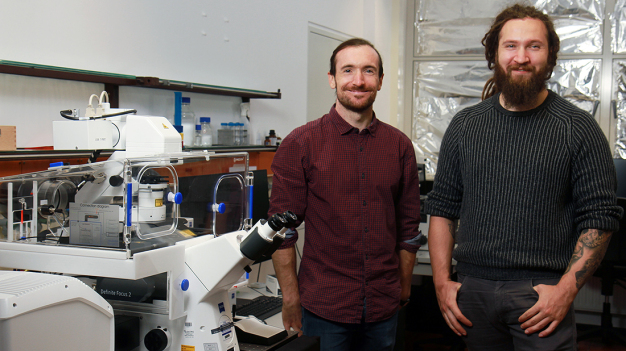
The team around Max Carlsson (right), the first author of the study, and Philipp Demuth (co-author of the study) has uncovered the mechanism. (TUK/view)
The natural compound methyleugenol occurs in various herbs and spices and enters our bodies through food. In the liver, it is activated by xenobiotic metabolism and can thus cause genetic damage there, as is well known. A research team from Kaiserslautern University of Technology (TUK), led by Professor Jörg Fahrer, has now succeeded in elucidating the cell death mechanism triggered by the genetic damage. A central role is played here by the protein p53, which largely activates the cell death program and thus prevents the survival of severely damaged liver cells. The research findings have recently been published in the renowned journal Cell Death & Disease.
Liver cancer is among the most common tumor diseases and is causally linked to viral infections of the liver, fatty liver disease, chronic alcohol consumption, and mold toxins in food. Furthermore, plant toxins are suspected of contributing to the development of liver cancer. These substances include methyleugenol, which naturally occurs in many herbs and spices such as basil, tarragon, and fennel, and enters our bodies through food. "It was previously known that methyleugenol is metabolized by certain enzymes in the liver and, as a result, can cause genetic damage, known as DNA adducts," says Professor Jörg Fahrer from the Department of Food Chemistry and Toxicology at TUK.
To find out how cells respond to these methyleugenol-derived genetic damages, a team led by Professor Fahrer used various biochemical, cell biological, and bioanalytical methods. The research group also included teams led by Professor Elke Richling and former junior professor Alexander Cartus. Additionally, scientists from Mainz University Medical Center and Justus Liebig University Giessen contributed to the study, which was funded as part of a third-party funded project by the German Research Foundation.
The team initially demonstrated and quantified the formation of DNA adducts in liver cells and other cell models using a mass spectrometric method. Furthermore, they demonstrated for the first time that the damage blocks the DNA replication process. This process, called DNA replication, is essential for the correct transmission of genetic information during cell division. Using high-resolution confocal microscopy and protein biochemical analyses, the team characterized the activation of the DNA damage response. "This cellular defense program led, among other things, to the activation of the tumor suppressor protein p53 in liver cells," explains Max Carlsson, a doctoral student in the Fahrer group and first author of the study. Together with Dr. Anastasia Vollmer, who also completed her doctorate in this research area, he carried out the key experiments of the study.
The researchers then focused on the toxicity of the genetic damage. Further investigations showed that a high level of DNA adducts triggers a programmed form of cell death called apoptosis, with mitochondria playing a central role. "Mitochondria are the power plants of our cells and are also involved in cell death processes," explains Professor Fahrer. By combining molecular biological methods and confocal microscopy, the researchers demonstrated that DNA damage leads to the upregulation of certain cell death genes and the activation of Bax. "This is a pro-apoptotic protein that, after activation, migrates to the outer membrane of the mitochondria and forms pores," explains Max Carlsson.
Finally, to clarify the role of p53 in the triggered cell death program, this was turned off in various cell models using pharmacological inhibitors and genetic approaches. The scientists demonstrated that the loss of p53 suppresses the activation of Bax and inhibits the induction of cell death in liver cells.
"In summary, our findings show that in cells with severe DNA damage caused by methyleugenol, the mitochondrial, p53-mediated cell death pathway is triggered," says Professor Fahrer. This could serve as a tumor-suppressive mechanism to eliminate heavily damaged cells and thus prevent permanent genetic alterations.
Publication
Carlsson MJ, Vollmer AS, Demuth P, Heylmann D, Reich D, Quarz C, Rasenberger B, Nikolova T, Hofmann TG, Christmann M, Fuhlbrueck JA, Stegmüller S, Richling E, Cartus AT and Fahrer J. p53 triggers mitochondrial apoptosis following DNA damage-dependent replication stress by the hepatotoxin methyleugenol. Cell Death Dis. 2022, 13(11): 1009.
Doi: 10.1038/s41419-022-05446-9
https://www.nature.com/articles/s41419-022-05446-9
Contact
Prof. Dr. Jörg Fahrer
Food Chemistry and Toxicology
Department of Chemistry
Kaiserslautern University of Technology
Phone: 0631/2052974
Email: fahrer@chemie.uni-kl.de
Technische Universität Kaiserslautern
67663 Kaiserslautern
Germany