




- Award
- Translated with AI
Bacteria produce bioplastics, living nerve cells process information
Wittenstein Biointelligence Award awarded
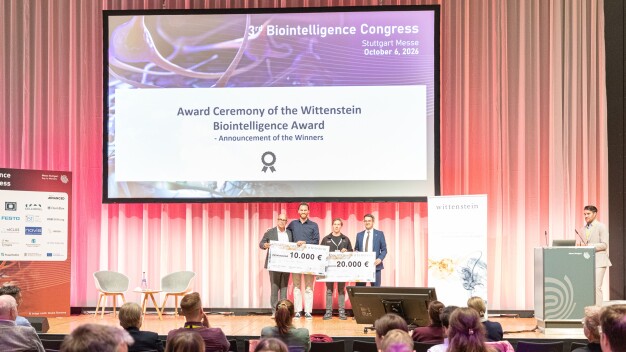
Award ceremony of the Wittenstein Biointelligence Prize, from left: Thomas Bauernhansl, Moritz Bross, Daniel Tanneberg (who accepted the award on behalf of Cortical Labs), and Benedikt Hofmann. © Fraunhofer IPA/Photo: Rainer Bez
At the third Biointelligence Congress, the Wittenstein Biointelligence Award was presented on Tuesday evening. In the "Individual" category, biotechnologist Moritz Bross won, and Cortical Labs was awarded in the "Company" category. The Wittenstein Foundation honors innovative, practically applicable, and sustainable solutions that combine biology with information and production technology.
Cyanobacteria produce bioplastics
Biotechnologist Moritz Bross uses cyanobacteria to produce a biodegradable plastic from carbon dioxide and sunlight. For this, he modified the bacteria's metabolism during his doctoral studies at the University of Tübingen so that they produce the bioplastic polyhydroxybutyrate. The approach aims to create an alternative to plastics based on fossil raw materials that are not biodegradable. For his work, Bross was awarded the Wittenstein Biointelligence Prize in the "Individual" category on Tuesday evening.
"His approach convincingly combines biotechnology, sustainability, and intelligent process adaptation, offering a promising path toward fossil-free material production," explains Professor Thomas Bauernhansl, justifying the jury's decision. The head of the Fraunhofer Institute for Production Technology and Automation IPA presented the Wittenstein Biointelligence Prize together with Benedikt Hofmann, the Innovation and Development Board Member of Wittenstein SE. The "Individual" category award is endowed with 10,000 euros.
The "Company" category was won by Cortical Labs. The Melbourne-based company develops biological computers in which living nerve cells work together with electronic components. Unlike conventional systems, the CL1 platform not only simulates them software-wise but also uses them directly for information processing. Cortical Labs aims to develop learning and adaptable computers that could require significantly less energy than current AI applications.
"Cortical Labs is opening new pathways for adaptive and energy-efficient computing. By combining living neural networks with silicon technology, the company demonstrates how biointelligence could reshape future AI and computer architectures," explains Bauernhansl. The Wittenstein Biointelligence Prize in the "Company" category is endowed with 20,000 euros.
Wittenstein Biointelligence Prize recognizes interdisciplinary approaches
The Wittenstein Biointelligence Prize targets companies and individuals who connect various fields of knowledge. Companies must combine expertise from at least two of the areas: biotechnology, artificial intelligence, production technology, and sustainability. Individuals can apply with interdisciplinary research work focusing on biotechnology, artificial intelligence, or sustainability.
The five-member jury places particular emphasis on novelty, practical applicability, and sustainability. Its members include Thomas Bauernhansl, Benedikt Hofmann, Professor Sahar Salehi-Müller, Adrian Thoma, and Christian Gnam. Salehi-Müller heads the Department of Engineering of Biointelligent Systems at the University of Hohenheim and the Biointelligent Production and Systems research team at Fraunhofer IPA. Thoma is Managing Director of the NXTGN Innovation Platform, and Gnam is Managing Director of the Biotechnology Innovation and Startup Center.
Award ceremony concluded the third Biointelligence Congress
The award ceremony marked the conclusion of the third Biointelligence Congress held at the Stuttgart Trade Fair grounds. Experts from research, industry, and startups discussed how insights from biology, technology, and computer science can be integrated to develop and produce products in the future without exploiting nature. A total of six finalists—three scientists and three business representatives—presented their research or business models at the conference.

Fraunhofer-Institut für Produktionstechnik und Automatisierung IPA
Nobelstraße 12
70569 Stuttgart
Germany
Phone: +49 711 970 1667
email: joerg-dieter.walz@ipa.fraunhofer.de
Internet: http://www.ipa.fraunhofer.de