




- New building
- Translated with AI
Martin Schäfer
A new high-security laboratory for Marburg virology
Foundation stone laid for the "Marburg Centre for Epidemic Preparedness" (MCEP)
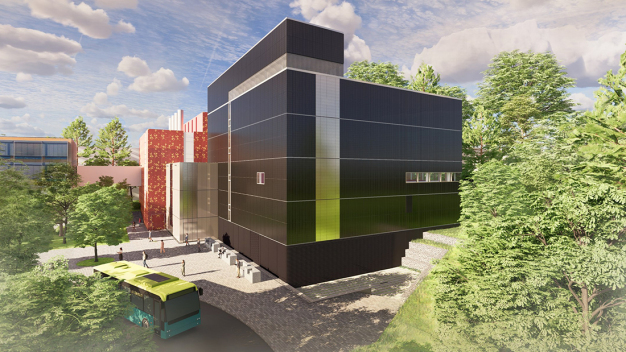
The visualization shows the future research building of the Marburg Centre for Epidemic Preparedness. (HWP Planning Company, Stuttgart)
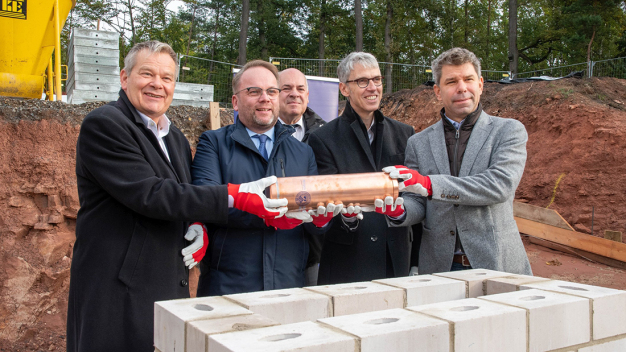
On the Lahnberge campus of Philipps University of Marburg, the foundation stone for the new Marburg Centre for Epidemic Preparedness was laid. Present were (from left) Marburg's Mayor Dr. Thomas Spies, Hessian Minister of Science Timon Gremmels, Thomas Platte (Director of the State Building and Real Estate Hessen), Prof. Dr. Stephan Becker (Director of the Institute of Virology), and University President Prof. Dr. Thomas Nauss. They placed a so-called time capsule into the foundation stone of the research building. (Photo: Markus Farnung)
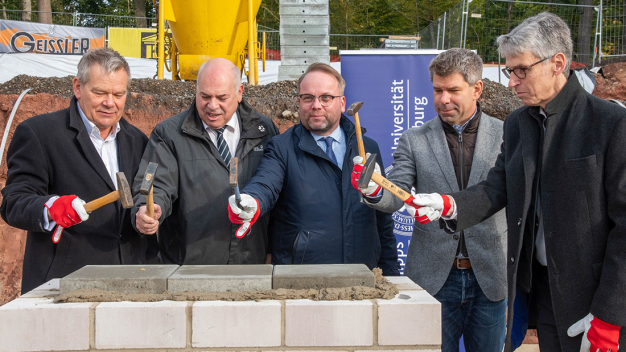
Together, they laid the foundation for the new Marburg Centre for Epidemic Preparedness: (from left) Marburg's Mayor Dr. Thomas Spies, Thomas Platte (Director of the State Agency for Construction and Real Estate Hessen), Hessian Minister of Science Timon Gremmels, University President Prof. Dr. Thomas Nauss, and the Director of the Institute for Virology Prof. Dr. Stephan Becker. (Photo: Markus Farnung)
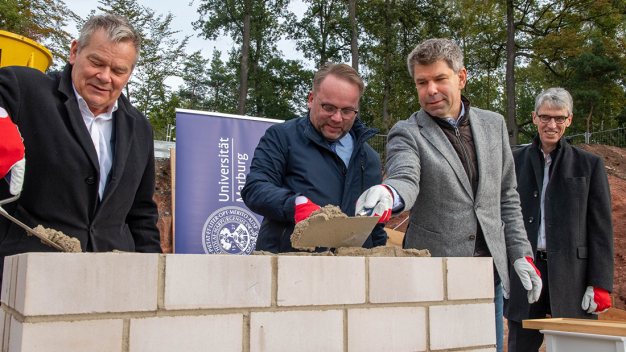
From left: Marburg's Mayor Dr. Thomas Spies, Hessian Minister of Science Timon Gremmels, University President Prof. Dr. Thomas Nauss, and Prof. Dr. Stephan Becker (Director of the Institute of Virology) at the laying of the foundation stone for the new Marburg Centre for Epidemic Preparedness. (Photo: Markus Farnung)
On the Lahnberge Campus of Philipps University Marburg, the foundation stone for the new Marburg Centre for Epidemic Preparedness was laid. Present were (from left) Marburg's Mayor Dr. Thomas Spies, Hessian Minister of Science Timon Gremmels, Thomas Platte (Director of the State Building and Real Estate Hessen), Prof. Dr. Stephan Becker (Director of the Institute of Virology), and University President Prof. Dr. Thomas Nauss. They placed a time capsule into the foundation of the research building.
In the presence of Hessian Minister of Science Timon Gremmels, Philipps University Marburg laid the foundation stone for the "Marburg Centre for Epidemic Preparedness" on October 14, 2024. The new highest-security-level laboratory (biosafety level, short BSL-4) will be built by the end of 2026 in immediate proximity to the existing BSL-4 laboratory on the Lahnberge campus. The Science Council had endorsed the project in April 2021 and recommended the construction of the MCEP for funding.
The federal government is investing approximately 19 million euros in the research building, with the state of Hessen funding the project with around 27 million euros. The total cost for the new research laboratory is estimated at about 46 million euros. Additionally, around 4.6 million euros are allocated for initial equipment and major apparatus. Hessian Minister of Science Timon Gremmels emphasizes the importance of this investment in the future of virological research: "At a time when global health crises pose unprecedented challenges, research into epidemics and their prevention is of central importance to all of us. The 'Marburg Centre for Epidemic Preparedness' will contribute as a center for outstanding scientific work and innovative research solutions to increase our society's resilience against future epidemics. With today's laying of the foundation stone for the MCEP, we are not only marking the start of a new construction project but also symbolizing the dawn of a new era in health research, creating urgently needed space and modern technologies for scientists and their vital work."
University President Prof. Dr. Thomas Nauss thanked the federal government and the state of Hessen for their generous support. "I am very pleased that the top-level research on highly pathogenic viruses, which has been carried out successfully here in Marburg for many years, is receiving this recognition. The funding allows Marburg virology to continue contributing at the highest level in basic research and transfer to combat major epidemic crises in the coming years."
The director of the State Building and Real Estate Hessen (LBIH), Thomas Platte, emphasizes: "The demanding new construction of the high-security laboratory essentially represents a 'house within a house' construction. An extra enclosed laboratory area will be realized within the planned building, designed for maximum safety – similar to the construction of the BSL-4 laboratory operated without incident for nearly two decades in immediate proximity. About 70 percent of the total construction costs are allocated to the necessary technical equipment. The project is of great importance to science. Therefore, special thanks go to all involved who are advancing the construction with their commitment and expertise."
The existing high-security laboratory (BSL 4 laboratory) reached its spatial capacity especially during times of virus outbreaks due to a sharply increased number of research and development activities. New technologies require additional space, and the growing need for staff able to work under these conditions has further increased the space requirements.
"The new rooms and improved equipment are an essential foundation for advancing our research," emphasizes Prof. Dr. Stephan Becker, head of the Marburg Institute of Virology. "This investment in the future of virological research will enable us to conduct research on epidemic and pandemic viruses with the latest technology and under improved conditions in the future. The new laboratory will also help us be better prepared for health emergencies."
With the new laboratory building, researchers will have approximately 400 square meters of laboratory space available in the future. The laboratory itself occupies only one floor (level +1), with the other floors reserved for the complex technical systems of the laboratory infrastructure. Photovoltaic modules on the roof and on the east and south facades help ensure that the building's power supply is secured primarily through renewable energy sources.
The new laboratory building will be constructed according to the strict requirements of applicable safety regulations and with state-of-the-art technology to protect employees and the environment. All work areas are designed so that, in the event of technical failures, all essential systems can continue to operate, and employees are protected. The work of researchers takes place in the so-called containment area, wearing full protective suits with external air supply.
The Stuttgart-based HWP Planning Company is responsible for the design. The project management and control are handled by the State Building and Real Estate Hessen (LBIH). The existing BSL-4 laboratory is to be overhauled after the new building is completed and, following long-term operation, will continue to be used for research.
Background: Research on Highly Pathogenic Viruses
In 1967, the outbreak of a virus transmitted by monkeys and deadly to humans (Marburg virus) led to the establishment of research on highly pathogenic viruses at the University of Marburg, which was systematically expanded over the following decades.
Highly pathogenic viruses with epidemic/pandemic potential often originate in the animal kingdom and can cause severe to fatal diseases after transmission to humans (zoonoses). Recently, there has been an increase in virus epidemics and pandemics caused by partly novel zoonotic viruses (e.g., Ebola virus, Zika virus, MERS and SARS coronavirus).
Highly pathogenic viruses may only be studied in research buildings of the highest biological safety level. In these laboratories, work is carried out under full protection with externally ventilated protective suits, minimizing the risk of infection for scientists. The laboratory itself is permanently under negative pressure and equipped with an extensive system for wastewater and exhaust air decontamination, so there is no risk to the environment from these laboratories. Of the four German BSL-4 laboratories, three are operated by federal or state ministries, with only the Marburg laboratory operated by a university.
At a Glance: The MCEP in Numbers
– Construction start: 04/2024
– Planned commissioning: end of 2026
– Construction costs: around 46 million euros
– Equipment and initial setup: around 4.6 million euros
– Laboratory space: around 400 square meters
– Usable space: around 830 square meters
Philipps-Universität Marburg
35037 Marburg
Germany