


- Vertaald met AI
Bierbrouwen – Brouwrestanten moeten op een duurzame manier worden hergebruikt
Achema 2018
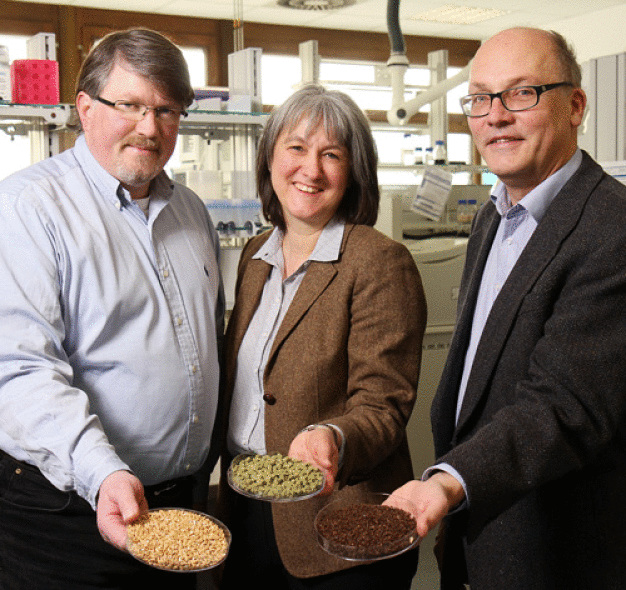
De teams van Professor Dr. Roland Ulber (links), Professorin Dr. Elke Richling en Professor Dr. Werner Thiel onderzoeken hoe de drijfmest op een andere manier kan worden gebruikt. (Foto: TUK/Thomas Koziel)
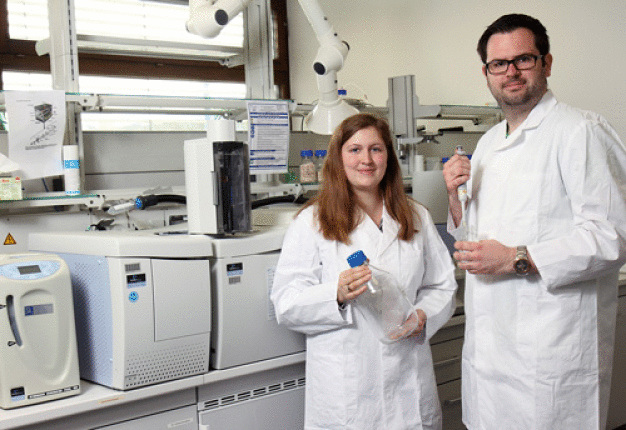
Ook Daniela Becker en Jens Weiermüller zijn betrokken bij het project. (Foto: TUK/Thomas Koziel)
On average, each German drank about 104 liters of beer in 2016. Brewing the barley drink produces many residues, totaling around 400,000 tons annually across Europe. Only a part of this is recycled as animal feed. Researchers from three disciplines at the Technical University of Kaiserslautern (TUK) are working on how to sustainably utilize this waste, for example as a raw material for the chemical industry or as a source for pharmacologically active substances, in a European project. They will present their project at the Process Industry Fair Achema in Frankfurt from June 11 to 15 at the Rheinland-Pfalz research stand (Hall 9.2, Stand A86a).
During brewing, yeasts convert the sugars contained in malt into alcohol and carbon dioxide during fermentation. Other components from the cereal malt are needed by microorganisms to grow and multiply. Nevertheless, a lot of waste is generated in this process. These residues, also known as spent grains in specialist circles, still contain many valuable substances. This is where the project begins, with three working groups from TUK working together with partners: They are investigating how the spent grains can be used sustainably and resource-efficiently in the future.
At Professor Dr. Roland Ulber's Department of Bioprocess Engineering, the team around doctoral students Jens Weimermüller and Alexander Akermann is exploring which substances are produced when the brewing residues are further fermented. "We use various microorganisms such as fungi and bacteria," says Akermann. These processes produce a variety of chemical products, such as lactic acid. In the future, this could serve as a starting material for bioplastics for industry.
In inorganic chemistry, the research team around Professor Dr. Werner Thiel and doctoral students Ranja Saynisch and Pascal Weingart is examining the fats present in the spent grains. "They contain, for example, numerous unsaturated fatty acids that the yeasts do not need during fermentation," says Thiel. The chemists first want to identify these substances more precisely. In a subsequent step, they aim to process them into products for industry. "Glycerin can be obtained from the fats, which can be converted into intermediate products for the chemical industry," the professor continues. "Among other things, the unsaturated fatty acids can be used to produce precursors for plastics. We will develop the necessary catalysts for this."
The team from the Department of Food Chemistry and Toxicology, led by Professor Dr. Elke Richling, with doctoral students Daniela Becker and Verena Kirsch, will investigate substances and extracts obtained from the residues, including those from project partners. They will first examine these for their biological activity. "We need to ensure that there is no danger to health from these substances," says Kirsch. Additionally, they will study how the substances influence human sugar metabolism. "There are some indications that various substances from the spent grains inhibit the absorption of sugar into the blood," Becker adds. "We will look into what exactly their effects are." Possibly, the insights gained could one day influence glucose metabolism, which is of great importance in diabetes treatment.
The "BIOVAL" project involves TUK, Saar University, the universities in Lorraine, Luxembourg, and Liège, as well as the Belgian company Celabor. It is funded by the European Regional Development Fund (ERDF) with 1.84 million euros. The total budget exceeds three million euros.
At Achema, the teams from the three working groups will present the project.
Technische Universität Kaiserslautern
67663 Kaiserslautern
Duitsland