

- Air
- Translated with AI
World IEQ Forum 2022: Good reasons why awareness of indoor air quality needs to be strengthened
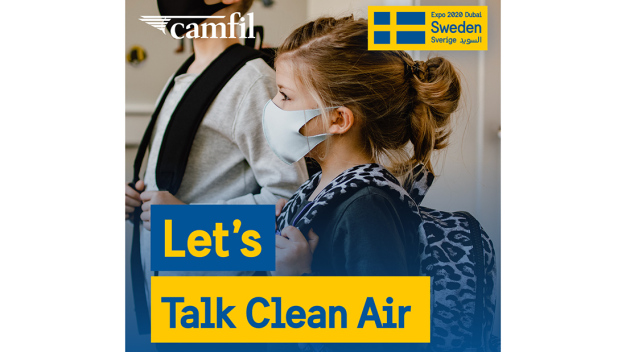
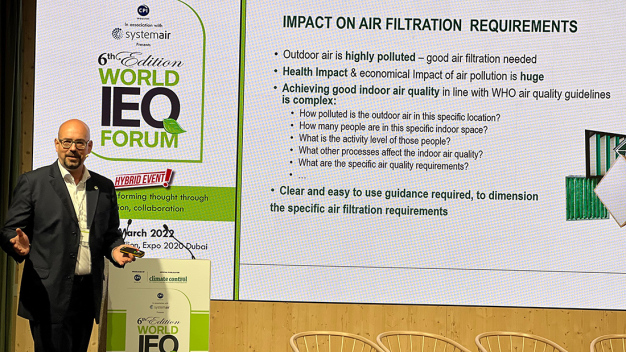

Air pollution affects human health and causes social and economic costs every year.
One way to protect people from air pollution is to ensure clean and healthy air inside buildings. This was one of the key conclusions of the 6th World IEQ Forum, held in early 2022 at the Swedish Pavilion at Expo Dubai.
Although the Expo in Dubai has ended, the issue of indoor air quality remains a global concern. According to the World Health Organization (WHO), the risk of COVID-19 virus transmission from person to person is higher in poorly ventilated indoor spaces. Furthermore, the WHO published a new version of its global air quality guidelines, which is the first update since 2005. "New scientific studies have shown that the pollution level threshold considered harmful to human health is now 50 percent lower than it was seventeen years ago when the previous air quality guidelines were published," says Tobias Zimmer, Vice President of Global Product Management and International Standards at Camfil.
Additionally, according to a recent WHO study, 99 percent of the world's population lives in areas with excessive air pollution. Air pollution has far-reaching consequences in the form of diseases, millions of premature deaths worldwide each year, and significant economic costs.
"In the North Africa and Middle East region, air pollution is responsible for 270,000 deaths annually and costs amounting to 41 billion US dollars," says Tobias Zimmer. He points out that most people spend 90 percent of their time indoors and that the simplest and most effective way to protect oneself from harmful particles in the air is to invest in efficient air filtration solutions in buildings.
"The need for high-quality air filtration is underscored by the much lower threshold values for PM2.5 and PM10 in the new WHO air quality guidelines. These thresholds also align with Eurovent Guideline 4/23 for selecting air filter classes according to EN ISO 16890 for general ventilation applications."
At the same time, Tobias Zimmer emphasizes that there is no one-size-fits-all solution for cleaning indoor air. "The consensus at the World IEQ Forum was that each solution must be tailored to the building's location. The quality of outdoor air determines which air filter solution is appropriate."
What works in a temperate zone, for example, may not be suitable in regions with high humidity. "Needs can also vary within a region. Cities are more affected by air pollution than rural areas. Some cities are more polluted than others, and so on."
The World IEQ Forum provides experts in indoor air quality, like Tobias Zimmer and his colleagues, the opportunity to exchange ideas with representatives from health ministries and other officials from various countries.
"It is essential that we continue to raise awareness about the urgent need to protect people from air pollution. When considering the human and financial costs on a global scale, it is clear that we cannot afford not to act."
Tobias Zimmer explains that they did not only discuss the importance of healthy indoor air quality. "We also demonstrated the concept by measuring outdoor and indoor air at the site during the EXPO. The outdoor air in Dubai was ten times more polluted than WHO recommendations. The air inside the Swedish Pavilion was well below WHO threshold levels."
He concludes by saying that the impact of clean indoor air in the Swedish Pavilion was visible to the naked eye. "After several hours of presentations by myself and other speakers, the audience was still fresh and alert. So, we can truly say that we proved the benefits of clean, healthy, and productive indoor air."

Camfil GmbH
Feldstr. 26 - 32
23858 Reinfeld
Germany
Phone: +49 4533 2020
Fax: +49 4533 202202
email: info.de@camfil.com
Internet: http://www.camfil.com