


- Translated with AI
Günter Knopf
Vacuum Fire Extinguishing System
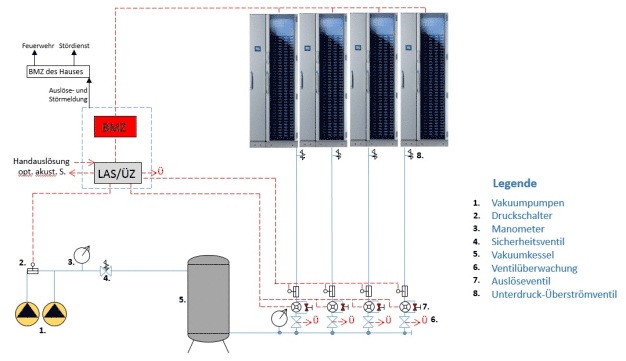
System diagram of the vacuum cleaning system
A recently developed extinguishing method is the vacuum fire extinguishing system. With relatively little effort, oxygen is quickly removed from the fire in the event of a blaze (see illustration).
Fires occur due to the coincidental presence of combustible materials, oxygen, and ignition energy (most exothermic reactions require this ignition energy). In the case of a developing fire, a vacuum extinguishing system removes a portion (about 50%) of the air or atmospheric air pressure (1,000 hPa or 100,000 Pa) within a defined space, leaving only a partial pressure of approximately 50,000 Pa. This air pressure corresponds to an altitude of about 6,000 meters and is no longer sufficient to sustain an exothermic oxidation reaction. Due to the lack of oxygen replenishment, oxidation comes to a halt. Consequently, no more heat is produced. The fire is extinguished instantly.
Features
Control cabinets and server racks would need to be designed structurally to connect to a vacuum extinguishing system, in order to, on the one hand, create and maintain a (partial) vacuum, and on the other hand, withstand the stress of the air pressure difference. Existing ventilation openings would need to be fitted with flaps that close in the event of a fire or vacuum loss and are self-sealing due to the air pressure difference. The housings would need to be sufficiently stabilized with cross braces. The interior of a simple household vacuum cleaner (English: vacuum cleaner), for example, also has about a 50% partial vacuum during operation under full load. For very large room volumes (e.g., high-bay warehouses), the corresponding air volume could be managed within a few minutes using 1 to 2 gas turbines (modified turbofan engines), reducing the air pressure to half of the normal atmospheric pressure. The fact that an aircraft engine is capable of this is demonstrated by the fact that the increased air pressure for the pressurized cabin (which during flight at about 12,000 meters altitude corresponds to an air pressure similar to about 3,000 meters) is taken from the bleed air line of the low-pressure axial compressor of most aircraft engines.
Applications:
- Inside control cabinets
- Inside server racks
- Small server rooms
- Operating rooms
- Cleanrooms
Advantages:
- The extinguishing leaves absolutely no damage, regardless of the objects involved,
- Minimizes operational and production downtimes and/or inventory losses and associated economic consequences,
- Is not dangerous to humans if pre-warning times are observed; the air pressure of 50,000 Pa is not lethal in the short term.
Ingenieurbüro für anlagentechnischen Brandschutz Knopf
12589 Berlin
Germany