

- Company
- Translated with AI
University of Rostock and Yaskawa agree on the continuation of their cooperation
Development of robot-based solutions for laboratory automation
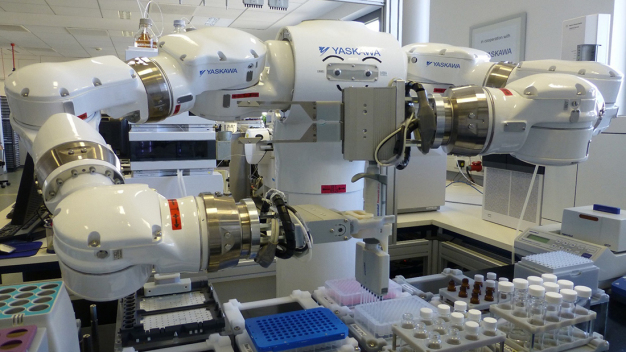
Yaskawa robot Motoman CSDA10F in use for automated sample preparation. The robot uses traditional multi-pipettes from manual laboratory work. (Source: CELISCA)
The Center for Life Science Automation (CELISCA) at the University of Rostock and Yaskawa have agreed to continue their collaboration in developing robot-based solutions for laboratory automation. As one of the first European users overall, the institution will also deploy a specially developed robot model from the new Motoman HD series, designed specifically for life science applications.
Since 2015, the Center for Life Science Automation (CELISCA) at the University of Rostock has been using a dual-arm robot, the Motoman CSDA10F, with a payload of 10 kg and a reach of 895 mm (per arm). Yaskawa introduced this robot to Europe just a year earlier, in 2014, and provided CELISCA with a specimen on a permanent loan. Since then, numerous research projects and scientific publications on robot-based laboratory automation have emerged from this collaboration.
“As a research institute, we primarily need a flexible system for many applications in the laboratory and with a certain payload,” explains Prof. Dr.-Ing. habil. Kerstin Thurow, Chair of Automation Technology / Life Science Automation and Managing Director of CELISCA, regarding the initial decision for this model. Over time, robotics has naturally evolved, says Prof. Thurow.
Robots for Hygiene-Sensitive Areas
Against this background, CELISCA will be provided with the new Hygienic-Design robot, the Motoman HD8 from Yaskawa. It is intended to be used in a fully automated system for sample handling in crystallization processes in materials research, within a EU-funded synergy project, where human intervention is no longer required.
The Motoman HD8 meets the high standards of laboratory and ISO cleanroom environments. It can perform various handling tasks in hygiene-sensitive areas of laboratory automation, the pharmaceutical industry, or the food industry.
Focus on Sample Preparation
The researchers at CELISCA place particular emphasis on sample preparation, such as activities and processes like pipetting or opening and closing screw caps. These are typically highly repetitive tasks that also require very high accuracy in repetition.
“These tasks are relatively boring for humans and ergonomically strenuous,” summarizes Prof. Thurow. “Automating these steps frees up laboratory staff for cognitive tasks.” The expert adds another aspect: only through automated processes in the laboratory can research results be truly standardized, repeatable, and thus comparable.
Points of Contact for the Future
CELISCA sees new interesting opportunities for the future in automating applications that are currently difficult to automate and in developing and utilizing standardized interfaces, such as those offered by the new Motoman HD8. “Automation must be attractive to the end customer,” explains Prof. Thurow. “In recent years, robotic systems for laboratory automation have become more affordable and thus more attractive to a wider range of users. Yaskawa systems are very reliable because they come from industrial applications, and you also receive excellent support.” Not least, automation, according to Prof. Thurow, “can also inspire young people in the life sciences industry, who are often more tech-savvy, helping to counteract the growing shortage of skilled workers.”
The Center for Life Science Automation CELISCA
Led by Prof. Dr.-Ing. habil. Kerstin Thurow, the Center for Life Science Automation (CELISCA) is a central scientific institution of the University of Rostock (according to § 94 LHG M-V) and has been researching highly automated processes in the field of life sciences, including medicine, since 2003. Pioneering work includes innovative automation concepts and the use of mobile robots in laboratories. CELISCA’s research is interdisciplinary and international, focusing on the interface of engineering sciences, medicine, and natural sciences. In October 2024, CELISCA will celebrate its 25th anniversary in Rostock.
YASKAWA Europe GmbH
85391 Allershausen
Germany