

- Translated with AI
The value added by component cleaning is increasing
27th Conference on Industrial Component Cleaning on March 15-16, 2018 in Ulm highlighted optimization potentials in the cleaning process
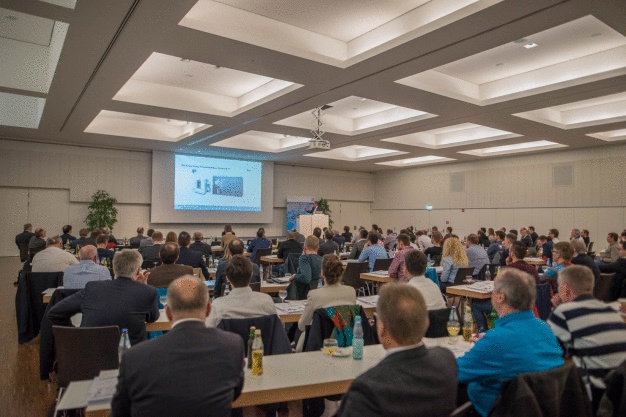
The increasing importance of component cleanliness as a quality criterion and value-adding factor requires exploiting optimization potential in the cleaning process. The conference highlights ways to achieve this. (Image source: fairXperts GmbH & Co. KG)
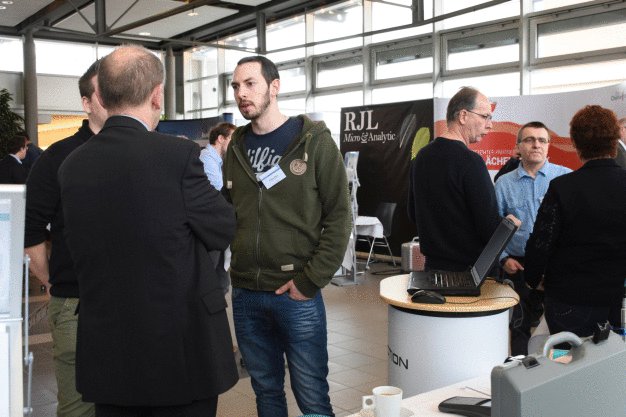
The opportunity for dialogue with the exhibiting companies is actively used during the specialist conference. (Image source: fairXperts GmbH & Co. KG)
That the FiT, with the program of the 27th Specialist Conference "Industrial Part Cleaning," provided answers to essential questions from users is demonstrated by comments from the 142 participants, such as "A very good mix of relevant topics for the field of industrial part cleaning." Furthermore, the lectures in the session "QSREIN 4.0 – Opportunities for Cleaning Technology" offered food for thought.
At the 27th Specialist Conference "Industrial Part Cleaning" on March 15 and 16, 2018, in Ulm, 142 participants learned about fundamentals, optimization potentials, and innovations in this manufacturing sector. The event organized by fairXperts GmbH & Co. KG on behalf of the Industrial Parts Cleaning Association (FiT) recorded the highest number of participants ever. No wonder, as part cleaning plays an increasingly important role across all industries as a quality criterion and value-added factor. The overall rating of the conference with a grade of 1.6, along with consistently positive comments from participants regarding the program, quality of lectures, and venue, demonstrates that FiT has hit the nerve of users and the industry as a navigator of part cleaning. At the same time, the high approval underscores the leading position of the conference as a source of knowledge on industrial part cleaning. The 22 exhibiting companies also expressed high satisfaction with their participation.
Experience reports on process optimization
The framework of the program was formed by the guidelines developed by FiT for quality-assuring process management in part cleaning. In the opening lecture, Kerstin Zübert (Hermann Bantleon GmbH) presented measures and changes in the manufacturing process that enabled a metalworking company to reliably and efficiently implement cleanliness requirements such as "no particles larger than 150 µm" and oil-free, ready-for-assembly parts. Starting from the existing cleaning concept, where degreasing was done internally in bulk and fine cleaning externally by a service provider, Frank Repenning (Progress Werke Oberkirch AG) presented the optimization of the supply chain through a company-specific cleaning process. Stations included the development of a cleaning magazine and investment in a new cleaning system with part delivery into a cleanroom. Michael Brust (Thor GmbH) addressed the causes, consequences, and prevention of microbiological contamination in the process chain. Michael Kuppinger (Steel Automotive GmbH) reported on the design and implementation of a new cleaning concept for solvent cleaning and preservation of stamping and forming parts for the automotive industry. He highlighted aspects related to chemistry, plant technology, part handling, solvent preparation, user-friendliness, environmental compatibility, and economic efficiency. Jörg Ihde (Fraunhofer Institute for Manufacturing Technology and Applied Materials Research IFAM) discussed inline cleaning processes such as plasma, CO2 snow blasting, and laser cleaning for secure bonding processes. He provided information on typical application areas, materials, as well as the strengths and weaknesses of each method. Matthias Wadle (Piller Entgrattechnik GmbH) introduced high-pressure water jetting as a cleaning and deburring process for various applications, from the automotive industry to hydraulics, pneumatics, and medical technology.
Participants received a first draft of the new FiT guideline "Controlling Film Contaminations" with their conference materials, which was developed by the FiT working group for measurement, testing, and control. In the related presentation, Michael Flämmich (VACOM Vacuum Components & Measurement Technology GmbH) provided information on the status, content, and goals of these new recommendations. Additionally, Wolfgang Schmitt (DODUCO Solutions GmbH) shared from the user's perspective the motivation to participate in the development of the guideline. An overview of the state of technology in measurement technology and parameters for monitoring the ultrasound effect chain was provided by Thomas Dreyer (Weber Ultrasonics AG) and Markus Windisch (Fraunhofer Institute for Process Engineering and Packaging IVV). Solutions for production-related monitoring of particulate contamination on parts and in the manufacturing environment using rapid measurement technology were presented by Markus J. Heneka (RJL Micro & Analytic GmbH).
The first day of the event concluded with the Innovation Forum for Part Cleaning, featuring six lectures. Providers from the fields of cleaning processes, measurement technology for controlling particulate and film cleanliness, water treatment, and filtration presented new solutions and services.
QSREIN 4.0 – Opportunities for Cleaning Technology
The second day focused on digitalization and began with a lecture titled "Smart Factory – Where is it heading?" Jochen Leppert (Staufen Digital Neonex) introduced Industry 4.0 innovation approaches in the areas of cyber-physical systems, assistance systems, as well as technical and process innovations. He also shared examples of implemented solutions across various industries. The lecture by Prof. Lothar Schulze (Deputy Chairman of the FiT) and Robert Huber (Pero AG) addressed the connection between fundamental research and user orientation in the FiT research program QSREIN 4.0. They discussed goal clarification, insights from industrial practice, suggestions from plant technology, solution approaches, and proposals for a research concept. They also called on participants to contribute. Joachim Schwarz and Thomas Gutmann (both MAFAC E. Schwarz GmbH & Co. KG), as well as Roland Denefleh (SEW-Eurodrive GmbH & Co. KG), presented a real-world example from SEW-Eurodrive illustrating how existing solutions can enhance process stability and plant availability through knowledge-based process control. Under the motto "A modern part cleaning system monitors, communicates, and intervenes," Robert Huber (Pero AG) presented a practical example from medical technology. He explained which optimization potentials can be exploited by recording various parameters in the cleaning process. The lecture by Prof. Andreas Syska (Fascination Production) with his presentation "Beyond Industry 4.0" also offered food for thought. He invited participants to share the vision of a digital and social market economy that serves people, while also critically examining the possible negative social and employment-related impacts of digitalization and networking.
The next conference "Industrial Part Cleaning" will take place on March 15 and 16, 2019, in the Donausaal at Messe Ulm.
fairXperts GmbH & Co. KG
72639 Neuffen
Germany