


- R+D & Community of Interest
- Translated with AI
Surface cleaning into the last corner
1. Price Clean! 2018
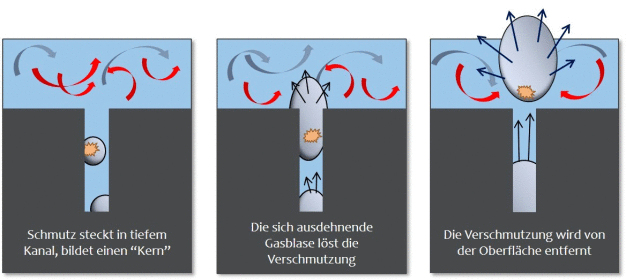
The effects of foam formation. (Source: LPW Reinigungssysteme GmbH)
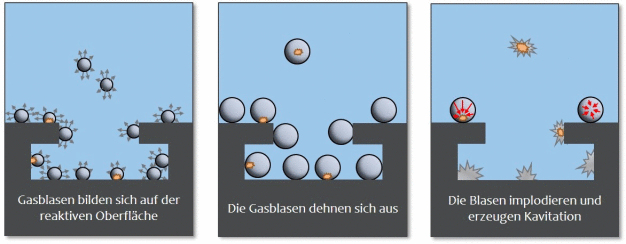
Foam formation and cavitation. (Source: LPW Reinigungssysteme GmbH)
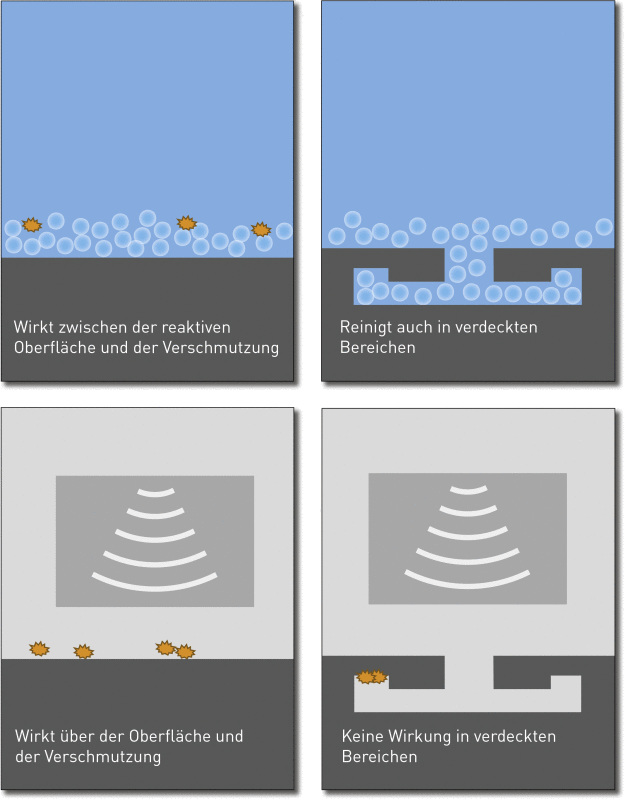
The cyclic nucleation exerts its effect partly also under contamination and in concealed areas of the component directly on the surface of the component. (Source: LPW Reinigungssysteme GmbH)
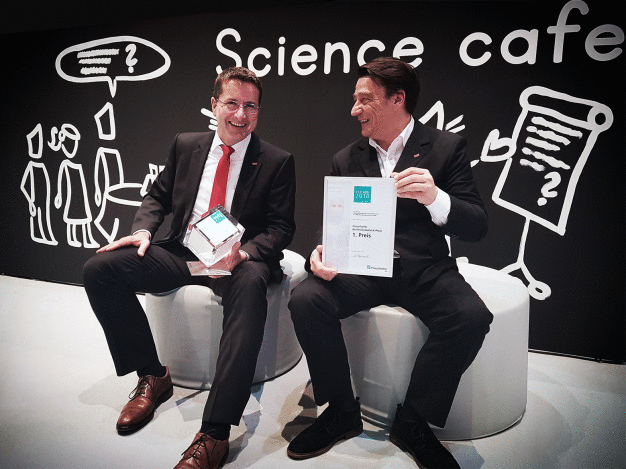
Gerhard Koblenzer and Hans Hauger, LPW Cleaning Systems GmbH. (Source: LPW Cleaning Systems GmbH)
Surface cleaning down to the last corner. Whenever we open a carbonated water bottle, the bursting bubbles greet us with effervescence. They form during the transition from the liquid to the gaseous phase and are an example of a physical process whose mechanism is used for cleaning. This so-called nucleation has been further developed by LPW Cleaning Systems GmbH for their cleaning processes and has been awarded the 1st prize Clean! 2018.
The «Cyclic Nucleation Process (CNp)» technology operates on the principle of cyclic nucleation, a vacuum process with particular strengths in cleaning capillary structures and complex geometries, as they occur everywhere in industrial production:
In a sealed container filled with cleaning or rinsing liquid, the pressure is reduced until bubbles form inside the container and directly on all surfaces, especially in complex structures such as fine elongated hollow spaces, so-called capillaries and drillings. When the vacuum is suddenly released, the formed vapor bubbles collapse. The implosion generates a so-called pressure change force, which mechanically acts on the component surface and penetrates and lifts dirt.
The actual innovation is hinted at by the adjective «cyclic» nucleation. «The decisive mechanical washing effect consists in defining a fixed cycle between a set lower switching point in the vacuum and an upper switching point in the underpressure or possibly overpressure, which can be repeated and varied arbitrarily,» explains LPW Managing Director Gerhard Koblenzer.
The pressure changes propagate through the cleaning liquid into the last corners. A media flow occurs across the entire surface, enabling targeted exchange. Particles and dirt in hard-to-reach areas are loosened by the cavitation effect and transported out of the immediate vicinity of the component through the asymmetric media exchange.
The CNp process not only offers process-safe cleaning for the electronics and semiconductor industries, medical technology, and optical industry as before. It is also suitable for cleaning tasks in many other industrial sectors, such as the automotive industry. Examples include fine drilling in fuel injection technology as well as hidden and complex internal geometries like cooling elements or bulk material.

Fraunhofer-Institut für Produktionstechnik und Automatisierung IPA
Nobelstraße 12
70569 Stuttgart
Germany
Phone: +49 711 970 1667
email: joerg-dieter.walz@ipa.fraunhofer.de
Internet: http://www.ipa.fraunhofer.de