




- Electronics (wafers, semiconductors, microchips,...)
- Translated with AI
Strengthening Saxon microelectronics research for chiplet innovations within the framework of the APECS pilot line
Saxony promotes microelectronics research within the framework of the EU Chips Act with 38 million euros
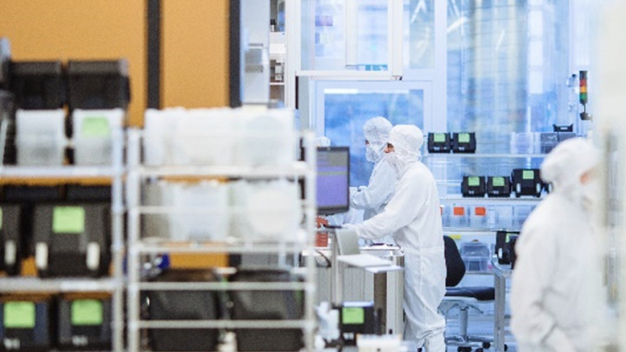
Work in the 200-mm cleanroom at Fraunhofer IPMS. © Fraunhofer IPMS
![Ceremonial presentation of the symbolic check for 38 million euros from Prime Minister Michael Kretschmer to the Saxon microelectronics institutes of the Fraunhofer Society (from left to right: Prof. Dr. Harald Kuhn [Fraunhofer ENAS], Prof. Dr. Martin Schneider-Ramelow [Fraunhofer IZM], Prof. Dr. Harald Schenk [Fraunhofer IPMS], Prime Minister Michael Kretschmer, Dr. Stephan Guttowski [Research Factory Microelectronics Germany], Prof. Dr. Peter Schneider [Fraunhofer IIS, Institute Division for Development of Adaptive Systems], Dr. Oliver Höing [Federal Ministry of Education and Research BMBF]) © Fraunhofer IPMS](/uploads/images/_scale/mg8446apecsfoerderurkundempkretschmerfraunhoferipms_169_626x352.jpg "Ceremonial presentation of the symbolic check for 38 million euros from Prime Minister Michael Kretschmer to the Saxon microelectronics institutes of the Fraunhofer Society (from left to right: Prof. Dr. Harald Kuhn [Fraunhofer ENAS], Prof. Dr. Martin Schneider-Ramelow [Fraunhofer IZM], Prof. Dr. Harald Schenk [Fraunhofer IPMS], Prime Minister Michael Kretschmer, Dr. Stephan Guttowski [Research Factory Microelectronics Germany], Prof. Dr. Peter Schneider [Fraunhofer IIS, Institute Division for Development of Adaptive Systems], Dr. Oliver Höing [Federal Ministry of Education and Research BMBF]) © Fraunhofer IPMS")
Ceremonial presentation of the symbolic check for 38 million euros from Prime Minister Michael Kretschmer to the Saxon microelectronics institutes of the Fraunhofer Society (from left to right: Prof. Dr. Harald Kuhn [Fraunhofer ENAS], Prof. Dr. Martin Schneider-Ramelow [Fraunhofer IZM], Prof. Dr. Harald Schenk [Fraunhofer IPMS], Prime Minister Michael Kretschmer, Dr. Stephan Guttowski [Research Factory Microelectronics Germany], Prof. Dr. Peter Schneider [Fraunhofer IIS, Institute Division for Development of Adaptive Systems], Dr. Oliver Höing [Federal Ministry of Education and Research BMBF]) © Fraunhofer IPMS
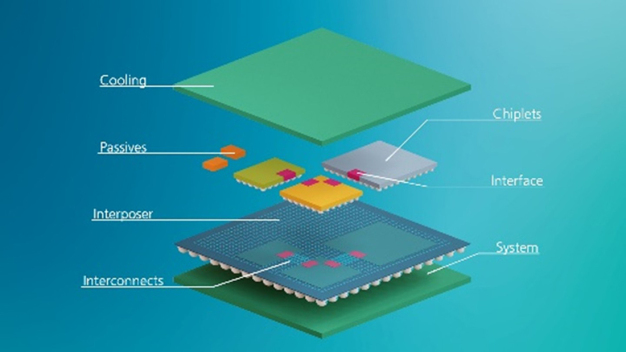
Design of chiplet-based systems using a modular approach. © Fraunhofer IPMS
The Saxon microelectronics institutes of the Fraunhofer Society are expanding their technological capacities in the field of chiplet innovation and making a significant contribution to the APECS pilot line within the framework of the European Chips Act. The state of Saxony is investing 38 million euros in funding for this purpose. On January 30, Prime Minister Michael Kretschmer presented a symbolic check for the funding amount. APECS enables the further expansion of research and development infrastructure across Europe over the next 4.5 years. The total funding amounts to 730 million euros, provided by Chips Joint Undertaking, the Federal Ministry of Education and Research (BMBF), and other national funding sources. APECS is coordinated by the Fraunhofer Society and implemented by the Research Factory Microelectronics Germany (FMD).
As part of the pilot line "Advanced Packaging and Heterogeneous Integration for Electronic Components and Systems" (APECS), the Saxon Fraunhofer institutes IPMS and ENAS, along with parts of the Fraunhofer IZM and Fraunhofer IIS, will significantly expand their semiconductor research infrastructure over the next 4.5 years. The APECS pilot line is a key component of the EU Chips Act to advance chiplet innovations and increase research and manufacturing capacities for semiconductors in Europe. The state of Saxony supports this with funding of 38 million euros. During a ceremonial event on January 30, 2025, Prime Minister Kretschmer handed over the symbolic check for the funding amount and learned about the APECS pilot line. A particular focus was on the offerings of the Fraunhofer institutes resulting from the pilot line for industry.
"With the European Chips Act, the EU has made a smart decision to invest and expand European chip manufacturing. It is important for our economy and our prosperity that we become more independent in this key industry in Europe and Germany. The Free State plays a decisive role as a leading European microelectronics location. With the involvement of four Fraunhofer institutes in Saxony within the framework of the pilot line, this position is now further strengthened and consolidated. The Free State supports this strategically important investment so that Europe's chip offensive will be a success," said Prime Minister Kretschmer during the handover of the symbolic funding check.
Saxony's Minister of Science Sebastian Gemkow adds: "Investments in semiconductor research are urgently needed. We need this boost if Europe is to continue to influence technological developments in microelectronics and set industrial standards in the future. The research environment in Saxony, with institutions of the Fraunhofer Society, strong universities, and industry partners, provides a solid foundation. A large part of the funds allocated to APECS by the EU, federal government, and the Free State benefits the local scientific institutions. This significantly accelerates the transfer of research results into industry and particularly strengthens Saxony's chip industry as a driver within the European network."
Strengthening European competitiveness and technological resilience in the development and production of semiconductors
The leaders of the four Fraunhofer institutes are very grateful for the generous support from Chips Joint Undertaking, the Federal Ministry of Education and Research, and the state of Saxony: "Through investments via the APECS pilot line, the performance of the existing research infrastructure will be significantly improved. The Silicon Saxony institutes will thus be able to research pioneering heterointegration technologies and develop them for industrial application. Companies nearby and across Europe will have access to enormous innovation potential to strengthen their global competitiveness," said the institute directors in consensus.
APECS: Heterogeneously integrated technologies for Europe's economy
The APECS pilot line is a crucial component of the EU Chips Act to promote chiplet innovations and increase research and manufacturing capacities for semiconductors in Europe. The institutes collaborating within the FMD work closely with other European partners to build the pilot line and thus make a significant contribution to strengthening Europe's technological resilience and thereby increasing global competitiveness in the semiconductor industry.
Both large industrial companies and small and medium-sized enterprises (SMEs) and startups will benefit from the pilot line by gaining accessible access to cutting-edge technologies and ensuring secure, resilient semiconductor value chains. APECS is co-financed by Chips Joint Undertaking and national funding from Belgium, Germany, Finland, France, Greece, Austria, Portugal, and Spain within the framework of the "Chips for Europe" initiative. The total funding for the APECS pilot line amounts to 730 million euros over 4.5 years.
The APECS pilot line focuses on the scalable industrial transfer of newly developed innovations in heterointegration, especially the use of new chiplet technologies, thus bridging the gap to application-oriented research. APECS goes beyond traditional system-in-package (SiP) methods and aims to deliver robust and trustworthy heterogeneous systems that significantly enhance the innovative capacity of Europe's semiconductor industry.
On the topic of chiplets
The idea behind chiplets is to use different types of Intellectual Property (IP) that can be utilized for specific functions. IP cores are pre-fabricated, reusable functional blocks of a chip design in the semiconductor industry. These are often licensed as intellectual property from the developer to other IC designers to integrate into a larger IC design. The various blocks are already tested and can be assembled like puzzle pieces, allowing existing IC structures to be used and only parts to be redesigned. A chiplet is not a fully functional individual chip but a part of a chip that can be combined with other functional elements. The concepts and initial implementations of chiplets promise not only higher integration densities but also touch on environmental aspects of electronics concerning resource efficiency, critical raw materials, modularity, and reusability of design blocks.
Fraunhofer-Institut für Photonische Mikrosysteme IPMS
01109 Dresden
Germany



