


- Translated with AI
Real-time measurement of particle deposition is a revolution
apmon_2012
apmon_system_2
In cleanrooms, a lot of attention is currently being paid to suspended solids. However, product quality is not affected by small particles in the air that do not settle but by large particles that fall onto the product. Particulate deposition also occurs in the cleanest cleanrooms where people work or machines operate. This has been confirmed through elaborate, slow, and costly testing procedures. The introduction of the award-winning APMON, an affordable, independent real-time deposition measurement system, changes everything. APMON can be used as an alarm system, for employee training, for root cause analysis of particle deposition, and even for setting limits for particle deposition in cleanrooms.
Large particles ranging from 10 to 100 micrometers can settle on products even in the cleanest cleanrooms. Considering extensive air filtration and intelligent airflow, this seems impossible but applies to all cleanrooms where people work or machines run. Particle filtration ensures that the air entering a room is almost particle-free and completely free of such large particles. This is a crucial prerequisite for clean production but not sufficient on its own. Operating machinery and working people also cause particle deposits in the cleanroom. Activities such as walking and working generate particles; cleaning or touching surfaces also stir up deposited particles. The closer this occurs to the critical surface of a product, the higher the likelihood of particles settling there. Although a good cleanroom is designed to keep particles away from these surfaces, protection is never truly complete. Especially large particles are only minimally influenced by airflow.
Precipitation
To combat particle deposition and thus improve process results in cleanrooms, it is extremely important to identify the main causes of deposition. Therefore, deposition must be measurable. All current methods for measuring particle deposition or particle fallout use test plates. These test plates are placed on a surface for a specific period, usually 24 hours. The placement and collection of the test plates must be carried out with utmost care to prevent contamination. After collection, they are usually manually inserted into a surface analysis device. These devices typically operate slowly and are expensive. With these devices, the particle size distribution can be determined, from which the level of particle deposition (Particle Deposition Class, PDC) is derived. At the end of this effort, there is this small but very valuable hint.
Detection
Koos Agricola, the cleanroom officer at Océ in the Netherlands, demonstrated that PDC determination can be used to show the effectiveness of various particle control procedures, e.g., more frequent cleaning and improved clothing. By placing different test plates at various locations, he was able to identify which machines (and workers) contributed most to particle spread. Achieving these results requires a very precise approach and considerable perseverance. The outcome is likely positive, but the extent of improvement is probably difficult to measure. Therefore, such investigations are rarely conducted. Even routine PDC measurements are often only performed irregularly, if at all. And when they are performed, results are only available after 24 hours or more, which can lead to significant production downtime in the meantime. In conclusion, there is currently no international standard for particle deposition, partly because no simple and cost-effective measurement method has been developed to date.
Fast
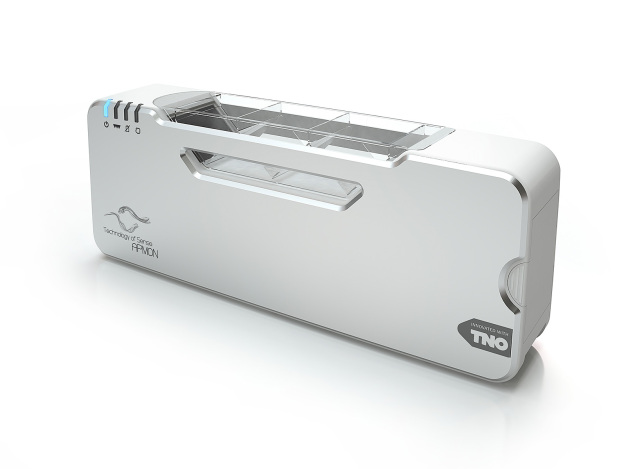
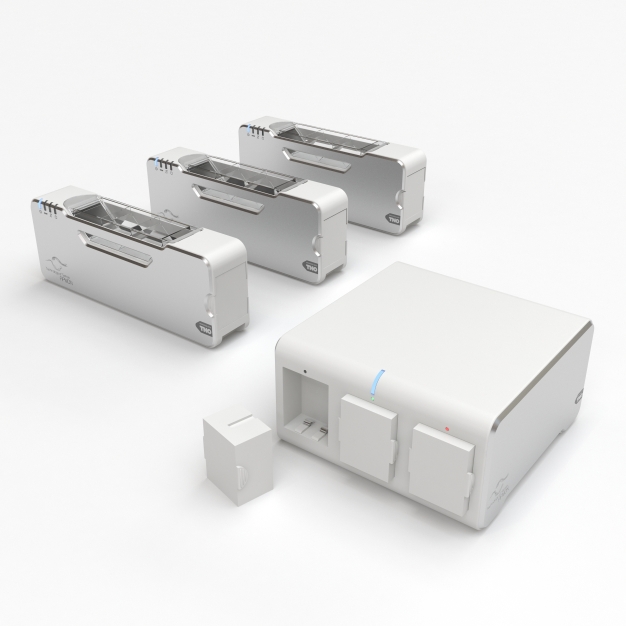
APMON, the Advanced Particle MONitor, fundamentally changes this. An optical system automatically creates a snapshot of a total surface of about 60 cm every few minutes. Each snapshot is compared with the previous one, counting and measuring all newly arrived particles. The recorded data are automatically and continuously transferred into PDC levels. The system consists of a monitor (up to six monitors to determine PDC levels at six different locations simultaneously) and a base unit that performs calculations and stores data. The system can be set to trigger an alarm if more particles are deposited than permitted between two snapshots. The user can set the alarm level or the permissible PDC value and specify where the alarm is triggered: either on the monitor itself, the base unit, or the cleanroom officer’s workstation. Maintenance of the APMON is straightforward. From time to time, the single-use detection module, on which particles deposit, must be replaced. How often this needs to be done depends on the cleanroom quality and can range from two to three weeks. The system automatically calibrates itself after installing the new detection module and subsequently with each new snapshot. The data are stored automatically, making it easy to generate status reports using the system.
Standard
Setting up and maintaining APMON for PDC control in cleanrooms is very simple. Since the investment costs are comparable to those of common systems, using APMON is definitely more cost-effective. But the most important advantage is that measurements are performed in real-time and at least 150 times faster than conventional methods. This allows you to act quickly by stopping production or isolating patients who could be harmed by sudden particle deposition. It also clearly shows what caused the sudden deposition, such as floor cleaning, a lunch break with many people moving around, or inexperienced staff. Therefore, APMON is ideal for employee training and quality monitoring in cleanrooms and operating rooms. This further underscores the importance of establishing clear PDC limits for different types of cleanrooms. There is no doubt that cleanroom managers and other professionals will appreciate APMON. Recently, APMON was awarded the Cleanroom Innovation Award at Cleanzone 2012 in Frankfurt. Out of five nominated products, no less than 80 percent of visitors voted for APMON.
We believe that APMON will revolutionize cleanroom monitoring. Occasional airborne particle measurements will still be necessary to verify air filtration. However, the primary means of contamination control will be particle deposition measurement.
Technology of Sense b.v.
7500 AA Enschede
Netherlands