



- Furnishing
- Translated with AI
Maike Kranz
New Lab
Maike Kranz
Terms like Lab 4.0 or the Laboratory of the Future are currently frequently used when discussing trends and technologies that significantly shape and influence laboratory planning. But what exactly lies behind these buzzwords, and what does it mean for companies that want to modernize or redesign their laboratories? What core factors must laboratories fulfill to have the necessary flexibility and performance capacities now and in the future to meet both evolving professional requirements and the challenges of modern work environments?
A new and innovative laboratory must be well planned and thoughtfully designed. Laboratories have already evolved into highly complex data factories in parts, a trend that will continue with new and more powerful technologies in even shorter innovation cycles.
The world is in upheaval, and we are experiencing transformation on various levels – technological, social, and ecological.
The digitization of information is increasingly becoming the key to success, and the associated data form an essential asset. Companies want their laboratories to interact worldwide in real time, with the degree of automation serving as a tool for maintaining the highest quality standards.
The experiences of recent years have also shown us that laboratory staff no longer necessarily perform their activities at the lab bench, but there is also significant flexibility in working hours and locations, up to complete relocation of the workplace.
Last but not least, the urgently needed shift towards greater climate protection and effective sustainability also influences innovative planning and modern design of future-proof work environments in the laboratory.
The transformations described in laboratories can take many forms. However, the top priority should be to put people and their needs at the center. Respectful handling of the resource "human" means creating relief, optimizing processes and work safety through digitalization, and creating free spaces for experimental work or other core activities.
So-called smart buildings offer intelligent networking of building management with application- and usage-specific automation, which also optimally supports digitalization in laboratory operations. They open up new possibilities for designing innovative and holistic work environments in the laboratory, enabling the people working there to have all the options for exchange, communication, creativity, and knowledge transfer needed in the future laboratory.
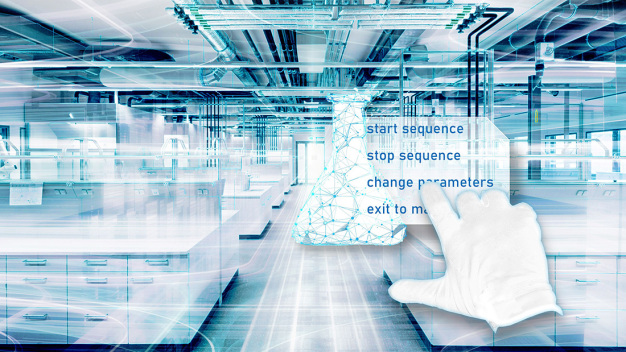
The range of digital systems in the laboratory is broad and can both facilitate daily work and improve result quality.
An example is the switch to LIMS and LES systems, which replace manual, error-prone documentation with immediate electronic data collection from measurement or analysis devices. Traceability of (measurement) data creates transparency and ensures the integrity of the generated information. This requires a more sophisticated technical infrastructure within laboratories, which is often lacking in older buildings. Intelligent buildings also enable users to access important environmental data via sensors, making the reproducibility and control of experiments and analyses easier.
The processing of data is often still decentralized in traditional laboratory environments. Integrating laboratory, room, environmental, and device data on a digital data platform allows targeted and location-independent data use.
Another application area that has been adopted across all manufacturing industries for many years and is increasingly mentioned in the context of digitalization is robotics. Today, repetitive processes can also be performed by robots in the laboratory, providing relief for staff.
An intelligent linking of the described application cases gives us an initial idea of the future already available today. Automated, repetitive processes can be linked with equipment bookings, leading to more effective utilization. Planned shared use of equipment allows for longer usage periods per day. Automation of processes can also extend device usage beyond regular working hours. For example, repetitive processes could run overnight, while devices are used during the day by staff for more specialized, non-repetitive tasks.
In facility management, applications such as predictive maintenance—proactive maintenance of machines and devices based on continuous monitoring and ongoing data analysis—are already common practice. Another area of process digitalization is logistics. Here, networking activities and operating systems in the laboratory with procurement can optimize storage, provisioning, and purchasing.
Many existing laboratories are currently not fully exploiting the potential offered by digitalization. Change means uncertainty and often requires rethinking. The many opportunities that digitalization offers individuals are best experienced through direct involvement in the development process. Therefore, Carpus+Partner AG conducts workshops with employees and stakeholders from all functions at the beginning of the planning phase, where staff can freely express their needs and wishes for the new workplace. Those involved in shaping their environment identify more strongly with their work and the workspace. Analyzing the current state and the individual processes and workflows in the facilities often reveals deficiencies in the existing spaces. Through employee participation in planning, the new laboratory structures can be tailored to specific activity requirements, pathways shortened, and daily work made easier and more efficient.
To enhance employee performance and attract new skilled workers, "job satisfaction" is a key focus. Practical experience impressively shows how much an innovative work environment with relaxation zones, attractively designed thinking rooms, and communication zones contributes. Even in existing laboratories, work environments can be significantly improved through technical optimizations, such as acoustic elements or slowed ventilation speeds, or through the use of new materials, colors, and spatially adapted concepts.
Influenced by the crises of our time, the topics of skilled labor shortages and digitalization have recently been complemented by a significant increase in motivation and the need for greater sustainability in laboratory operations. Sustainability is not a single measure but a holistic approach to re-planning laboratories and a continuous process involving many steps in existing labs. This includes technical solutions such as the use of support beam technology in fume hoods, variable laboratory ventilation control, presence-based lighting and ventilation, night setback, or water-saving fixtures. Operational measures like avoiding single-use items, better waste disposal concepts, or evaluating the energy consumption of laboratory equipment are also effective. Additionally, reducing built-up space, open laboratory layouts, and utilizing space or equipment sharing through room or device sharing contribute significantly to sustainability in laboratory operations.
So what is the laboratory of the future?
A flexible, inviting laboratory work environment that meets the demands of technological advancement and digitalization.
At the same time, the future-proof laboratory should be modern and sustainable, providing ample space for people and allowing for tranquility. A place of work that fosters safety, creativity, productivity, and connectivity.
Carpus+Partner AG
52074 Aachen
Germany



