- Planning
- Translated with AI
Modern building design with Building Information Modeling
Facility and Process Design Life Sciences Smart Building Engineering and Management
The planning, construction, and management of a building are complex tasks. Many different disciplines are involved, and consequently, there is a lot to coordinate. Architects, civil engineers, and technicians work on their specialized fields – but how can we ensure that they do not work in isolation side by side, but instead collaborate efficiently?
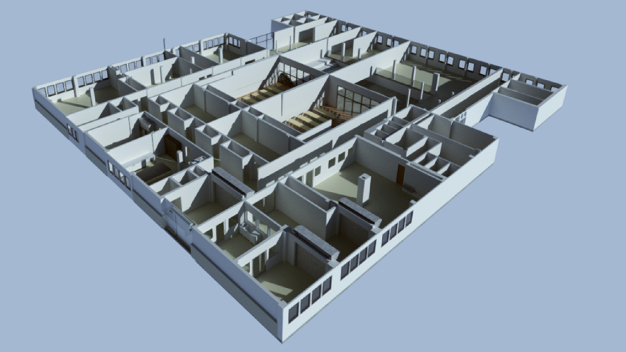
This is where Building Information Modeling (short BIM) comes into play. BIM is understood as an optimized method for planning structures based on software, with a focus on a collaborative approach. Specifically, BIM involves creating a virtual 3D model of a building that all participants can jointly edit and design digitally. The model contains a multitude of information, including technical aspects, as well as scheduling and project costs. Changes and their impacts on the overall project can be directly traced: for example, if the architect moves a door, the electrical wiring may need to be rerouted. If the structural engineer widens a support pillar, it affects the ventilation system, and so on. Using Building Information Modeling, such adjustments are immediately visible to all involved, greatly facilitating information exchange and the entire planning process. Moreover, BIM drastically reduces the frequency of errors during planning, resulting in significantly fewer additional costs during the construction of the building. These often lead to disputes, including lengthy legal conflicts.
In addition to its central importance during the planning phase, BIM also offers many advantages for the ongoing operation of buildings. The data created during modeling are reused and support, for example, maintenance. Therefore, BIM is also indispensable for modern, efficient facility management.
At the Faculty of Life Sciences, students in the field of Smart Building Engineering and Management, as well as in the Master's program in Facility and Process Design, have the opportunity to learn the fundamentals of BIM and further deepen their knowledge if they are particularly interested. They acquire valuable skills that are highly sought after in the industry. Especially BIM managers, that is, specialists who coordinate such projects across disciplines, are becoming increasingly important in the sector. Because BIM, as described, not only facilitates the planning process but can also significantly increase project efficiency and save costs.
An impressive example of a BIM project is the bachelor's thesis by Seyit Cal, who, under the supervision of Prof. Dr. Peter Schwarz, created a digital replica of the new model factory of the Sigmaringen Innovation Campus.

Hochschule Albstadt-Sigmaringen
Fakultät Life Sciences
Anton-Günther-Str. 51
72488 Sigmaringen
Germany
Phone: +49 7571 7328242
Fax: +49 7571 7328235
email: schmida@hs-albsig.de
Internet: http://www.hs-albsig.de/Seiten/homepage.aspx