



- Translated with AI
Minimal expenditure for maximum savings
Minimal expenditure for maximum savings
SCHMIDT Technology offers affordable flow sensors specifically for compressed air applications. Although compressed air is "only" just compressed air, it ranks among the most expensive energy carriers overall, costing between 1.5 and 3 cents per cubic meter. This provides ample reason to handle it sparingly. The use of suitable sensors helps analyze and optimize compressed air consumption, detect leaks more quickly and accurately, and reduce maintenance efforts. SCHMIDT Technology introduces the SS20.261, a submersible flow sensor designed for volume flow measurement in compressed air systems up to 8 bar. It is easy to use and very cost-effective, priced below €700.
Even if compressed air generation systems consist of coordinated system components, losses occur in every compressed air network, which can add up significantly. For example: In a medium-sized manufacturing operation, compressed air is produced with a compressor capacity of 960 m³/h. Besides the compressor's energy costs of approximately €21,000, the company must also spend an additional €5,300 per year on losses of 25%. However, if actual consumption is measured precisely and continuously and then optimized, energy costs could be reduced to around €17,000, and losses to just €850. How is this achieved? With a one-time investment starting at €629 for a volume flow sensor.
Strong Price and Many Advantages
At this price, SCHMIDT Technology is the only sensor manufacturer offering the SS20.261, a submersible flow sensor specifically designed for leak detection and consumption measurement in compressed air networks. It is pressure-resistant up to 8 bar and can detect standard flow velocities from 0.2 m/s up to 40, 60, or 90 m/s. In addition to the measurement range, users can choose between two sensor lengths of 200 mm and 350 mm, which can be immersed in pipes with diameters ranging from DN25 to DN600. Depending on the configuration, standard volume flows of up to 74,000 m³/h can be measured. The measurement accuracy is ±5%. Upon request, SCHMIDT Technology also offers the sensor with a high-precision calibration and ISO calibration certificate, increasing accuracy to ±3%. This is important for billing compressed air costs.
To display in m³/h, it is only necessary to multiply the pipe cross-section and the profile factor by the measured flow velocity. Temperature and pressure do not need to be considered. The reason for this straightforward evaluation lies in the sensor's measurement principle, which is based on thermal anemometry. This method eliminates errors caused by conversions from the outset, providing consistently high accuracy without drift or maintenance.
Save Energy and Increase Energy Efficiency
Like other machines, a compressed air system is subject to aging. Over time, leaks develop, from which air escapes silently and usually unnoticed. Through stationary measurement using a fixed immersion probe, actual consumption and leaks can be continuously analyzed even during downtime. Consequently, it is immediately recognized when the set limit is exceeded and maintenance outside the interval is necessary. This not only helps prevent production outages but also makes maintenance more cost-effective and condition-based. Furthermore, ongoing recording supports billing for compressed air consumption and contracting.
Image:
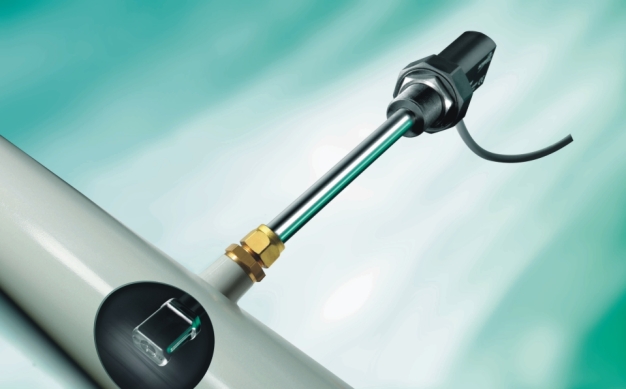
Schmidt Technology-1004-SS20261-Image4: Installed in pipes with diameters between DN25 and DN600, the sensor can measure volume flows of up to 74,000 m³/h.

SCHMIDT Technology GmbH
Feldbergstraße 1
78112 St. Georgen / Schwarzwald
Germany
Phone: +49 7724 899198
Fax: +49 7724 899101
email: o.joos@schmidttechnology.de
Internet: http://www.schmidttechnology.de