

- Hygiene & Cleaning
- Translated with AI
H2O2 Biodecontamination as a supplement to traditional disinfection cleaning
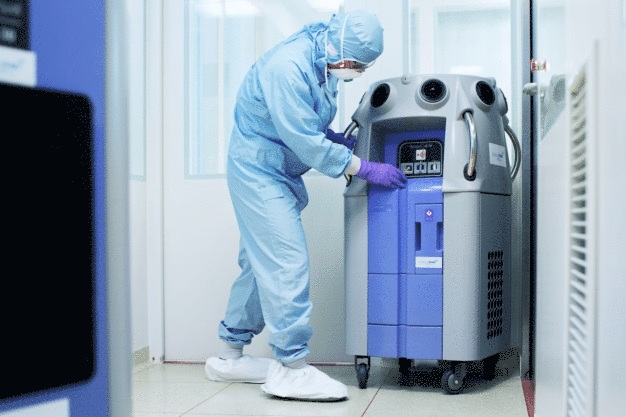
Disinfection with hydrogen peroxide (H2O2)
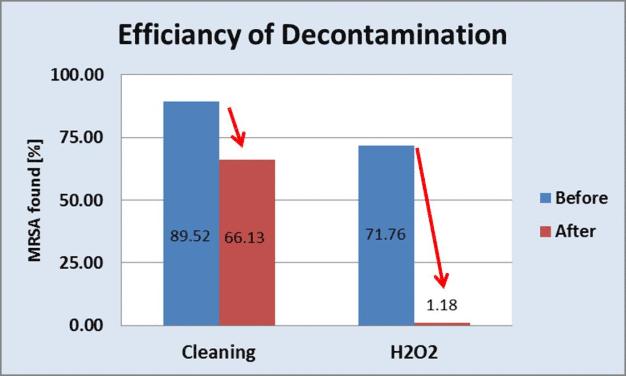
Figure 1: Efficiency of decontamination according to French et al, J Hosp Infect, 2004.
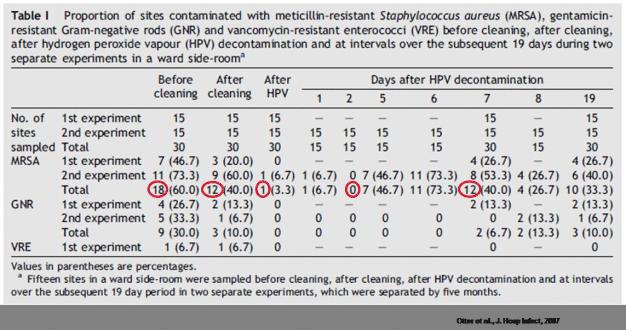
Table 1
Manual disinfection is a necessary and simultaneously difficult-to-validate process in cleanrooms. This is mainly due to the unpredictability of the human factor. Automatic disinfection of rooms can be a sensible alternative.
For producers of highly sensitive hygienic products such as pharmaceuticals, medical devices, or food, cleaning for requalification of the cleanroom and its potential validation is a challenging issue. Basically, the GMP guidelines require that "at each process stage, products and materials should be protected from microbial and other contamination" and that "written procedures for these processes should be formulated." Additionally, "cleaning and decontamination procedures with known efficacy should be used, as inadequate cleaning of equipment can often cause cross-contamination." The influence of the human factor, however, cannot be underestimated, as it is subject to significant fluctuations. Maintaining validation of a cleaning process and subsequent compliance with these regulations can only be reasonably achieved through close supervision and ongoing training of personnel. This often leads to a reliance on validated disinfectants and cleaning procedures, even though better, safer, and more effective methods and procedures are available over time.
Manual Disinfection
The effectiveness of manual disinfection heavily depends on the procedure and equipment used. Generally, it can be said that due to economic considerations, it is rarely feasible to manually disinfect all surfaces in a room, as especially cleanrooms, but also rooms in hospitals, food production, or manufacturing plants, tend to be highly complex. Complete manual cleaning and disinfection of all surfaces would require a lot of time and would be very difficult to justify in times of control and cost-saving measures. This problem is particularly critical when cleaning is outsourced. The tendency to assign the task to very inexpensive providers—without critically assessing whether the cleaning work can actually be completed within the offered timeframe—is high. Whenever possible, production facilities use so-called CIP systems (Cleaning-in-Place), which automatically clean and disinfect the entire system. Of course, this cannot be applied to entire rooms. Here, personnel deployment is indispensable. However, this method is prone to errors. Common mistakes include over- or under-dosing disinfectants, using incorrect water temperatures, incomplete or uneven wetting of all surfaces to be disinfected, improper use of cleaning equipment, infrequent or omitted intermediate cleaning to remove disinfectant residues, ignoring contact times, etc. Often, the specific instructions of operational SOPs are not correctly followed. This concerns especially cleaning too quickly, incomplete cleaning of surfaces, or incorrect cleaning techniques. These errors lead to insufficient dosing or undesired residues on surfaces. Byers et al. (Infection Control and Hospital Epidemiology, 1998) demonstrated that disinfection was unsuccessful even when staff were informed about sampling points and disinfection control procedures. Surfaces play an important role as sources of microbiological, chemical, or physical contamination transfer. These contaminations can be transmitted via the hands of staff, through used equipment and fixtures, or via the air. Additionally, the repeated use of cleaning textiles in different rooms can promote cross-contamination. Various studies have shown that spores can even survive disinfection with chlorine bleach (e.g., Boyce et al., Infect Control Hosp, 2008) or that bacteria can be transferred from "cleaned surfaces" to hands (Bhalla et al., Infect Control Hosp Epidemiol, 2004). A possible solution to this problem is improved staff training. A study by Hayden et al. (2006, Clinical Infectious Diseases) showed that after training interventions, staff not only had fewer germs on their hands but also that the treated surfaces remained less contaminated over a longer period, without additional instructions. An option to increase compliance with cleaning and disinfection procedures is the use of dosing devices to prevent incorrect dosing, as well as validated cleaning systems with pre-wetting of cleaning textiles (see, for example, the system boxes from PPS Pfennig). Increased hygiene monitoring and the use of markers visible only under UV light can also improve disinfection performance. However, since these measures have their limits, it is advisable to consider automated decontamination as an alternative or supplement.
Gassing with Hydrogen Peroxide (H2O2)
An example of an automated process is decontamination with H2O2. The general procedure for such decontamination begins with a detailed assessment of the on-site situation. This serves to clarify the feasibility and safety of the decontamination, as materials, layouts, fixtures, and ventilation systems can vary greatly from customer to customer. Based on the information obtained, a process plan is created and coordinated with the cleanroom operator. Then, the points for hygiene monitoring are defined. In addition to standard swab tests and air microbial sampling, biological indicators (BI) and chemical indicators (CI) are used. The BIs consist of 1 million spores of Geobacillus stearothermophilus, which are applied to a stainless steel disc and enclosed in a Tyvek cover. These are placed along with the CIs, which are validated for the BIs, at locations in the room that are difficult for the gas to reach or are critical for the product or process. These locations must be determined through a risk assessment and require a high level of experience. This assessment also serves to validate the process, which should be performed before use in regulated areas. This validation is primarily possible because the entire process runs automatically and, depending on parameters such as hydrogen peroxide concentration, relative humidity, room load, presence of suction materials, and ambient temperature, it always proceeds in the same way. The worst-case scenario is validated to cover as many configurations as possible. The room preparation begins with sealing all access points leading into the area to be decontaminated. These can be ventilation inlets and outlets, doors, or other passages. This is done for safety reasons and to ensure that the appropriate hydrogen peroxide concentration can be achieved inside. Surfaces must be dry and visibly clean to ensure the success of the decontamination process, as microorganisms can be protected under residues from the decontamination. Contact surfaces (i.e., surfaces in direct contact with each other) should be avoided as much as possible, since hydrogen peroxide may be ineffective there. If they cannot be eliminated, manual disinfection with a sporicidal solution should be performed. This also applies to the decontamination devices used. The devices themselves must also be disinfected. Smoke detectors should be turned off or covered to prevent accidental triggering during the process. The BIs and CIs are then placed in the room according to the hygiene monitoring plan. Subsequently, the decontamination can begin. In some technologies, the room or area is gassed until saturation of H2O2 occurs and micro-condensation forms. Depending on the technology, H2O2 with concentrations from 12% to 35% is used. After a contact time, the ventilation is activated, and the H2O2 is broken down into water and oxygen. The use of HVAC systems can support ventilation but is not strictly necessary, as catalysts can also be used to decompose H2O2 into water and oxygen. The process is thus residue-free—assuming the chemicals used are pure—and the room can be safely re-entered after approximately 4-8 hours for complete decontamination. The CIs immediately indicate whether the gassing was successful, as they change color after exposure to a certain amount of H2O2 over a specific period. The BIs must be protected to prevent spore growth. The spores simulate a worst-case scenario in the room, as they are very resistant and difficult to kill. Since these spores only grow at around 54°C, they are highly resistant to conventional disinfectants, making these indicators a reliable and highly valid quality control method. One can assume that if no spore growth occurs, any existing contamination in the room has also been eliminated. (see Figure 1)
The process described so far ensures successful decontamination. However, it is equally important that the decontamination personnel behave correctly after gassing and do not introduce contamination into the cleanroom. The use of BIs and CIs informs about the success of decontamination but not about subsequent behavior. Additional quality assurance measures, such as swab tests and air microbial sampling, are intended to ensure that the decontamination personnel have properly donned the protective clothing and behaved correctly in the cleanroom. This requires that the personnel have undergone the appropriate training. This point is often neglected.
Gassing with H2O2 thus demonstrably reduces the risks associated with manual disinfection. Especially in complex rooms or after new constructions or renovations, this technology leads to a significantly better disinfection outcome, as all existing and visible surfaces are decontaminated (French et al, J Hosp Infect, 2004).
Equally important is the health of the staff. The use of H2O2 bio-decontamination technologies can avoid the routine use of sporicidal solutions. During requalification cleaning, staff will be in contact with disinfectants for an extended period, some of which emit gases that burden the mucous membranes of the respiratory tract. Even with manual disinfection, attention should be paid to the MAC value (Maximum Workplace Concentration), as manufacturer specifications are not automatically checked for compliance with this value. (see Table 1)
Conclusion
Manual cleaning and disinfection have significant weaknesses, especially in sensitive and regulated areas, regarding validation, compliance, and disinfection success. These gaps can largely be closed through automated procedures. The key factors are the decontamination personnel and the associated processes. The technology itself plays a secondary role, provided it can achieve the required results. The body of research on hydrogen peroxide gassing is extensive—regardless of the technology—and shows a clearly increased efficacy compared to traditional methods. Additionally, these processes are less prone to errors, very safe, and can be validated very well.
References
Byers, K.E., Durbin, L.J., Simonton, B.M., Anglim, A.M. Adal, K.A. & Farr, B.M. (1998). Disinfection of Hospital Rooms Contaminated with Vancomycin-Resistant Enterococcus faecium. Infection Control and Hospital Epidemiology, 19 (4), 261-264.
Boyce, J.M., Havill, N.L., Otter, J.A., McDonald, L.C., Adams, N.M.T., Cooper, T., Thompson, A., Wiggs, L., Killgore, G., Tauman, A. & Noble-Wang, J. (2008). Impact of Hydrogen Peroxide Vapor Room Decontamination on Clostridium difficile Environmental Contamination and Transmission in a Healthcare Setting. Infection Control and Hospital Epidemiology, 29 (8), 723-729.
Carling, P.C., Briggs, J.L., Perkins, J. & Highlander, D. (2006). Improved cleaning of patient rooms using a new targeting method. Clinical Infectious Diseases, 42 (3), 385-388.
Bhalla, A., Pultz, N.J., Gries, D.M., Ray, A.J., Eckstein, E.C., Aron, D.C. & Donskey, C.J. (2004). Acquisition of Nosocomial Pathogens on Hand After Contact With Environmental Surfaces Near Hospitalized Patients. Infection Control and Hospital Epidemiology, 25 (2), 164-167.
Hayden, M.K., Bonten, M.J.M., Blom, D.W., Lyle, E.A., van de Vijver, D.A.M.C. & Weinstein, R.A. (2006). Reduction in Acquisition of Vancomycin –Resistant Enterococcus after Enforcement of Routine Environmental Cleaning Measures. Clinical Infectious Diseases, 42, 1552-1560.
French, G.L., Otter, J.A., Shannon, K.P., Adams, N.M.T., Watling, D. & Parks, M.J. (2004). Tackling contamination of the hospital environment by methicillin-resistant Staphylococcus aureus (MRSA): a comparison between conventional terminal cleaning and hydrogen peroxide vapour decontamination. Journal of Hospital Infection, 57, 31-37.
Michelle M Nerandzic, Jennifer L Cadnum, Michael J Pultz and Curtis J Donskey (2010). Evaluation of an automated ultraviolet radiation device for decontamination of Clostridium difficile and other healthcare-associated pathogens in hospital rooms. BMC Infectious Diseases 2010, 10-197.
Enzler Hygiene AG
8005 Zürich
Switzerland