
- Planning
- Translated with AI
Four significant areas in the cleanroom
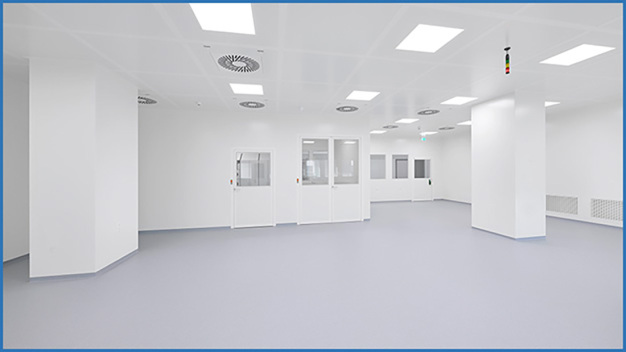
The term cleanroom technology encompasses all measures taken to ensure that contaminants in the air, on the floor, and on work equipment within a room are excluded. But why is a cleanroom necessary?
When sunlight makes its way through a room, you can see many particles floating in the air. In a so-called cleanroom, the concentration of these airborne particles is kept to a minimum. Rooms with this level of purity are necessary when the production and quality of a product are threatened by these particles. Dust, hair and skin particles, as well as germs and chemicals, are among the particles that must be removed from the air and necessary work equipment in a cleanroom. Since these are not visible to the naked eye, cleanrooms are subject to standards and cleanroom classes that ensure the appropriate level of cleanliness.
To convert a workspace into a cleanroom, several factors must be considered:
– Materials entering the room
– Air quality
– Human behavior
– Filtration systems
– Used machines and tools
– Employee clothing
– Airlocks and transfer systems
Cleanrooms are used in industries such as:
– Optics
– Circuit board technology
– Microelectronics
– Laser technology
– Space technology
– Fiber optic technology
Absolutely dust-free and pure rooms are also needed in pharmaceuticals, hospitals, the food industry, and in the manufacturing of medical devices (sterile dressings).
To maintain cleanliness in these rooms, standard operating procedures and maintenance plans have been introduced. It is easier and more cost-effective to regularly maintain these rooms than to have a contaminated cleanroom completely cleaned. In such cases, the cleanroom cannot be used for its intended purpose, which incurs additional costs.
Typically, rooms contain germs, aerosols, low-molecular-weight substances, and fine dust. In operational rooms, cleaning and disinfectant agents, chemicals, and particles of highly active substances such as antibiotics, hormones, and cytostatics are also present. These particles can contaminate the products manufactured in cleanrooms and burden the human body. Through cleanroom technology, the air and all existing equipment are freed from these particles to create a germ-free environment.
To meet the prescribed standards, the following cleanroom products and equipment, as well as protocols, are necessary to ensure the purity of these rooms.
Replacement filters for the airflow system
As soon as filtration systems are used, they must be regularly maintained and replaced. While this may have little consequence in private settings, in industrial environments, it can halt entire production. If filtration systems fail, a cleanroom becomes contaminated. Tiny particles are not visible to the eye, but if they settle on microchips or circuit boards, these products are contaminated and may no longer be functional.
Filtration systems contain multiple filter stages, including HEPA and ULPA filters. Pre-filters are the most heavily loaded and need frequent replacement. Intermediate and final filters have a longer lifespan because their collection rate is lower than that of pre-filters. This means that at least two spare pre-filters should be available to prevent production interruption in case of filter failure.
Final filters contaminate more slowly, so they can be used for several years without replacement. Nevertheless, regular inspection of these filters should be part of the cleanroom monitoring, as these filters are the heart of the cleanroom system. They filter out the smallest particles in the room and make the cleanroom possible.
The correct clothing for cleanrooms
Cleanrooms must be entered with special clothing, as regular everyday clothing would not only carry contaminants from the outside world into the cleanroom. At a very high standard, protective suits, shoe covers, cleanroom gloves, masks, safety glasses, and hoods must be worn. Lower standards may require coats, special cleanroom shoes, and hairnets.
To keep a cleanroom sterile, this protective clothing must always be available in sufficient quantities. This way, you are always prepared for urgent situations. The pandemic has shown us clearly that proactive organization can save lives because quick action is necessary in disaster scenarios.
Effective cleaning materials for a cleanroom
In addition to air purification and monitoring of air filters, cleanrooms require regular cleaning. This guarantees smooth production processes and the health of personnel. Individual cleaning plans determine the necessary rhythm. For example, daily cleaning at a normal level should be performed in shift operations. Deep cleaning is necessary once a week, and a complete thorough cleaning is scheduled once a month. The frequency and intensity of cleaning depend on specific regulations.
Since each cleaning must meet set standards, special cleaning agents and disinfectants against fungi and bacteria are used. These include distilled water, denatured ethanol, isopropanol (IPA), and lint-free mops and cleaning carts made from low-abrasion stainless steel. Generally, all cleaning equipment must be made from materials that do not leave particles on surfaces during cleaning and do not decompose upon contact with cleaning agents.
Protocols for a cleanroom
To ensure regular and complete control of ventilation systems and cleaning procedures, a cleanroom manager is appointed. This person is responsible for maintenance and validation of the cleanrooms. It is not only about monitoring the measures carried out.
People tend to fall into routines and overlook regulations and everyday practices required in their professional field. Therefore, it is also the responsibility of the cleanroom manager to regularly remind all personnel of the requirements associated with working in a cleanroom. The most effective way to implement this is through posters that visually emphasize strict adherence to specific behaviors.
Looking for a cleanroom?
ap-systems designs cleanrooms for every industry!
Get free consultation at https://www.ap-systems.de now.
ap-systems GmbH
72766 Reutlingen
Germany