



- Hygiene & Cleaning
- Translated with AI
Deacidification with counter-current process
Conserve resources and save operating costs
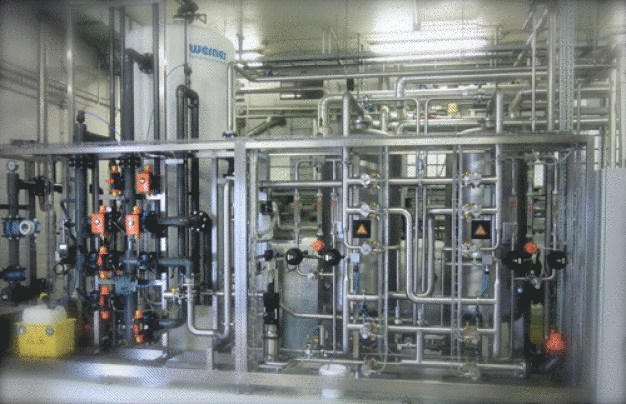
Werner Disinfection System, serial counter-current technology, 18 m³/h thermally sanitizable. ©Werner GmbH 2016.
Competitiveness also requires efficiency improvements in production within the pharmaceutical industry. A significant cost-saving potential is offered here by reducing the ongoing operating costs. To optimize operating costs for pharmaceutical water systems, WERNER successfully employs series-connected and thus permanently flowing deionization systems using countercurrent technology.
The Countercurrent Process
For the quality of deionized water, intensive regeneration of the last flowing resin layer (fine cleaning zone) is crucial. Compared to the still widely used direct current process, the regeneration of the ion exchanger is carried out against the flow direction. This causes the fine cleaning zone to be regenerated first with the regenerant (salt solution). In the direct current process, to achieve the same regeneration result, large excesses of regenerant and water are required.
Operational Cost Savings
The operational cost savings of a deionization system with countercurrent regeneration compared to a system with direct current regeneration are approximately 50%.
With an average raw water hardness of 15 °dH and a system capacity of 10 m³/h — which corresponds to an annual requirement of about 80,000 m³ — the operational cost savings amount to approximately €14,000 per year. This results from wastewater savings of about 2,000 m³/year at €4/m³ and salt savings of about 30 tons/year at €200/ton.
The higher investment costs for the more complex countercurrent technology usually amortize in the shortest time, depending on the design, system size, and materials used.

EnviroFALK PharmaWaterSystems GmbH
Maybachstraße 29
51381 Leverkusen
Germany
Phone: +49 2171 7675 0
email: info@envirofalk-pharma.com
Internet: http://www.envirofalk-pharma.com



