- Translated with AI
Confidently mastering filmic impurities
Guideline of the Professional Association for Industrial Parts Cleaning e.V. (FiT)
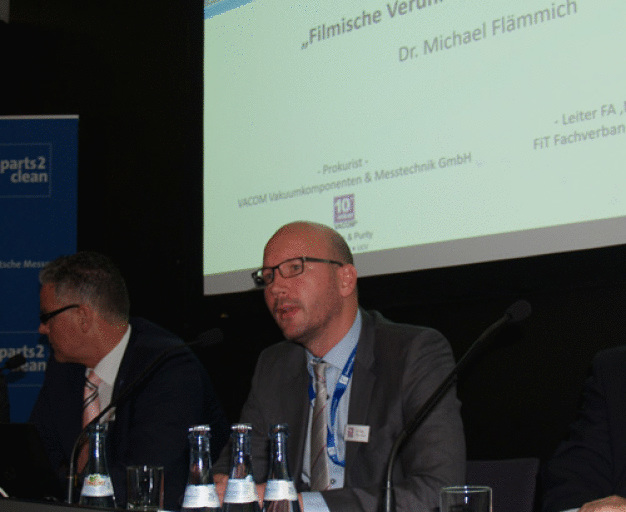
At the opening press conference of parts2clean 2018, which was attended by numerous members of the press, Dr. Michael Flämmich, head of the FiT specialist committee for Testing, Inspection, and Certification, presented the FiT guideline in detail. (Image: ZVO)
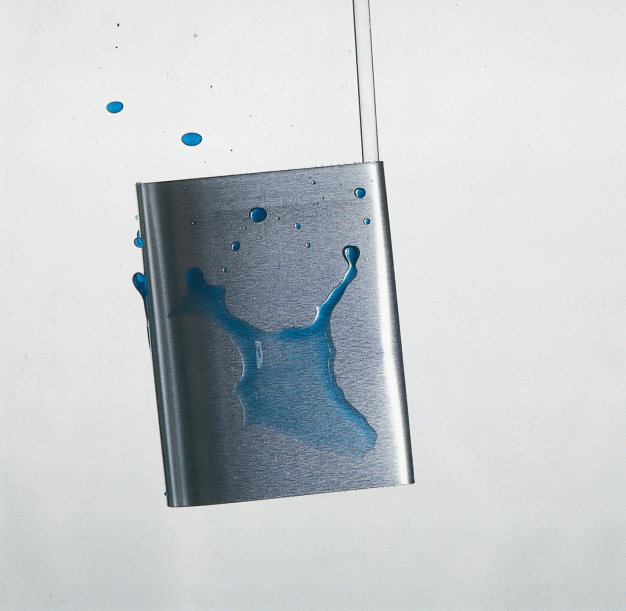
The filmic contaminants include oils and fats, but also residues of corrosion inhibitors, coatings, coolants, and other manufacturing aids. (Image: SurTec)
With its first guideline, the Professional Association for Industrial Part Cleaning e.V. (FiT) thoroughly addresses the topic "Controlling Filmic Contaminations." It is aimed at operators of part cleaning systems, responsible personnel for cleaning processes, process chain managers, as well as users of measurement and testing technology, and is intended to facilitate quality-assured process management in industrial part cleaning concerning filmic contaminations.
In many industries, the cleanliness of component surfaces after pre-, intermediate-, and final cleaning steps is an important quality feature. Despite the use of state-of-the-art production techniques, manufacturing-related contaminations cannot always be completely eliminated. Existing dirt must be properly cleaned to ensure that the component has sufficient cleanliness for subsequent manufacturing steps (such as joining, painting) and final applications. While in recent years primarily particulate contaminations have been considered, there is an increasing perception that chemical/filmic contaminations also influence quality.
FiT has recognized the industry's need for practical recommendations for quality-assuring process management regarding filmic contaminations. Based on the current state of technology, enriched with practical and expert knowledge as well as user experience of the authors, the guideline "Controlling Filmic Contaminations" was developed between 2015 and 2018. It was publicly presented for the first time at the parts2clean trade fair from October 23 to 25, 2018, in Stuttgart. There, FiT was prominently represented with a booth, a special area dedicated to the research project "QSREIN4.0 – Opportunities for Cleaning Technology," contributions to the technical forum, and during the opening press conference.
Filmic Contaminations Are Often Unavoidable
Filmic contaminations include oils and fats, but also residues of corrosion protection agents, coatings, coolants, and other manufacturing aids. Also included are preservatives and adhesives, as well as hand welding and fingerprints. In general, filmic contaminations can be described as a thin, continuous (non-particulate) layer of unwanted, foreign substances on parts or full surfaces of components.
The disruptive effect of oils and fats (and similar substances) in certain processes is well known. Therefore, the currently widespread specification "oil- and fat-free" makes sense. Requiring the complete absence of an unwanted substance on a relevant surface is certainly a sensible first step. It raises awareness among all involved that oily and greasy residues can be disruptive. However, while a similar requirement "silicone-free" can often be practically implemented in many manufacturing processes by avoiding silicone-containing process aids, it is generally not possible to do without "oily" and/or "greasy" process aids. Essential process aids such as cutting fluids in machining operations necessarily contain natural or synthetic oils or fats. Therefore, practice requires setting process-appropriate limits for sufficient cleanliness.
The situation for parts manufacturers and cleaning system operators is becoming increasingly demanding, as an increasing number of manufacturing processes and end applications rely on clean component surfaces concerning filmic contaminations. To properly meet these ever-increasing requirements, the "Guidelines for Quality-Assuring Process Management in Component Cleaning" and the "Checklist for Planning a Cleaning Process" by FiT can provide initial guidance.
The present guideline "Controlling Filmic Contaminations" comprehensively addresses the topic.
Contents of the Guideline
The introductory part of the guideline provides definitions and terms to standardize terminology. It then explains the occurrence/sources of filmic contaminations, their properties, and effects. Using examples of processes, end applications, and industries, the increasing importance of filmic contaminations in manufacturing processes is illustrated. Finally, the scope of this guideline is outlined.
To develop, establish, and optimize manufacturing and cleaning processes in-house, thereby ensuring high overall process quality and reproducible end-product quality, basic knowledge is essential. Starting from the core of this guideline—the process chain in part cleaning—the initial condition of parts before cleaning and the currently available solutions regarding cleaning chemistry and procedures are summarized. The fundamental knowledge of cleanliness or contamination levels of components along the cleaning process can only be obtained through the optimal application of suitable measurement, testing, and analysis techniques. A selection of the most common, available methods is presented, highlighting their practical possibilities and limitations. Finally, current approaches and solutions in process monitoring are discussed.
In the practical section, the fundamentals are linked, and solutions are offered for typical tasks in part cleaning. Recommendations are given for systematically and quality-consciously designing cleaning processes and properly addressing necessary process adjustments or arising process disturbances. Additionally, practical possibilities for monitoring the effectiveness and contaminants in the cleaning process, as well as for checking the condition of components throughout the entire process chain, are presented. Besides identifying sources of chemical/filmic contaminations and testing the cleanliness of functional surfaces as typical tasks, a methodological approach for determining limits for sufficient component cleanliness regarding filmic contaminations is proposed. Based on the recommendations for typical tasks, the available measurement, testing, and analysis techniques are demonstrated in practical application, illustrating the advantages and limitations of various methods.
Furthermore, the FiT guideline provides additional recommendations for cleanliness-appropriate handling of components, for cleaning-appropriate component design, and for handling samples for surface analytical investigations. Considering these recommendations improves the successful control of filmic contaminations before, during, and after the component cleaning process.
Print version available
The guideline was developed by the FiT ad hoc working group "Filmic Contaminations." It is available to non-members of FiT at a price of 50 euros (plus 19% VAT) through ZVO Service GmbH, mail@zvo.org. Members receive it free of charge or at a reduced price.

Fachverband industrielle Teilereinigung (FiT) e.v.
Geschäftsstelle
Hauptstraße 7
72639 Neuffen
Germany
Phone: +49 7025 84340
Fax: +49 7025 843420
email: info@fit-online.org
Internet: http://www.fit-online.org