- Systems
- Translated with AI
Comparison: Measurement methods for differential pressure measurement in cleanrooms
Measurement from room to room vs. measurement against a reference point - Virtual sensors in the monitoring software combine the advantages of both methods
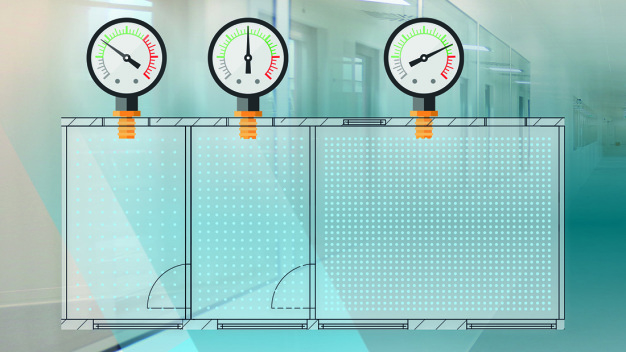
An essential parameter in cleanrooms is the room pressure. By maintaining stable pressure cascades, it is intended to prevent contaminated air from entering. A cleanroom in a pharmaceutical environment usually consists of multiple rooms. Zones with several pressure levels are created to protect the most sensitive areas most effectively.
The requirement for continuous overpressure monitoring described in the standard DIN EN ISO 14644 stipulates that a minimum difference between two rooms must be guaranteed.
There are now 2 possible approaches for this:
– Measurement from room to room
– Measurement with a common reference point
1. Measurement from room to room
In this method, the difference between two rooms is always measured. The measuring device will always display the actual differential pressure between these two rooms. In our example, ideally, all measuring devices show +15 Pa.
This method has the major advantage that you can see the difference to the anteroom at a glance – in line with the requirements of the standard.
However, the room-to-room measurement also has disadvantages. On the one hand, it raises the question of which room is being measured if there are multiple upstream rooms. In this case, several pressures must be specified to produce an unambiguous measurement result (e.g., differential pressure between the preparation room for women’s changing room, and between preparation and men’s changing room). In cleanrooms with many sluices and different preparation areas, this construct can become quite complex.
Furthermore, in this method, the calibration options must be clarified very precisely in advance, so that access to both pressure sensors installed in the room is possible from the calibration pressure generator.
And the biggest disadvantage in everyday use is that the actual room pressure is not visible at a glance. In our example, the pressure shows 15 Pa – although in Cleanroom 1, the actual pressure is 45 Pa.
2. Measurement with a common reference point
In this measurement method, the room pressure is measured against a reference point ("zero point").
The advantages lie in a much more structured system setup, as each room has exactly one differential measurement point relative to the reference, where the pressure levels and actual pressures can be viewed at a glance. In our example, the pressure cascade shows 15-30-45 Pa.
The disadvantage of this measurement method is that the differential pressure to the upstream room is no longer visible. And depending on the setting of alarm thresholds, an under-/overrun of the allowed pressure difference between two rooms can remain "undetected". Here's an example:
Room Set pressure Alarm limits
Cleanroom 1 45 Pa 42 – 48 Pa (+-3 Pa)
Sluice 1 30 Pa 27 – 33 Pa (+-3 Pa)
An pressure difference of at least 10 Pa between the two rooms should be ensured.
If, for example, Cleanroom 1 constantly measures at 42.1 Pa, and Sluice 1 at 32.9 Pa, no alarm will be triggered, but the required difference of 10 Pa between the two rooms cannot be guaranteed. Tighter alarm thresholds would lead to high pressure technical effort in this example, and many pressure alarms are likely to occur anyway.
Remember that we are measuring only "tiny" pressures in the cleanroom area – compared to the normal atmospheric pressure of about 1 bar, which is approximately 100,000 Pascals. Ten Pascals are therefore just an insignificantly small part of our ambient pressure.
The best solution: combine virtual sensors to leverage the advantages of both measurement methods. But which method is suitable for continuous differential pressure monitoring of an GMP monitoring system? Make it simple for yourself and combine the advantages of both methods to your benefit.
Measurement against a reference point for a structured display of actual room pressure
Room-to-room measurements via virtual sensors in the monitoring software
With virtual sensors, you can subtract the measurement data of two rooms (measured against the reference) to obtain the difference between the two rooms. Now, separate alarm thresholds can be configured for the actual pressures (see table in our example) and the calculated pressures (in our example, set pressure 15 Pa, alarm thresholds ±3 Pa). The decision on which rooms should have virtual sensors should be made in advance as part of a risk analysis.
Finally, we want to look more closely at the topic of "reference point". In room-to-room measurement, the first room must be measured against a reference point or reference room. The subsequent rooms use the previous room as the reference point. In measurements with a common reference point, all measurements are based on a previously defined reference point. A stable point, minimally influenced by external factors, is essential for these measurements. In practice, solutions with reference pressure containers of about 30 liters have proven useful. The placement of the container must be evaluated separately for each project. Minimize temperature fluctuations, ensure a dust-free environment, and consider a sensible hose routing.
Conclusion:
Both methods have advantages and disadvantages. For cleanroom projects, measuring against a reference point is usually the better choice. When combined with virtual sensors, the differential pressure between two rooms can also be displayed and alarmed where necessary. A suitable reference point should be established at the beginning of each project.

BRIEM Steuerungstechnik GmbH
Lauterstraße 23
72622 Nürtingen
Germany
Phone: +49 7022 60920
Fax: +49 7022 609260
email: info@briem.de
Internet: http://www.briem.de