


- Translated with AI
Compare individual measurement systems: Laboratory ring test by independent provider provides reliable data on measurement quality
Competence network presents complete cleanroom demo system including process chain for quality analysis
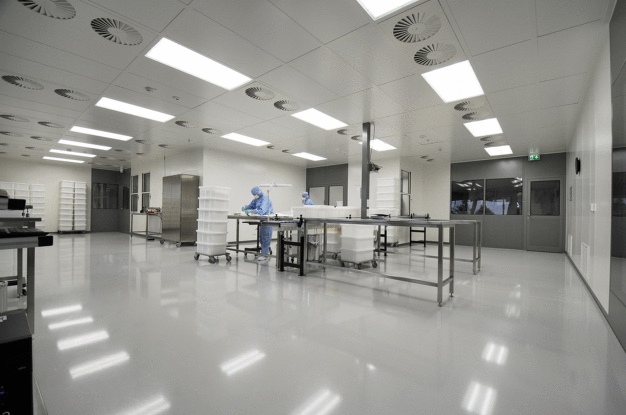
At this year's parts2clean, the Cleaning Excellence Center (CEC) Leonberg is showcasing a fully operational cleanroom facility, including an entire process chain for quality analysis. Twenty companies are involved in this collaborative project of the network. Source: Nerling Systemräume GmbH
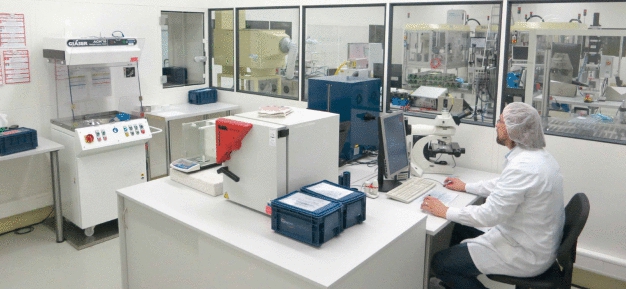
When operating a cleanliness laboratory, it is crucial that it is directly implemented into the manufacturing environment.
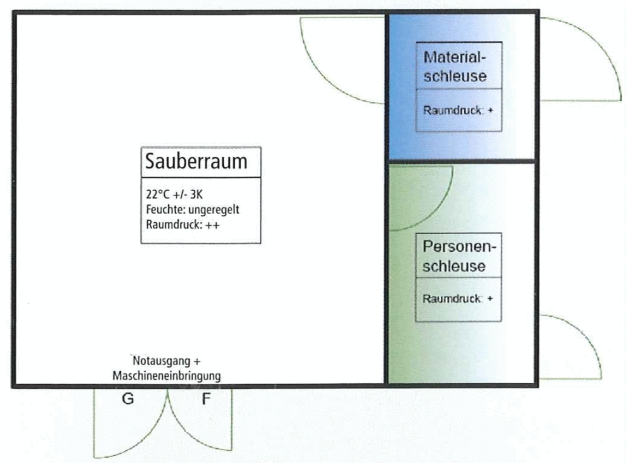
To ensure component cleanliness, it is generally necessary to install a cleanroom or clean environment system and to regularly check the room conditions or products. Source: Nerling Systemräume GmbH
Since microscopic particles can impair the function of sensitive or safety-critical components, technical cleanliness is becoming increasingly important in industries such as medical technology, mechanical engineering, and the automotive industry. Although processes are subject to strict guidelines like VDA 19 or ISO 16232, there has been a lack of customized cleanroom complete solutions in these industrial sectors, where individual components are specifically coordinated with each other. At this year's parts2clean, the Cleaning Excellence Center (CEC) Leonberg will present a demo system, including the entire process chain for quality analysis. The focus is on the regularly ISO 9001 or ISO/IEC 17025 verified quality management in the cleanliness laboratory and the added value of round-robin tests by independent providers: This analysis not only allows an anonymized comparison between particulate measurement systems and provides information about their precision, but also constitutes a significant accreditation prerequisite for testing laboratories.
Cleanrooms and ultra-clean rooms are gaining increasing importance for industrial environments: With the guidelines VDA 19 and ISO 16232, binding requirements for controlling and ensuring technical cleanliness have been introduced for the automotive industry and mechanical engineering. Component cleanliness serves as an important quality criterion here because it is crucial for the reliability and function of machines and production parts: "It's about detecting possible contamination and quantifying harmful particles," explains Ralf Nerling, General Authorized Signatory of the Nerling Group and Board Member at the CEC. "With this know-how, employees can manufacture more efficiently and also save time and costs."
Complete system with process chain for quality analysis
To ensure component cleanliness, it is usually necessary to install a cleanroom or cleanroom system and regularly check room conditions or products. "The cleanliness analysis can either be commissioned from component manufacturers to accredited laboratories or conducted in an in-house laboratory," says Nerling. When operating a cleanliness laboratory, it is crucial that it is directly integrated into the production environment — with short distances between production steps and the laboratory. This reduces the contamination risk and ensures an uninterrupted material flow.
However, a customized overall solution that considers these factors and optimally adapts to local conditions has so far been associated with very high costs and extensive logistical planning. Since manufacturers of individual cleanroom components rarely had insight into the process chain before and after their equipment, comprehensive process flow discussions and extensive consulting were only limitedly possible. At this year's parts2clean in Stuttgart, the CEC now presents a demonstrative complete system with an entire process chain from cleaning to quality analysis in the cleanroom according to VDA 19.1, involving more than 20 companies: Specifically, deburring (Benseler) and cleaning of components (Dürr Ecoclean) in the cleanroom, as well as transport through the gray zone using a cleanroom-compatible shuttle cart (Kögel) into the cleanroom of the test laboratory (Nerling) for proof of component cleanliness, are demonstrated. In the ISO7 or ISO8 cleanroom of the test laboratory (Nerling), the process sequence of rinsing (Gläser), filter drying (Binder), gravimetry (Sartorius), microscopy (Jomesa), and protocol creation (CleanControlling) is shown.
Ensuring measurement quality
Various standardized procedures can be used to assess cleanliness: "First, extraction takes place, i.e., the removal of particles from the test object using ultrasound, syringes, rinsing, shaking, or via an application-related test stand," explains Nerling. "They are filtered out and subsequently analyzed." Depending on the type of particles, different microscopy systems and flatbed scanners are used. For metallic particles, for example, linear polarized incident light microscopy is performed. For particle sizes > 3 µm, material microscopy is most suitable, and for particles > 25 µm, examination using stereomicroscopy.
To ensure long-term accurate measurements and precise results, in-house laboratories are recommended to verify their particulate measurement systems within their quality management according to ISO 9001 and to include the results of round-robin tests in their quality management manual. Particularly suitable are laboratory round-robin tests conducted by an independent provider, where identical reference samples are examined using the same procedures but with different measurement systems. These tests not only provide the opportunity to obtain a precise analysis of one's own measurement quality but also allow anonymized comparison of measurement results with those of other laboratories. For accredited testing laboratories, participation in round-robin tests, such as those offered three times a year by the CEC, is even mandatory: "According to ISO/IEC 17025, an initial method suitability test is required to obtain accreditation," explains Nerling. "Furthermore, the norm requires annual participation in a round-robin test to permanently ensure result quality."
Standardized comparison testing according to VDA 19.1
The CEC round-robin tests always follow a standardized process: First, a laboratory registers its various measurement systems independently of the system manufacturer for the round-robin test. "Various optical measurement instruments are approved: stereo, zoom, and material microscopes, as well as flatbed scanners," says Nerling. Then, a test filter is provided to the laboratory for each registered system, which the participant examines according to the standard analysis of VDA 19.1. The data resulting from this examination are transferred into a test report. "The required contents include the measured number of particles of different types (distinguishing between metallic shiny and non-shiny particles as well as fibers), in the size classes from 50 µm to > 3,000 µm, and the percentage filter coverage with particles and fibers, measured relative to the total surface of the filter membrane," explains Steffen Haberzettl, Head of the CEC. "Additionally, the largest and second-largest particles and fibers are reported for each type, along with their length and width measurements."
Once the test reports from all measurement systems have been received at the CEC, a confidential evaluation is carried out according to DIN 38402-45/3/. "The z-score for each measurement value of the respective particle size in the individual size classes is calculated to assess the classification of the measurement results," explains Haberzettl. "The identification of the largest and second-largest particles and fibers is done via visual comparison. Deviations in length and width from the average are also calculated." After this, all participants receive an anonymized results report for each registered measurement system, allowing them to compare their results with those of other laboratories. This way, potential weaknesses can be immediately identified and addressed. To ensure participant anonymity, each measurement system is assigned a number key that makes the instrument and its results only identifiable for the respective laboratory. Finally, each system that has successfully participated receives a CEC test badge, which auditors can immediately recognize as proof that the instrument was involved in a test recently.
Participation in a CEC round-robin test:
Currently, three laboratory round-robin tests are offered annually. A round-robin test begins once 40 measurement systems have registered. Therefore, timely registration is important.
The fee for a measurement system participating in the round-robin test is 550 euros, or 300 euros for CEC members (plus applicable VAT). Additional participating measurement systems receive a discount.
CEC
71229 Leonberg
Germany